OXO Good Grips 11 lb pull-out display scale
Best readable platformBest Use: Protein bowls and larger containers
$45-60
Quick picks
| Product | Key Specs |
|---|---|
| See price on Amazon |
|
| See price on Amazon |
|
| See price on Amazon |
|
Product availability, certifications, and retailer details can change; check the current Amazon page before buying.
Bottom line
A kitchen scale is one of the cheapest ways to make supplement and protein intake less sloppy. It will not make creatine work better, turn protein powder into a complete diet, or fix inconsistent training. It does solve a real measurement problem: scoops settle, powders vary in density, and rounded teaspoons can be far from the serving size you think you are using. Reference point: protein-target context.
For most people, a 0.1-ounce or 1-gram digital kitchen scale with a tare button is enough for protein powder, oats, yogurt, meal-prep portions, and creatine verification. If you use very small doses, choose a scale that reads reliably at gram-level weights. If you use large bowls or tubs, choose a platform and display you can actually see. Supporting source: creatine dose context.
Quick picks for portion accuracy
- Search Amazon for OXO Good Grips 11 lb kitchen scales — best when big bowls cover ordinary displays and you want a pull-out readout.
- Compare Escali Primo digital kitchen scales on Amazon — best budget pick for straightforward gram measurements without app clutter.
- Check Etekcity nutrition kitchen scales on Amazon — best if food logging is part of the same routine and you want nutrition-estimate features.
Practical score
| Factor | Weight | Score | Rationale |
|---|---|---|---|
| Research | 30% | 6.8 | The scale itself is not a clinical intervention, but accurate intake measurement supports evidence-based nutrition targets. |
| Evidence Quality | 25% | 7.0 | Protein and creatine dosing evidence is stronger than scoop accuracy evidence; the measurement logic is direct. |
| Value | 20% | 8.6 | A reliable scale is inexpensive and useful beyond supplements. |
| User Signals | 15% | 8.1 | Immediate feedback shows whether scoops, bowls, and serving sizes match reality. |
| Transparency | 10% | 7.8 | Good scales display units, tare, and repeatability clearly. |
| Composite | 100% | 7.5 | A low-cost accuracy upgrade for readers who already use powder, capsules, or structured food targets. Clinical context: label-serving context. |
Why scoops are a weak measurement tool
Supplement scoops are convenient, but they are not precision instruments. Powder density changes with settling, humidity, particle size, and how aggressively the scoop is packed. A scoop that claims 30 grams can become a different amount when the powder is compressed or when the scoop is heaped. Creatine is even more sensitive because the target serving is small. Safety context: food-weight database context.
This does not mean every meal needs laboratory precision. It means you should know what your usual scoop actually weighs. Weigh the empty cup, tare the scale, add your normal scoop, and repeat several times. If your routine scoop varies widely, the scale has already taught you something useful. For creatine, a few extra grams is not usually dangerous for healthy adults, but it can increase stomach discomfort and waste product. For protein, repeated undercounting can make a planned target unreliable. Dose reference: protein-target context.
The same measurement discipline appears in our creatine loading phase dosage guide. Dose decisions are only as good as the method used to measure them.
What to look for in a scale
Choose gram units, a responsive tare button, a stable platform, and an easy-to-read display. If you use large mixing bowls, a pull-out or angled display matters more than a fancy app. If you weigh coffee, creatine, and small supplement portions, check whether the scale responds well at low weights. Some kitchen scales technically show grams but are sluggish below five grams.
Capacity matters too. An 11-pound capacity covers most bowls and meal prep containers. A tiny pocket scale can measure small powders, but it is awkward for food. Most Body Science Review readers are better served by a normal kitchen scale first, then a smaller precision scale only if a specific supplement or recipe requires it. Background source: creatine dose context.
Look for ordinary batteries, an auto-off interval that is not too aggressive, and a surface that wipes clean. Backlit displays are helpful in dim kitchens, but touch buttons can be annoying if powder dust or wet fingers trigger them accidentally.
OXO-style pull-out display scale
An OXO Good Grips 11-pound scale is the most convenient category for people who weigh bowls, plates, tubs, and larger food-prep containers. The pull-out display solves a real kitchen problem: big bowls cover flat displays. That makes it easier to weigh Greek yogurt, oats, protein powder, and fruit without juggling containers.
This category costs more than a basic scale, so it makes sense when readability and capacity matter. Check that the model has gram units, tare, and a platform large enough for your usual containers. It is less necessary if you only weigh a scoop of powder in a small cup.
Search Amazon for OXO Good Grips 11 lb kitchen scales.
Simple budget digital scale
An Escali Primo-style digital kitchen scale is the right category if you want simple grams, tare, and repeatability without a connected app. For protein powder and creatine checks, simple is often better. You are trying to answer whether the serving is 24 grams, 31 grams, or 42 grams, not build a dashboard.
Budget scales can be accurate enough for food but still vary in durability, button feel, and low-weight response. Read reviews for drift, delayed readings, and displays blocked by plates. If you often weigh tiny servings under two grams, this may not be the right tool. Evidence anchor: label-serving context.
Compare Escali Primo digital kitchen scales on Amazon.
Nutrition-tracking scale
An Etekcity nutrition scale category can help people who already log food and want the scale to support that behavior. The useful feature is not a perfect database. It is the friction reduction of weighing a food and recording a reasonable estimate in the same workflow.
Do not over-trust nutrition databases, especially for mixed foods, restaurant meals, or supplement scoops from changing brands. Use the scale for weight and the label or trusted database for nutrition. The scale should still work as a normal scale if the app becomes annoying. Reader check: food-weight database context.
Check Etekcity nutrition kitchen scales on Amazon.
How to verify your protein scoop
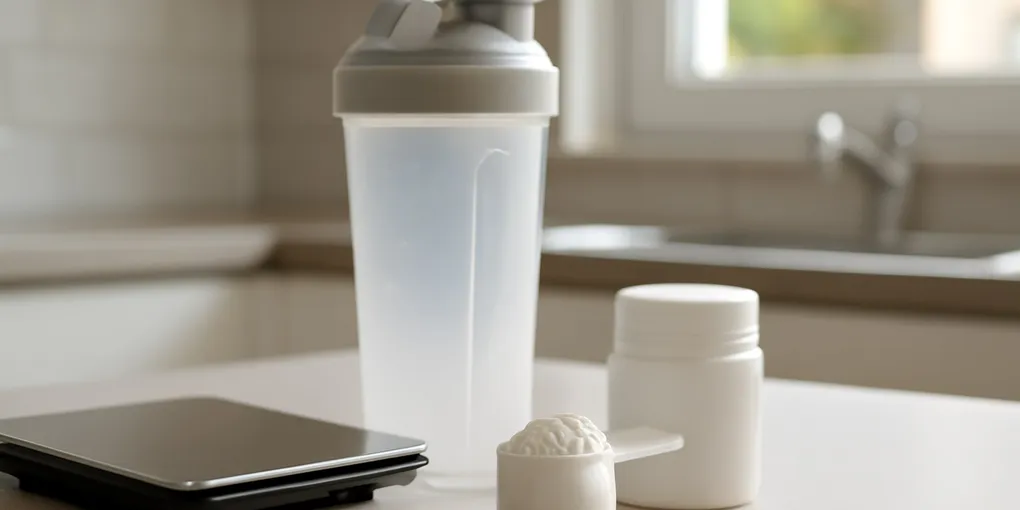
Put the shaker bottle or cup on the scale and press tare. Add one level scoop exactly how you usually prepare it. Write down the grams. Empty it, repeat two more times, then compare the average with the label serving. If your usual scoop is five to ten grams off, decide whether to change the scoop habit or use the scale for that product.
For protein powder, the practical target is consistency. If a serving claims 31 grams and your scoop averages 28 grams, that may be fine if you know it. If it swings from 22 to 42 grams depending on packing, the scoop is a poor guide. A scale makes post-workout shakes and high-protein breakfasts easier to repeat. Reference point: protein-target context.
How to verify creatine without overthinking it
Creatine monohydrate commonly uses a small daily serving. Many people use a teaspoon, but teaspoon density depends on powder and technique. Weigh the serving once, then decide on a repeatable method. If the scoop included in the tub is close and comfortable, you do not need to weigh every day.
The reason to measure is stomach tolerance and consistency. People who accidentally double a serving may blame creatine for bloating when the issue is dose. People who under-dose during a loading phase may wonder why the math did not work. A scale makes those questions less mysterious. Supporting source: creatine dose context.
Scale habits that improve supplement decisions
Use the scale to answer repeatability questions, not to punish normal eating. For protein powder, weigh the scoop once when you open a new tub, once after the powder has settled, and again if you switch brands. Different proteins have different density. Whey isolate, whey concentrate, casein, collagen peptides, and plant blends can all fill the same scoop differently. Clinical context: label-serving context.
For creatine, make one practical decision after measuring. If the included scoop reliably lands near the serving you want, keep using it. If it is far off, mark the scoop level you need or switch to weighing. Do not create a daily ritual so annoying that you quit the supplement altogether. Consistency beats theatrical precision.
For meal prep, tare the container, add the protein source, record the cooked weight if that is how you log it, and keep the method consistent. Raw and cooked weights differ because water changes, not because the protein vanished. Pick one method and use it repeatedly. The scale is there to reduce confusion, not add another source of anxiety. Safety context: food-weight database context.
Kitchen details that affect real-world use
A scale that lives in a drawer under heavy pans will not be used. Keep it near the protein powder, coffee, or breakfast station. Wipe powder from the platform so buttons do not stick. Replace batteries before readings start drifting. If the scale shuts off while you are adding ingredients slowly, choose a model with a longer auto-off interval next time.
For shaker bottles, place the empty bottle on the scale, tare, add liquid if needed, tare again, then add powder. This prevents powder from sticking to a separate spoon or cup. For creatine mixed into coffee or juice, tare the mug first and add the powder directly. The fewer transfers, the fewer measurement errors. Dose reference: protein-target context.
If several people in the household use the same scale, agree on units. Accidentally reading ounces when you meant grams is one of the few scale mistakes that can create a large supplement error. A model with a clear unit indicator is worth more than a sleek model with tiny symbols. Background source: creatine dose context.
When not to buy a scale
Do not buy a scale because an influencer made ordinary meals look scientific. If you do not use powders, do not have protein targets, and do not care about recipe repeatability, the scale may become drawer clutter. Also skip it if weighing food would worsen a history of disordered eating or obsessive tracking. In that case, use simpler portion structures and professional guidance where appropriate. Evidence anchor: label-serving context.
FAQ
Do I need a scale if my protein powder includes a scoop?
Not always, but weighing the scoop a few times tells you whether the scoop matches the label. After that, you can decide whether the convenience is accurate enough.
Is a kitchen scale accurate enough for creatine?
Many kitchen scales are acceptable around five grams, but very cheap models can lag at low weights. If you need sub-gram precision, use a small precision scale instead. Reader check: food-weight database context.
Should I track every gram of food?
No. The scale is most useful for repeat meals, protein targets, recipe consistency, and checking products where serving-size assumptions are unreliable.
What feature matters most for protein shakes?
Tare and display visibility. If the display disappears under the bowl or shaker, you will stop using the scale.
Evidence notes
- The International Society of Sports Nutrition position stand on protein and exercise supports using intake targets that require reasonable measurement.
- The ISSN position stand on creatine supplementation explains common dosing ranges and safety context for healthy adults.
- USDA FoodData Central and nutrition-label rules illustrate why weight-based serving sizes are more reproducible than household scoops when the goal is repeatable intake.