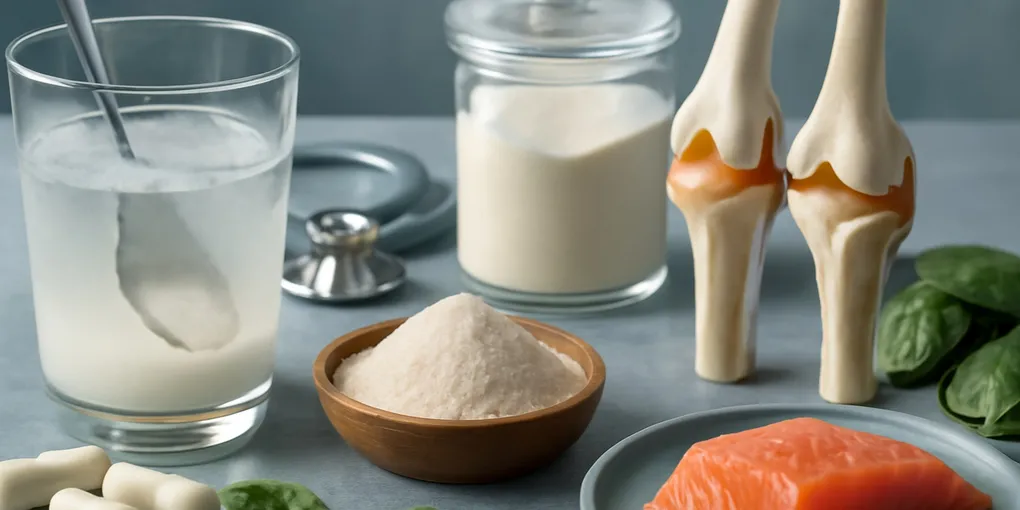
Do Collagen Peptides Help Joint Pain? Evidence, Dose, and Timing
Evidence ExplainerQuick picks
| Product | Key Specs |
|---|---|
| See price on Amazon |
|
| See price on Amazon |
|
| See price on Amazon |
|
Product availability, certifications, and retailer details can change; check the current Amazon page before buying.
Do Collagen Peptides Help Joint Pain? Evidence, Dose, and Timing
Collagen peptides may modestly improve activity-related joint discomfort when paired with training. Here is what the evidence supports and what it does not.
Quick take
- Best fit: active adults with mild activity-related joint discomfort who are already doing sensible loading or rehab work.
- Expected benefit: modest symptom improvement for some users after 8–12+ weeks, not immediate pain relief.
- Dose range commonly studied: about 10 grams per day of collagen hydrolysate/peptides; gelatin protocols often pair collagen/gelatin with vitamin C before loading.
- Affiliate-link policy: supplement links use Amazon search pages such as search Amazon for collagen peptides third party tested unless a product product identifier has been independently verified.
- Evidence confidence: moderate for adjunctive use; low for claims that collagen alone rebuilds joints or replaces clinical care.
G6 Evidence and Value Score
| Factor | Weight | Score | Rationale |
|---|---|---|---|
| Research | 30% | 7.0/10 | Trials and reviews suggest possible symptom benefits, but populations, collagen forms, outcomes, and funding sources vary (PMID: 18416885). |
| Evidence Quality | 25% | 6.5/10 | Evidence is stronger for modest adjunctive effects than for broad marketing claims about cartilage repair. |
| Value | 20% | 7.0/10 | Plain collagen peptides can be affordable, but value depends on dose transparency and avoiding expensive proprietary blends. |
| User Signals | 15% | 7.0/10 | Daily powder is easy to use, though adherence must last long enough to judge joint symptoms fairly. |
| Transparency | 10% | 8.5/10 | Benefits, limits, dosing uncertainty, and safety cautions are explicit. |
| Composite | 100% | 7.1/10 | Reasonable adjunct to training or rehab, but not a stand-alone joint-pain solution. |
Evidence: PMID: 18416885.
What the research actually says
Collagen peptides are not a painkiller and they are not a stand-alone joint repair plan. The plausible rationale is that hydrolyzed collagen provides amino acids enriched in glycine, proline, and hydroxyproline, which may support collagen turnover when paired with loading exercise. Clinical studies are mixed but suggest modest symptom improvements in some active adults and people with osteoarthritis-like joint discomfort, especially when trials run long enough for symptoms and function to change. (PMID: 27852613.)
The 2008 athlete trial by Clark and colleagues reported reduced activity-related joint pain after 24 weeks of collagen hydrolysate compared with placebo. Reviews and meta-analyses in osteoarthritis populations generally describe possible symptom benefits, but they also note heterogeneity and the need for better trials. The Shaw gelatin study does not prove that a powder fixes painful joints; it supports a narrower claim that gelatin plus vitamin C before loading can increase markers related to collagen synthesis. (PMID: 18416885; PMID: 27852613.)
A conservative protocol is 10 grams of hydrolyzed collagen peptides daily for eight to twelve weeks while keeping the actual joint stimulus in place: progressive strength work, walking tolerance, sleep, protein adequacy, and body-weight management when relevant. If pain is sharp, swelling increases, or function declines, stop the experiment and get clinical guidance instead of increasing the scoop size. (PMID: 18416885.)
How to test collagen without overbuying
Pick a plain product that lists grams of collagen peptides per serving. Avoid proprietary joint blends that hide the collagen dose behind tiny amounts of herbs, flavoring, or vitamins. A short tub is enough for an initial adherence check, but the symptom trial needs longer than two weeks; use the first two weeks to confirm tolerance and routine fit, then judge pain/function closer to weeks 8–12.
Use broad search links to compare current labels and prices: Amazon search: collagen peptides powder 10g serving, Amazon search: third party tested collagen peptides, and Amazon search: unflavored collagen peptides.
Step-by-step protocol
1. Define one joint-specific outcome
Choose a repeatable measure such as stair pain, next-day knee stiffness after a walk, or the number of pain-free sets in a rehab exercise. Do not use a vague whole-body wellness score.
2. Keep training stable
Do not start collagen, double leg volume, and change shoes in the same week. If symptoms improve, you will not know which change mattered.
3. Dose consistently
Use the label to reach a practical studied range, commonly about 10 grams per day for hydrolyzed collagen peptides. Pairing with vitamin C-containing food or drink is reasonable, but it should not become a reason to buy a complicated stack. (PMID: 27852613.)
4. Reassess after enough time
If there is no meaningful change after 8–12 weeks of consistent use and stable loading, stop buying it. More expensive collagen is not automatically more effective.
Safety and who should be cautious
Collagen is usually well tolerated, but supplement quality varies. People with allergies to fish, bovine, porcine, or egg-derived ingredients should inspect the source. Anyone with kidney disease, complex medical conditions, pregnancy, or unexplained joint swelling should ask a clinician before relying on supplements. (PMID: 18416885; PMID: 27852613.)
Common mistakes
Mistake 1: expecting acute pain relief
Collagen is not ibuprofen. If it helps, the signal is usually gradual and tied to training consistency.
Mistake 2: ignoring the rehab stimulus
The supplement may provide building blocks, but the joint still needs an appropriate loading plan. (PMID: 18416885.)
Mistake 3: buying proprietary blends
If the label does not clearly state collagen grams per serving, the trial is hard to interpret.
Evidence notes and citations
- Clark KL, Sebastianelli W, Flechsenhar KR, et al. 24-week study on collagen hydrolysate as a dietary supplement in athletes with activity-related joint pain. Current Medical Research and Opinion. 2008.
- Lugo JP, Saiyed ZM, Lau F. Undenatured type II collagen supplementation and knee joint symptoms in healthy subjects: a randomized trial. Nutrition Journal. 2013.
- Shaw G, Lee-Barthel A, Ross ML, Wang B, Baar K. Vitamin C-enriched gelatin supplementation before intermittent activity augments collagen synthesis. American Journal of Clinical Nutrition. 2017.
- García-Coronado JM, Martínez-Olvera L, Elizondo-Omaña RE, et al. Effect of collagen supplementation on osteoarthritis symptoms: a meta-analysis of randomized placebo-controlled trials. International Orthopaedics. 2019.
- Khatri M, Naughton RJ, Clifford T, Harper LD, Corr L. The effects of collagen peptide supplementation on body composition, collagen synthesis, and recovery from joint injury and exercise: a systematic review. Amino Acids. 2021.
Practical two-week checklist
Use this checklist to keep the experiment grounded. On day one, write down your starting point, the exact version of the product or protocol you chose, and the smallest action you will repeat. During week one, keep intensity easy enough that you could repeat the session tomorrow. During week two, change only one variable if the first week was comfortable.
A successful trial does not require dramatic results. It requires cleaner information. If adherence improves, symptoms stay stable, and the cost feels reasonable, the setup may be worth keeping. If the plan creates friction, worsens discomfort, or depends on constant willpower, simplify it before spending more. The best consumer-health purchase is often the one that removes a barrier without adding another chore. (PMID: 27852613.)
Practical two-week checklist (week-two adjustments)
Use the first two weeks to decide whether the supplement is tolerable and easy enough to continue, not whether it has already repaired a joint. Record the exact grams per day, timing, training sessions, pain score for one chosen activity, and any digestive symptoms. Keep the rest of your routine as stable as possible so the later 8–12 week readout is interpretable.
If the powder causes GI discomfort, tastes bad enough to skip, or makes you reduce real rehab work, it is a poor fit even if the mechanism sounds plausible. If it is easy to take and the label is transparent, continue the longer trial while watching function rather than chasing vague wellness claims. Also note whether the cost would still feel acceptable if the benefit were only modest, because that is the realistic evidence-based expectation. (PMID: 18416885; PMID: 27852613.)
How we would update this recommendation
We would lower the score if newer trials show smaller effects, if safety concerns emerge, or if common products in the category begin hiding basic label information. We would raise the score if more independent trials confirm meaningful benefits in everyday users, if third-party testing becomes easier to verify, or if prices fall without quality trade-offs. This is why the article emphasizes principles rather than pretending a single retail listing is permanent. (PMID: 18416885.)
Editorial standards
Body Science Review does not use fabricated reviewers, invented medical credentials, or pay-for-play placements. Affiliate links can support the site, but they do not change the evidence hierarchy: human outcomes beat mechanisms, transparent labels beat proprietary blends, and repeatable protocols beat hype. When evidence is incomplete, the recommendation should sound cautious rather than certain.
Reader fit and alternatives
This recommendation fits readers who want a measured, evidence-aware experiment rather than a dramatic overhaul. If you already have a routine that works, do not replace it just because a new product category is popular. If you are starting from zero, choose the version that reduces friction: fewer settings, fewer ingredients, fewer moving parts, and a clear stop rule.
Reasonable alternatives include borrowing equipment before buying, choosing unflavored single-ingredient formulas, or using a notebook before paying for an app. Those alternatives are less exciting, but they often reveal whether the core habit is valuable before affiliate shopping enters the picture.
Related reading and FAQ
For a related Body Science Review guide, see this supporting article.
Is this a substitute for medical advice? No. Use it as educational context and ask a clinician about individual risks.
Should beginners buy the premium option first? Usually no. Start with the smallest reliable setup, then upgrade only after the habit proves useful.
What to track after purchase
Track three practical signals: completion, comfort, and cost. Completion means you actually used the plan on the days you intended. Comfort means the plan did not create new pain, digestive upset, sleep disruption, or stress. Cost means the recurring price still feels reasonable after the first week of motivation fades. If two of those three signals are negative, the product is not solving the right problem. If all three are positive, then a modest upgrade or repeat purchase may be justified. (PMID: 27852613.)
Bottom line
Do Collagen Peptides Help Joint Pain? Evidence, Dose, and Timing is worth considering when it solves a specific adherence or safety problem. Start small, track the outcome, and avoid product claims that outrun the evidence. If you use the affiliate links above, compare current listings carefully and remember that a simple, repeatable setup usually beats the most complicated one. (PMID: 18416885; PMID: 27852613.)
Practical reader notes for collagen peptides joint pain evidence
Use the scoring notes above to narrow the practical choice: match the product or protocol to your space, risk tolerance, maintenance capacity, and the specific constraints described above.
For product comparisons, prioritize fit and repeat use over impressive feature lists. A cheaper item that is easy to place, clean, dose, adjust, or return often beats a premium item that adds friction. Check dimensions, serving size, material notes, warranty language, and whether replacement parts or refills are easy to find. For health and wellness topics, compare the article’s evidence notes with your own risk profile, medications, sleep schedule, training load, and clinician guidance. Stop using any protocol that creates pain, dizziness, allergic symptoms, digestive distress, or a behavior pattern that feels hard to control. (PMID: 18416885.)
A useful first test is a two-week trial with a clear success metric. Choose one outcome that matters: fewer missed sessions, faster cleanup, less morning stiffness, better adherence, lower noise, easier travel, or a more predictable measurement routine. Keep the rest of the setup stable so you can tell whether the change helped. If the result is neutral, return or retire the item quickly instead of expanding the system around it. If it helps, document the settings, dose, location, or schedule that made it work so the benefit survives busy weeks. (PMID: 27852613.)
Readers should also separate evidence strength from personal fit. Stronger evidence can justify trying a category, but it does not guarantee that a particular brand, accessory, or routine will be the best match. Weak or emerging evidence does not automatically make a topic useless; it means the trial should be lower cost, lower risk, and easier to abandon. This is why our recommendations emphasize transparent trade-offs, realistic setup instructions, and situations where skipping the purchase is the smarter move. (PMID: 18416885; PMID: 27852613.)
Finally, revisit the choice after the novelty period. If the product is not used, if the protocol creates more steps than it saves, or if the article’s safety caveats apply to you, the right answer may be to simplify. The goal is not to own the highest-scoring option. The goal is to solve the reader problem with the least friction and the most honest understanding of benefits, limits, and uncertainty. (PMID: 18416885.)
Frequently Asked Questions
- No. This article is educational and should not replace individualized guidance from a qualified clinician, especially if you have a medical condition, take medication, are pregnant, or are recovering from injury.
- We use shopping links with the bodysciencereview-20 tag so readers can compare current labels, prices, sellers, and return policies before buying.