How to Choose Resistance Bands for Home Workouts: A Joint-Friendly Buying Protocol
ProtocolQuick picks
| Product | Key Specs |
|---|---|
| See price on Amazon |
|
| See price on Amazon |
|
| See price on Amazon |
|
Product availability, certifications, and retailer details can change; check the current Amazon page before buying.
How to Choose Resistance Bands for Home Workouts: A Joint-Friendly Buying Protocol
A step-by-step protocol for choosing loop bands, tube bands, and fabric bands for strength, rehab, and travel workouts.
Quick take
- Best fit: home trainees who need low-cost strength equipment for rows, presses, lower-body work, travel, or rehab-style progressions.
- First purchase: a light-to-medium set that lets you complete controlled reps; do not start with maximum-tension bands.
- Safety priority: inspect bands for cracks, protect the anchor point, and avoid face-level stretched positions unless the setup is redundant.
- Affiliate-link policy: gear links use Amazon search pages such as search Amazon for resistance band set with handles unless a product product identifier has been independently verified.
- Evidence confidence: good that elastic resistance can build strength when effort and progression are adequate; lower for claims that one band style is best for everyone.
G6 Evidence and Value Score
| Factor | Weight | Score | Rationale |
|---|---|---|---|
| Research | 30% | 7.5/10 | Meta-analyses and resistance-training guidance support elastic resistance as a viable strength tool when programmed progressively. |
| Evidence Quality | 25% | 7.0/10 | Strength outcomes depend on effort, exercise selection, and progression; product durability claims are less standardized. |
| Value | 20% | 8.5/10 | Bands are inexpensive, portable, and scalable before buying heavier home-gym equipment. |
| User Signals | 15% | 7.5/10 | Easy storage and fast setup improve adherence, but poor anchors and wrong resistance levels frustrate beginners. |
| Transparency | 10% | 9.0/10 | The article separates training principles from gear preferences and flags safety trade-offs. |
| Composite | 100% | 7.8/10 | A high-value home-training purchase when the band type matches the exercise and safety setup. |
What the research actually says
Resistance bands can build strength when they are used with enough effort and progression. The important evidence point is not that elastic resistance is magical; it is that muscles respond to challenging sets, progressive overload, adequate volume, and consistency. Bands can deliver that stimulus at home when the anchor is safe, the resistance curve fits the exercise, and the user can make sets hard without joint irritation.
Comparative studies and reviews generally find elastic resistance can improve strength, especially for beginners, older adults, rehabilitation contexts, and people who need portable training. Free weights and machines still have advantages for precise loading and maximum strength, but bands are legitimate when you train close enough to fatigue and make the setup repeatable.
For beginners, tube bands with handles are often easiest for rows and presses, loop bands are useful for lower-body work, and long flat bands are flexible for assisted mobility or rehab-style progressions. The safest buying protocol is to choose a light-to-medium set first, inspect for cracks before each session, avoid face-level stretched positions unless the anchor is redundant, and progress by reps and tempo before jumping to the heaviest band.
Choose the right band type
Tube bands with handles
Best for rows, presses, curls, triceps work, and standing exercises where handles improve grip. Look for clear resistance labels, sturdy clips, and a door anchor that can be positioned on the hinge side of a closed door. Replace the set if tubing becomes cloudy, nicked, or sticky.
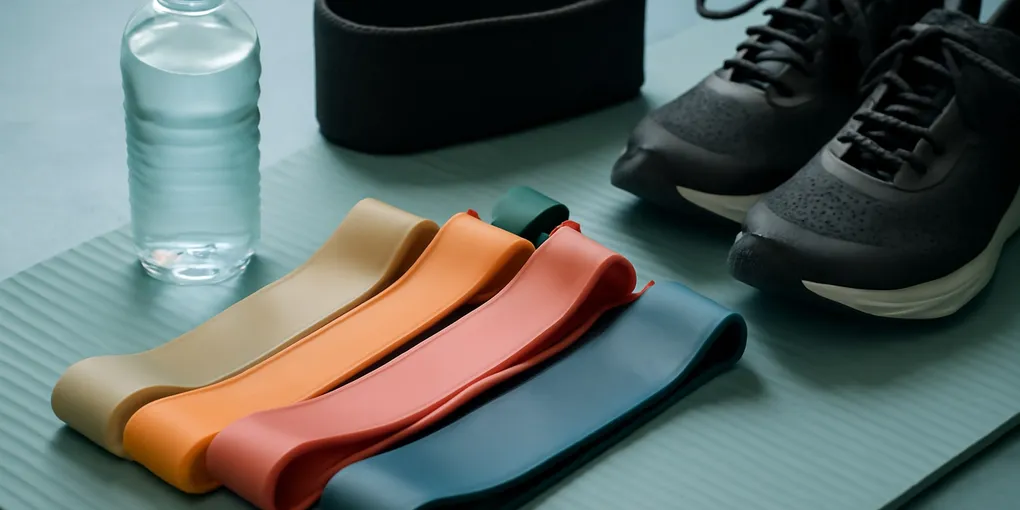
Mini loop bands
Best for glute bridges, lateral walks, warm-ups, and lower-body accessory work. Fabric loops are more comfortable and less likely to roll, while latex loops are cheaper and easier to pack. Heavy loops can change form quickly, so start lighter than your ego wants.
Long flat bands
Best for assisted pull-ups, mobility work, and rehab-style progressions where you need a wide contact surface. They are versatile but can snap back hard if anchored poorly.
Buying protocol without overbuying
Start with the exercises you actually plan to do. If your program is mostly rows and presses, search for a tube-band kit with handles: Amazon search: resistance band set with handles. If you need lower-body warm-ups, compare Amazon search: fabric loop resistance bands. If you need assisted pull-ups or mobility work, compare Amazon search: long flat resistance bands.
A good first set has multiple resistance levels, no chemical odor that makes indoor use unpleasant, clear replacement/return terms, and enough total tension for 8–20 challenging reps. Avoid oversized bundles if most accessories will sit unused.
Step-by-step protocol
1. Match the band to the movement
Rows and presses usually need handles. Glute work usually needs loops. Assisted pull-ups usually need long flat bands. Buying by exercise reduces clutter.
2. Test anchor safety before load
Pull lightly from the intended direction before starting a set. Door anchors should be used only on a secure closed door, ideally pulling against the door frame rather than toward the opening.
3. Progress reps and tempo first
Before moving up a band level, add controlled reps, slower lowering, or a pause in the hardest position. Heavy bands can change your joint angle and make the exercise less useful.
4. Retire worn bands early
Cracks, whitening, sticky texture, or damaged clips are replacement signals. A snapped band can injure eyes or skin.
Safety and who should be cautious
Anyone with acute injury, unexplained pain, recent surgery, or balance problems should get individualized guidance. Avoid stretched bands near the face, and wear eye protection if a drill places the band in line with the eyes. Pain should change the exercise choice, not become proof that the band is working.
Common mistakes
Mistake 1: buying bands that are too heavy
If you cannot control the first and last rep, the resistance is too high.
Mistake 2: ignoring the resistance curve
Bands are hardest when stretched. An exercise can feel easy at the bottom and too hard at the top, so adjust stance and range of motion.
Mistake 3: trusting a flimsy anchor
The anchor is part of the product. A good band with a bad anchor is still unsafe.
Evidence notes and citations
- Colado JC, Triplett NT. Effects of a short-term resistance program using elastic bands versus weight machines for sedentary middle-aged women. Journal of Strength and Conditioning Research. 2008.
- Lopes JSS, Machado AF, Micheletti JK, de Almeida AC, Cavina AP, Pastre CM. Effects of training with elastic resistance versus conventional resistance on muscular strength: a systematic review and meta-analysis. SAGE Open Medicine. 2019.
- Aboodarda SJ, Page PA, Behm DG. Muscle activation comparisons between elastic and isoinertial resistance: a meta-analysis. Clinical Biomechanics. 2016.
- Fragala MS, Cadore EL, Dorgo S, et al. Resistance training for older adults: National Strength and Conditioning Association position statement. Journal of Strength and Conditioning Research. 2019.
- American College of Sports Medicine. Progression models in resistance training for healthy adults. Medicine & Science in Sports & Exercise. 2009.
Practical two-week checklist
Use this checklist to keep the experiment grounded. On day one, write down your starting point, the exact version of the product or protocol you chose, and the smallest action you will repeat. During week one, keep intensity easy enough that you could repeat the session tomorrow. During week two, change only one variable if the first week was comfortable.
A successful trial does not require dramatic results. It requires cleaner information. If adherence improves, symptoms stay stable, and the cost feels reasonable, the setup may be worth keeping. If the plan creates friction, worsens discomfort, or depends on constant willpower, simplify it before spending more. The best consumer-health purchase is often the one that removes a barrier without adding another chore.
Practical two-week checklist (week-two adjustments)
Build three short sessions around the bands before buying more equipment. Pick one pull, one push, one lower-body movement, and one optional mobility drill. Log band color or stated resistance, anchor location, reps, RPE, and whether the setup felt secure. If you cannot repeat the same tension next session, simplify the exercise or mark your stance distance on the floor.
After two weeks, upgrade only the bottleneck. If grip comfort limits rows, handles matter. If loops roll during lower-body work, fabric loops may be worth it. If the anchor feels questionable, solve that before adding stronger bands. The best set is the one that makes safe progressive training easier, not the bundle with the most pieces.
How we would update this recommendation
We would lower the score if newer trials show smaller effects, if safety concerns emerge, or if common products in the category begin hiding basic label information. We would raise the score if more independent trials confirm meaningful benefits in everyday users, if third-party testing becomes easier to verify, or if prices fall without quality trade-offs. This is why the article emphasizes principles rather than pretending a single retail listing is permanent.
Editorial standards
Body Science Review does not use fabricated reviewers, invented medical credentials, or pay-for-play placements. Affiliate links can support the site, but they do not change the evidence hierarchy: human outcomes beat mechanisms, transparent labels beat proprietary blends, and repeatable protocols beat hype. When evidence is incomplete, the recommendation should sound cautious rather than certain.
Reader fit and alternatives
This recommendation fits readers who want a measured, evidence-aware experiment rather than a dramatic overhaul. If you already have a routine that works, do not replace it just because a new product category is popular. If you are starting from zero, choose the version that reduces friction: fewer settings, fewer ingredients, fewer moving parts, and a clear stop rule.
Reasonable alternatives include borrowing equipment before buying, choosing unflavored single-ingredient formulas, or using a notebook before paying for an app. Those alternatives are less exciting, but they often reveal whether the core habit is valuable before affiliate shopping enters the picture.
Related reading and FAQ
For a related Body Science Review guide, see this supporting article.
Is this a substitute for medical advice? No. Use it as educational context and ask a clinician about individual risks.
Should beginners buy the premium option first? Usually no. Start with the smallest reliable setup, then upgrade only after the habit proves useful.
What to track after purchase
Track three practical signals: completion, comfort, and cost. Completion means you actually used the plan on the days you intended. Comfort means the plan did not create new pain, digestive upset, sleep disruption, or stress. Cost means the recurring price still feels reasonable after the first week of motivation fades. If two of those three signals are negative, the product is not solving the right problem. If all three are positive, then a modest upgrade or repeat purchase may be justified.
Bottom line
How to Choose Resistance Bands for Home Workouts: A Joint-Friendly Buying Protocol is worth considering when it solves a specific adherence or safety problem. Start small, track the outcome, and avoid product claims that outrun the evidence. If you use the affiliate links above, compare current listings carefully and remember that a simple, repeatable setup usually beats the most complicated one.
Frequently Asked Questions
- No. This article is educational and should not replace individualized guidance from a qualified clinician, especially if you have a medical condition, take medication, are pregnant, or are recovering from injury.
- We use shopping links with the bodysciencereview-20 tag so readers can compare current labels, prices, sellers, and return policies before buying.