Quick picks
| Product | Key Specs |
|---|---|
| See price on Amazon |
|
| See price on Amazon |
|
Product availability, certifications, and retailer details can change; check the current Amazon page before buying.
Bottom line
Morning bright light is one of the simplest ways to reinforce sleep timing. The goal is not to stare at the sun or buy the most powerful lamp. The goal is consistent bright light soon after waking, preferably outdoors, paired with a regular wake time and dimmer evenings. A light box can help in dark seasons or shift-work constraints, but it needs cautious use.
Why it works
Light is the strongest environmental signal for the circadian clock. Morning light tends to advance the clock, making it easier to feel sleepy earlier at night and alert earlier the next day. Evening bright light tends to delay the clock. This is why the same lamp can help or hurt depending on timing.
Useful references include circadian phase-response research summarized by the Sleep Foundation and clinical light-therapy guidance for circadian rhythm disorders: https://pubmed.ncbi.nlm.nih.gov/24477381/ and https://jcsm.aasm.org/doi/10.5664/jcsm.5100.
Practical score
| Factor | Weight | Score | Rationale |
|---|---|---|---|
| Research | 30% | 8.0 | Circadian light biology is well established. |
| Evidence Quality | 25% | 7.4 | Strong for timing effects, individualized for symptoms. |
| Value | 20% | 8.8 | Outdoor light is free; lamps are reusable. |
| User Signals | 15% | 7.6 | Adherence improves when paired with coffee or walking. |
| Transparency | 10% | 7.5 | Lux ratings and timing can be documented. |
| Composite | 100% | 7.9 | High-value behavioral protocol with safety caveats. |
The 14-day protocol
Day 1 through 3: set a wake time you can keep within 30 minutes on workdays and weekends. Within the first hour after waking, go outside for 10 to 20 minutes. Do not look directly at the sun. Cloudy outdoor light is often still brighter than indoor lighting.
Day 4 through 7: add a short walk if possible. Movement is not required for circadian signaling, but it improves adherence and may help morning alertness. If outdoor light is impossible, use a light therapy lamp at the manufacturer-recommended distance while eating breakfast or reading. Keep it off to the side, not pointed directly into your eyes.
Day 8 through 14: adjust based on sleep timing. If you are getting sleepy too early, reduce duration. If you still cannot fall asleep until very late, keep morning exposure consistent and reduce bright screens and overhead lights in the last hour before bed.
Gear criteria
| Check price | Tool | Best fit |
|---|---|---|
| Search Amazon | 10,000 lux light therapy lamp | dark winter mornings or early indoor work |
| Search Amazon | Sunrise alarm clock | gentler wake cue before actual light exposure |
| Search Amazon | Blue-light dimming bulbs | evening environment support |
| Search Amazon | Sleep mask | protects the dark side of the rhythm equation |
Use marketplace search links as a starting point only; confirm the current label, serving size, seller, and return policy before buying.
Safety rules
Do not stare at the sun. Do not use a light box longer or closer than the instructions recommend. If you have bipolar disorder, retinal disease, recent eye surgery, migraine triggered by light, or photosensitizing medication, ask a clinician before using a bright lamp. Stop if light exposure causes agitation, eye pain, headaches, or unusual mood elevation.
How to measure results
Track wake time, bedtime, time to fall asleep, nighttime awakenings, morning sleepiness, caffeine timing, and light exposure. Keep the notes simple. The protocol is working if wake-up feels easier, bedtime becomes more predictable, and you rely less on late caffeine. If insomnia persists, combine light timing with sleep hygiene and consider clinical help.
For an adjacent sleep-environment tool, see our sleep mask protocol.
Common mistakes
The first mistake is using the lamp at random times. Timing matters more than owning the product. The second mistake is expecting one morning to fix months of irregular sleep. Give the protocol two weeks. The third mistake is fixing morning light while leaving evenings bright, stressful, and caffeine-heavy.
Outdoor light versus indoor light
Outdoor light is usually the best default because it is bright even when the sky looks dull. Indoor rooms often feel bright while delivering far less light to the circadian system. A cloudy morning walk can still beat a kitchen ceiling fixture. The behavioral advantage is also important: stepping outside creates a clean boundary between sleep and day.
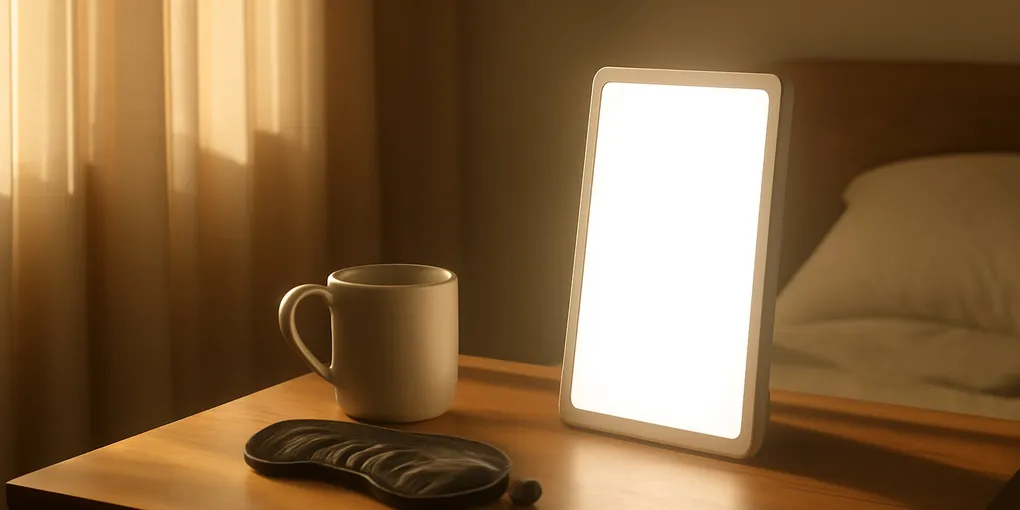
Indoor light boxes are useful when weather, safety, caregiving, or work schedules make outdoor exposure unrealistic. The lamp should be bright enough, stable on a desk, and positioned according to instructions. Bigger is not automatically better. A lamp that is uncomfortable will not be used consistently.
Do not confuse decorative sunrise alarms with therapeutic light boxes. A sunrise alarm may make waking gentler, but it usually does not deliver the same intensity as outdoor light or a dedicated lamp. It can be a helpful cue, not the whole protocol.
Troubleshooting the protocol
If you feel sleepy too early in the evening, the exposure may be too strong, too early, or paired with a very early wake time. Shorten the session and keep bedtime stable. If you still cannot fall asleep until late, audit evening light, caffeine, naps, and weekend schedule drift. Morning light cannot fully overcome bright screens at midnight and irregular wake times.
If the lamp causes headaches, increase distance, reduce duration, try outdoor shade instead, or stop. Symptoms matter more than completing a protocol. If bright light causes agitation, unusually elevated mood, or impulsive energy, stop and seek medical guidance, especially if there is any bipolar history.
If you work night shifts, the standard morning-light rule may not apply. Shift workers need a schedule-specific plan that protects sleep after work and uses light strategically before or during the night shift. Random bright light after a night shift can make daytime sleep harder.
Building the full day around the signal
Morning light works best when the rest of the day supports it. Keep caffeine mostly in the first half of the day. Get some movement, even a short walk. Dim the house in the last hour before bed. Charge the phone away from the bed if scrolling delays sleep. Use a cool, dark bedroom. These steps are not glamorous, but they reduce the amount of willpower needed at bedtime.
Nutrition and training also matter. Very late heavy meals, late alcohol, and intense late-night training can all disturb sleep. The light protocol is a timing anchor, not a license to ignore other signals.
Product selection details
For a light box, look for a 10,000-lux claim at a realistic distance, UV filtering, a stable stand, and a panel large enough that you do not have to keep your face six inches from it. A lamp that fits beside a laptop for 20 to 30 minutes is more useful than a tiny bright point you avoid.
For sunrise alarms, focus on dimming controls, backup alarm reliability, and warm evening modes. Treat them as wake cues, not replacements for outdoor morning light or a dedicated bright-light box.
FAQ
Is outdoor light better than a lamp?
Usually yes for convenience, intensity, and whole-environment cues. A lamp is a fallback when outdoor light is impractical.
How soon after waking should I get light?
Within the first hour is a practical target. Very delayed exposure may be less useful for shifting the clock earlier.
Can I wear sunglasses?
If glare or safety requires sunglasses, use them. For circadian effect, unshaded outdoor light is stronger, but eye safety and comfort come first.
Does this replace insomnia treatment?
No. It is a behavioral support. Chronic insomnia, sleep apnea symptoms, or severe mood changes deserve professional evaluation.