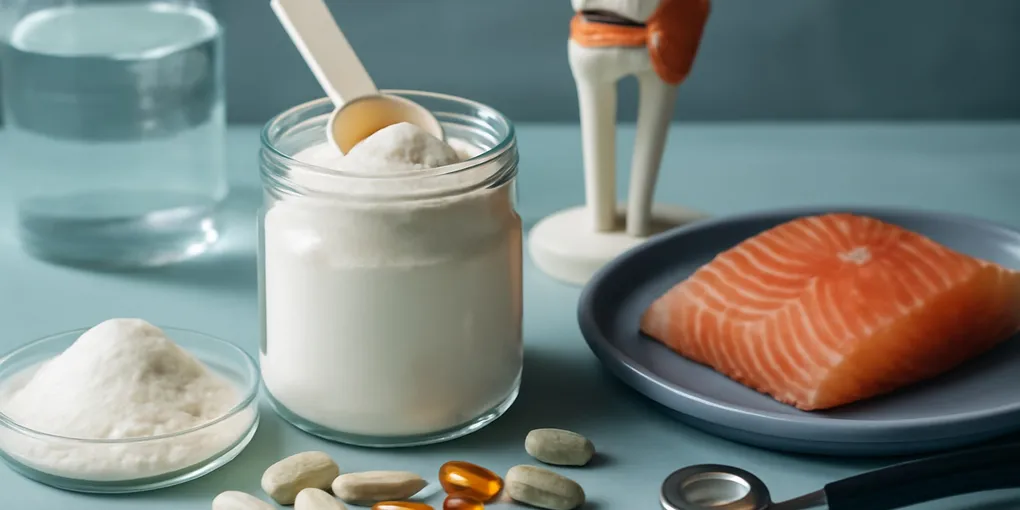
Collagen Peptides for Joints and Tendons: Evidence, Dose, and Product Reality
Evidence ExplainerQuick picks
| Product | Key Specs |
|---|---|
| See price on Amazon |
|
| See price on Amazon |
|
| See price on Amazon |
|
Product availability, certifications, and retailer details can change; check the current Amazon page before buying.
Bottom line
Collagen peptides are plausible for joint discomfort and tendon-focused rehab, but they are not a shortcut around progressive loading. The best evidence points toward a supportive role: collagen or gelatin provides glycine, proline, and hydroxyproline-rich amino acids that may support collagen turnover when the tendon or joint is also being stressed by appropriate exercise. That makes collagen more like a targeted nutrition add-on than a pain pill.
If you buy it, choose a powder you will use consistently, confirm the serving actually provides about 10-15 grams of collagen peptides, and treat vitamin C and loading as part of the same plan. Readers who mainly need total daily protein should start with higher-quality complete proteins instead; collagen is low in leucine and does not replace whey, dairy, eggs, meat, soy, or mixed dietary protein for muscle protein synthesis (gelatin plus vitamin C tendon-collagen trial: PMID: 27852613).
Where to start if you are buying
- Search Amazon for unflavored collagen peptides powder — best for readers who want the simplest 10-15 gram serving without turning the supplement into dessert.
- See current NSF Certified for Sport collagen peptide prices — best when banned-substance risk matters more than lowest price.
- See current collagen plus vitamin C powder prices — convenient if you will not pair collagen with citrus, kiwi, berries, or a separate vitamin C source.
Practical score
| Factor | Weight | Score | Rationale |
|---|---|---|---|
| Research | 30% | 6.6 | Human trials and reviews exist, especially for joint symptoms and connective-tissue markers, but outcomes are mixed (PMID: 30368550). |
| Evidence Quality | 25% | 5.9 | Many studies are small, use different collagen formats, and combine supplementation with exercise or rehab. |
| Value | 20% | 6.4 | Powder servings can be affordable, but premium blends often charge for flavoring and vague joint claims. |
| User Signals | 15% | 6.8 | The routine is easy to follow if the powder dissolves well and does not upset the stomach. |
| Transparency | 10% | 6.2 | Better products list grams of collagen per serving and third-party testing; weaker labels hide behind proprietary blends. |
| Composite | 100% | 6.4 | Worth considering for a tendon or joint plan, not as a stand-alone cure. |
What the evidence actually supports
A 2018 randomized trial in activity-related knee joint discomfort reported improved symptoms in some collagen-peptide users, but the study does not prove that every knee-pain case is a collagen deficiency. Reviews also note possible benefits for connective tissue and joint outcomes while emphasizing variation in dose, duration, and population.
The practical interpretation is narrow: collagen is most defensible when your goal involves tendons, ligaments, or joint comfort during training, and when the supplement is paired with a progressive strength, mobility, or rehab plan. It is less convincing as a general anti-aging powder, a substitute for medical evaluation, or a fix for pain that worsens, swells, locks, or follows an injury.
For muscle gain, collagen is the wrong primary protein. It lacks enough essential amino acids for a strong muscle-building signal compared with complete proteins. If your daily protein target is low, fix that first with ordinary food or a complete protein powder; then consider collagen for the connective-tissue use case.
How to choose a collagen product
Start with the serving size. A product that requires two scoops for 10 grams may still be fine, but the cost comparison should be per effective serving, not per tub. Avoid labels that emphasize “beauty,” “joint complex,” or “proprietary blend” while making it hard to see the collagen grams (collagen supplementation review: PMID: 30368550).
Unflavored hydrolyzed collagen peptides are the safest default because they mix into coffee, water, smoothies, or yogurt without forcing a sweet flavor every day. If you compete in tested sport, prioritize third-party certification. If you have digestive sensitivity, buy a smaller container first; some people tolerate collagen well, while others dislike the texture or mild aftertaste.
Timing, dose, and the exercise pairing
A reasonable trial is 10-15 grams of collagen peptides daily for 8-12 weeks. Many tendon-focused protocols pair collagen or gelatin with vitamin C and then load the target tissue through rehab or strength work. The timing does not need to become mystical, but taking collagen 30-60 minutes before the loading session is a common research-informed pattern.
For an Achilles, patellar tendon, rotator cuff, or elbow-tendon goal, the supplement should sit beside a written loading plan. That can mean isometrics, slow resistance work, or sport-specific progression from a clinician or coach. If the exercise dose is random, collagen will not rescue the program (gelatin plus vitamin C tendon-collagen trial: PMID: 27852613).
Who should skip or be careful
Skip collagen if the ingredient source conflicts with your diet, religious needs, or allergy concerns. Most collagen is bovine, porcine, marine, or chicken-derived, and vegan collagen peptides are usually not true collagen. People with kidney disease, complex medical diets, pregnancy, or persistent joint swelling should ask a clinician before adding concentrated supplements (collagen supplementation review: PMID: 30368550).
Also be careful with claims around cartilage regrowth. Collagen peptides may support symptoms or connective-tissue turnover, but they should not be sold as a way to rebuild a damaged joint. If pain changes your gait, wakes you at night, or follows trauma, evaluation matters more than a tub of powder.
FAQ
Is collagen better than whey protein for joints?
For a tendon or joint-specific plan, collagen may be more targeted because of its amino acid profile. For muscle building and total protein adequacy, whey or another complete protein is stronger. Many readers use collagen only for the connective-tissue goal and keep complete protein separate (collagen supplementation review: PMID: 30368550).
Do I need vitamin C with collagen peptides?
Vitamin C is involved in collagen synthesis, so pairing collagen with a vitamin C source is reasonable. That can be a product blend, fruit, or a normal vitamin C-containing meal. More vitamin C is not automatically better.
How long before I know whether collagen is helping?
Give it 8-12 weeks alongside consistent loading and symptom tracking. If pain is worsening or function is declining, stop treating the supplement as the main experiment and get the injury assessed.
Sources
- Clifford T, et al. Collagen peptides and exercise-induced muscle damage and recovery. PubMed.
- Khatri M, et al. Collagen supplementation for skin, bone, and joint outcomes: review evidence and limitations. PMC.
- Shaw G, et al. Vitamin C-enriched gelatin supplementation before intermittent activity and collagen synthesis. PMC.
Related reading: Creatine monohydrate evidence and Best kitchen scales for protein and creatine accuracy.