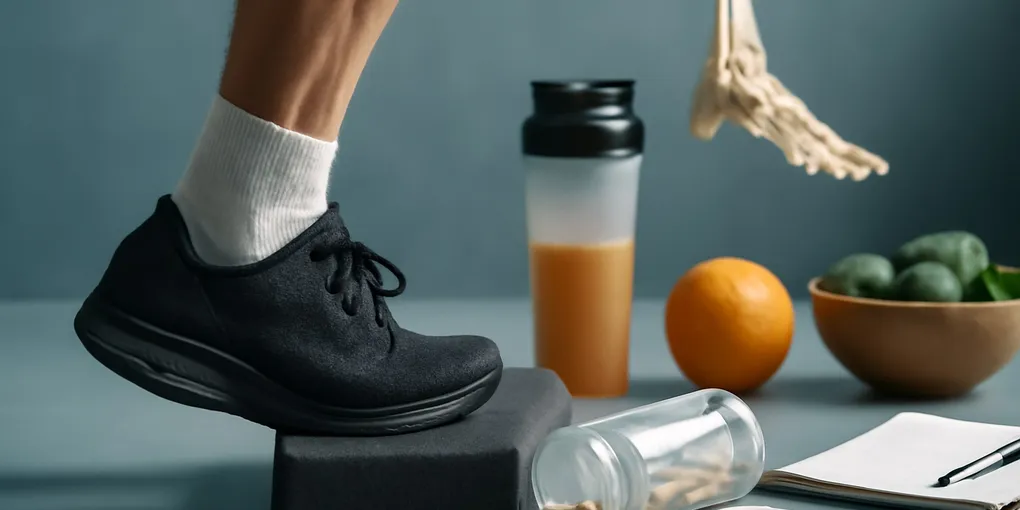
Eccentric Calf Raise Protocol for Achilles Stiffness: How to Use a Step or Slant Board Safely
ProtocolQuick picks
Adjustable slant board for calf raises
★ Top pick Best controlled setup- Best Use: Progressive heel-drop angle and stable home setup
- Caveat: Not needed if a safe step already works
Non-slip aerobic step platform
Best multi-use option- Best Use: Heel drops, step-ups, and general home training
- Caveat: Must be stable enough for single-leg loading
Bottom line
Eccentric calf raises are a reasonable loading strategy for many cases of mid-portion Achilles tendinopathy, but they are not a universal fix for every heel or tendon pain. The useful part is progressive tendon loading. The risky part is treating pain as proof that more volume is better.
If you have sudden sharp pain, a pop, major swelling, inability to push off, insertional pain right at the heel bone, inflammatory disease, diabetes-related foot concerns, or recent fluoroquinolone antibiotic exposure, get clinical advice before following a home protocol. Those warning signs can point to problems beyond routine tendinopathy. If your symptoms are mild, gradual, and clearly load-related, a conservative calf-raise plan can be a structured starting point (PubMed search on Achilles tendinopathy loading guidance).
Quick picks for Achilles calf-raise setup
- See current adjustable slant board prices if you need a stable surface and want to control ankle angle.
- See current non-slip step platform prices if you want a cheaper multi-use platform for heel drops and step work.
Practical score
| Factor | Weight | Score | Rationale |
|---|---|---|---|
| Research | 30% | 7.4 | Progressive calf loading is a core rehab concept for Achilles tendinopathy (PubMed search on Achilles loading guidance). |
| Evidence Quality | 25% | 6.8 | Protocols vary, and response depends on tendon location, pain duration, and adherence. |
| Value | 20% | 7.7 | A step or slant board is inexpensive compared with many recovery devices. |
| User Signals | 15% | 6.2 | The plan is simple but can be boring and uncomfortable. |
| Transparency | 10% | 7.0 | Equipment needs are easy to inspect: stability, angle, surface grip, and load capacity. |
| Composite | 100% | 7.1 | A useful loading protocol when matched to the right tendon problem and progressed carefully. |
Step 1: identify the pain pattern
Mid-portion Achilles pain usually sits a few centimeters above the heel bone. It often feels stiff in the morning, warms up during activity, and gets cranky after a jump in running, hills, court sports, or calf-heavy training. Insertional Achilles pain sits where the tendon meets the heel bone and can be more sensitive to deep heel drops below neutral.
That distinction matters. Traditional heel-drop protocols may aggravate insertional symptoms because the tendon is compressed at the heel in deep dorsiflexion. When in doubt, keep the heel from dropping far below level and ask a physical therapist or sports clinician to classify the problem.
Step 2: choose a safe surface
A staircase can work if the tread is wide, dry, and stable. A slant board is useful when you want a predictable angle and less fear of slipping. An aerobic step can be a good compromise because it also supports other training. Do not use a wobbly box, stack of books, slick yoga block, or narrow stair edge.
The product decision is simple: stability first, angle second. A steep slant board is not automatically better. Many users need a mild angle, good rail or wall support, and enough room to place the ball of the foot securely.
Step 3: start with a tolerable version
Begin with double-leg calf raises on flat ground. If that is painful or weak, do not jump straight to single-leg heel drops. Use two feet to rise, shift slightly toward the target side, and lower slowly for three to four seconds. Keep the movement controlled and avoid bouncing at the bottom.
A common starting dose is 2-3 sets of 8-12 slow reps, three days per week. Mild discomfort during the exercise may be acceptable for some tendon rehab plans, but pain should not spike sharply, change your walking, or be worse the next morning. If it does, reduce range, volume, or load; progressive loading protocols are usually adjusted by symptoms and tendon location rather than pushed through blindly (PubMed search on eccentric Achilles protocols).
Step 4: progress one variable at a time
Progress by improving control first, then range, then single-leg load, then external load. Adding a backpack, dumbbell, or weighted vest too soon can turn a rehab plan into a flare-up. Use a simple log: date, version, sets, reps, pain during, pain next morning, and whether walking felt normal.
When the flat-ground version is easy, move to a step or low slant. If that is tolerated for two weeks, consider single-leg lowering. If symptoms are insertional, keep the heel from dropping below the step until a clinician confirms deeper range is appropriate.
Step 5: return to running or jumping carefully
Calf raises are not the same as running. Before adding hills, sprints, box jumps, or jump rope, check whether you can walk briskly, climb stairs, and perform controlled calf raises without a next-day symptom jump. Reintroduce impact with short, flat, predictable sessions. Hills and speed work come later.
For a broader conditioning tool that can stress the calves quickly, see our weighted jump rope buyer guide. Rope skipping can be useful, but it is a poor first reintroduction if Achilles symptoms are still reactive.
Equipment notes
Adjustable slant board
A slant board is helpful if the surface is wide, grippy, and rated for body weight. Adjustable angles let you start mild instead of forcing a deep stretch. Wood and metal boards can both work if the hinge or support mechanism feels solid.
See current adjustable slant board prices.
Aerobic step platform
A non-slip step is more versatile. It may be enough for heel drops, step-ups, split squats, and balance work. Check platform height and rubber feet. The step should not slide when you load one foot near the edge.
See current aerobic step platform prices.
FAQ
Should eccentric calf raises hurt?
Mild tendon discomfort can occur in some rehab plans, but sharp pain, limping, swelling, or worse morning symptoms mean the dose is too high or the diagnosis may be wrong. Treat those as stop-and-reassess signals, not proof that the protocol is working (PubMed search on Achilles tendinopathy guidance).
Do I need a slant board?
No. A safe step or flat-ground progression can work. A slant board is mainly a stability and angle-control tool, not a magic tendon device.
How long before Achilles stiffness improves?
Many tendon-loading programs require weeks to months. Early progress is often better morning stiffness and less next-day reactivity, not instant pain elimination.
Sources
- Alfredson H, et al. Heavy-load eccentric calf muscle training for chronic Achilles tendinosis. https://pubmed.ncbi.nlm.nih.gov/9617396/
- Cook JL and Purdam CR. Tendinopathy continuum model. https://pubmed.ncbi.nlm.nih.gov/18812414/
- Malliaras P, et al. Achilles and patellar tendinopathy loading programs review. https://pubmed.ncbi.nlm.nih.gov/26390269/
- Related reading: Foam rolling protocol for soreness and mobility and Best yoga mats for joint-friendly home workouts.