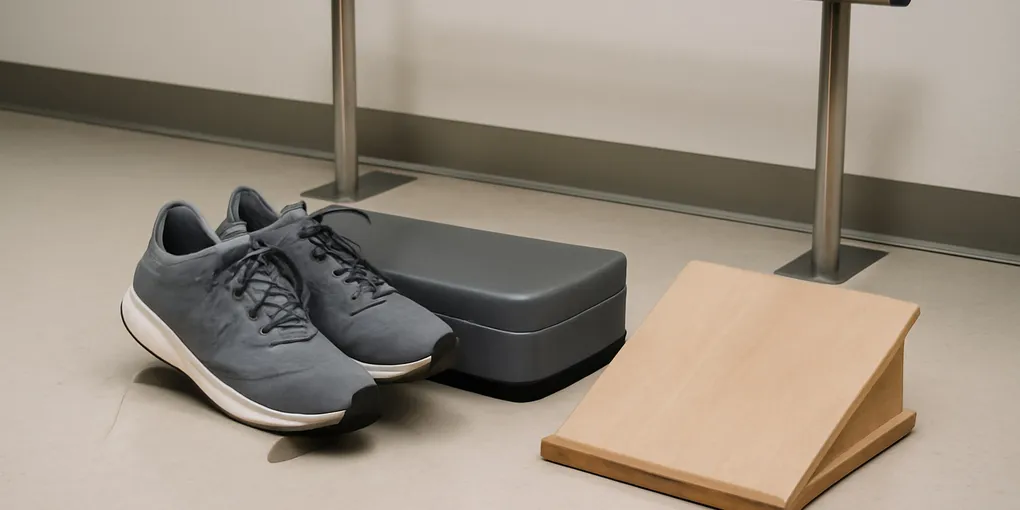
Eccentric Heel Drop Protocol: Calf and Achilles Loading Without Turning Pain Into a Test
ProtocolQuick picks
StrongTek wooden slant board
★ Top pick Controlled angle option- Best Use: Gradual calf loading and mobility work with a stable surface
- Caveat: Angle and surface grip matter more than a steep setting
Yes4All adjustable slant board
Budget adjustable board- Best Use: Users who want multiple incline settings
- Caveat: Check hinge stability and anti-slip surface
Vive balance pad
Later-stage balance add-on- Best Use: Later calf and ankle control work after pain is calm
- Caveat: Do not add unstable surfaces early in a painful tendon flare
Bottom line
Eccentric heel drops are a loading tool, not a toughness test. The useful version is slow, supported, and easy to stop when symptoms change. The risky version is bouncing off a stair edge while hoping pain means progress. If your calf or Achilles problem is sudden, swollen, bruised, or sharp, get medical guidance before loading it.
For equipment, start with a stable step or stair. A Search Amazon for StrongTek wooden slant board or Search Amazon for Yes4All adjustable slant board can help later if the surface is secure. A Search Amazon for Vive balance pad belongs near the end of the progression, not day one.
Protocol fit
- Best fit: calm, gradual calf and Achilles loading when walking is not acutely painful.
- Weak fit: fresh injuries, sudden pops, major swelling, limping, or uncertain diagnosis.
- Main setup rule: hold a rail or wall so balance does not decide the tendon load.
- Main progression rule: add control before adding range, speed, weight, or unstable surfaces.
Quick comparison
- Stable step or stair: best first setup because it is free, predictable, and easy to hold with a rail.
- Adjustable slant board: useful after the basic heel drop is calm, especially if you want repeatable ankle angles.
- Balance pad: later-stage control tool, not an early tendon-loading surface.
- Added weight: a progression only after bodyweight drops stay calm during the set and the next morning.
Practical score
| Factor | Weight | Score | Rationale |
|---|---|---|---|
| Research | 30% | 7.0/10 | Eccentric calf loading has a long rehab history, especially for Achilles tendinopathy. |
| Evidence Quality | 25% | 6.5/10 | Protocols vary and individual diagnosis matters, so this is not a universal fix. |
| Value | 20% | 8.5/10 | A step, rail, and consistent plan cost very little. |
| User Signals | 15% | 6.5/10 | Symptoms provide useful feedback, but pain interpretation is easy to get wrong. |
| Transparency | 10% | 8.0/10 | Range, tempo, support, and next-day response are visible checks. |
| Composite | 100% | 7.2/10 | High-value when matched to the right problem and kept within a cautious pain boundary. |
Before you start
Screen for red flags. Do not use this as self-treatment for a sudden pop, visible deformity, major swelling, bruising, inability to push off, numbness, fever, or pain that changes your walking. Those signs deserve clinical evaluation. The American Academy of Orthopaedic Surgeons includes calf raises and ankle exercises in general foot and ankle conditioning, but it also emphasizes matching exercise to the injury and medical plan (AAOS foot and ankle conditioning).
Choose a stable step where the forefoot can sit securely and the heel can lower below the edge. Hold a rail, rack upright, or wall. Barefoot work can irritate the forefoot on hard edges, so most people should use shoes at first.
The starter protocol
Use this three-day-per-week version for the first two weeks:
- Stand with both forefeet on the step and hold support.
- Rise up using both legs.
- Shift more weight to the working side.
- Lower slowly for three to four seconds until the heel reaches a comfortable stretch.
- Put the other foot back on the step before rising again.
- Perform 2 sets of 8 to 10 reps per side.
The key is the lowering phase. Do not bounce at the bottom. Do not force the heel lower than the ankle tolerates. Stop the set if the movement changes from controlled tendon loading to a grimace-and-drop pattern.
Straight-knee versus bent-knee work
Straight-knee heel drops place more demand on the gastrocnemius, the larger calf muscle that crosses the knee. Bent-knee heel drops bias the soleus, which is heavily involved in walking, running, and standing endurance. Many complete rehab plans use both, but you do not need both on day one.
Start with the version that is least provocative and easiest to control. If both feel fine, alternate them: straight-knee drops on one day, bent-knee drops on the next. If one version reliably causes next-day worsening, remove it and get advice rather than forcing symmetry.
Pain rules that keep the protocol honest
A mild local tendon sensation during loading may be acceptable in some tendon plans. Sharp pain, spreading pain, pain that changes your gait, or next-day worsening is not a green light. Track three things: pain during the set, pain two hours later, and pain the next morning.
If symptoms are calm for two weeks, add volume first. Move from 2 sets to 3 sets before adding weight. If symptoms flare, return to the prior dose or switch temporarily to flat-ground calf raises. Tendons often dislike sudden jumps more than they dislike load itself.
When to add a slant board or weight
A slant board changes the ankle angle and can make the bottom position feel stronger. Use it only when a normal step version is controlled. Start with the lowest angle. The board should not slide, wobble, or force the toes into a cramped position.
Weight comes later. A backpack or dumbbell can increase demand, but only if bodyweight sets are boring and next-day symptoms are stable. If you add weight, reduce reps for the first week and keep support nearby. The goal is progressive loading, not proving the calf can survive a surprise.
How this fits with other lower-leg work
Heel drops are one piece of a calf and ankle plan. Many runners also need soleus endurance, hip strength, foot intrinsic work, and workload control. Our tibialis raise protocol covers the front of the lower leg, while the balance pad ankle stability protocol is better saved for later control work after pain is settled.
A review of Achilles tendinopathy loading options notes that eccentric exercise has evidence, but loading type and individual tolerance matter (Achilles loading review). That is the reason this protocol uses response checks instead of a fixed promise.
Eccentric heel drop FAQ
Should I do heel drops every day?
Not at first. Three days per week gives symptoms time to report back. Daily loading can work in some clinician-led plans, but it is not the safest default for a self-guided start.
Can I do this for plantar fasciitis?
Maybe, but the target is different. Plantar heel pain can involve calf mobility and foot loading, but an Achilles-style heel-drop plan is not automatically the right treatment.
What if I only feel calf muscle burn?
That can be normal, especially if the calf is detrained. The concern is tendon pain that escalates, sharpens, or changes walking mechanics.
Is a balance pad useful?
Later, possibly. Early rehab should make the load predictable. Add unstable surfaces only after pain is calm and basic strength is reliable.
Sources
- AAOS foot and ankle conditioning program: https://orthoinfo.aaos.org/en/recovery/foot-and-ankle-conditioning-program/
- Achilles tendinopathy loading review: https://www.ncbi.nlm.nih.gov/pmc/articles/PMC4723437/
- Body Science Review tibialis raise protocol: /blog/tibialis-raise-shin-strength-protocol/
Frequently Asked Questions
- They can be useful in some tendon-loading plans, but sharp pain, swelling, sudden injury, or worsening symptoms need clinical guidance.
- Straight-knee drops bias the gastrocnemius more, while bent-knee drops bias the soleus more. Start with the variation that stays controlled and tolerable.
- Mild tendon discomfort may be acceptable in some rehab plans, but pain should not spike, alter your gait, or feel worse the next day.
- No. A stable step or stair can work. A slant board is useful only if it gives a controlled angle and secure footing.