Gua Sha for Muscle Recovery: Scraping Tool, Circulation Ritual, or Bruise Machine?
Evidence ExplainerQuick picks
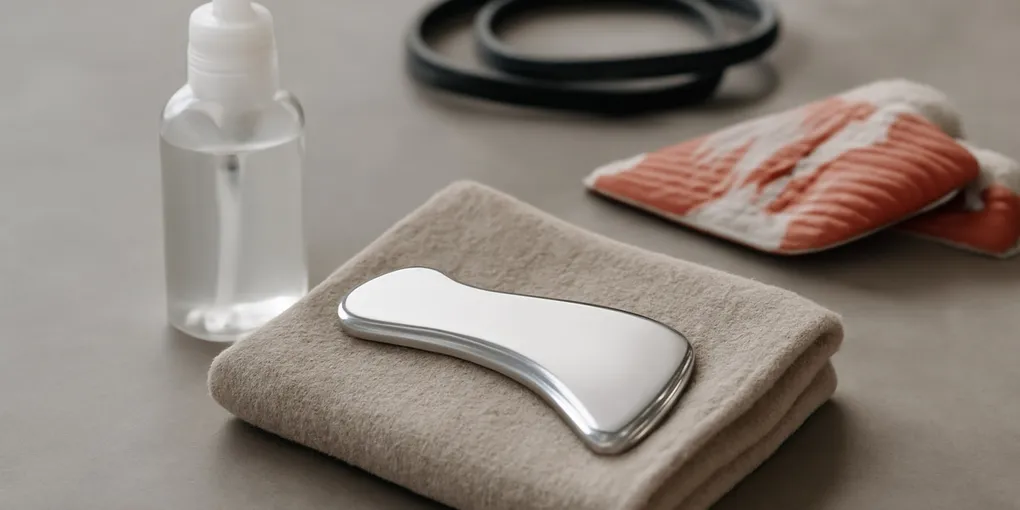
Stainless Steel Gua Sha or IASTM Tool
★ Top pick Best durable tool type- Best Use: Light gliding pressure on large muscle areas with lotion
- Caveat: Can bruise skin quickly if you chase redness or dig hard
Lacrosse Ball Massage Ball
Better pressure alternative- Best Use: Foot, glute, and small-area pressure without scraping skin
- Caveat: Can be too intense over nerves or bony areas
Gua sha and muscle scraping tools sit in an awkward place: some people like the sensation, many claims outrun the evidence, and aggressive scraping can turn a recovery habit into skin irritation. If you buy one, buy it for light self-massage and short-term comfort, not for detox, fascia remodeling, or guaranteed performance.
For a durable, washable option, search Amazon for a stainless steel gua sha or IASTM tool. If your goal is targeted pressure without scraping, search Amazon for a lacrosse ball massage ball and use our lacrosse ball foot mobility protocol as a pressure-dosing example.
Quick picks
- Best durable scraper: stainless steel gua sha or IASTM tool with rounded edges, used with lotion and light pressure.
- Best non-scraping alternative: lacrosse ball massage ball for small areas where pressure is useful but skin scraping is not.
- Best skip rule: do not scrape over bruises, rashes, varicose veins, acute swelling, numbness, or skin you would not comfortably massage by hand.
Quick verdict
Gua sha can be a reasonable recovery accessory if you use lotion, light pressure, and short sessions on large muscle areas. It is a poor choice if you expect bruising to prove effectiveness or if you want to treat pain, swelling, nerve symptoms, or injury without a clinician.
People who already overdo massage guns, hard balls, or foam rolling should be especially cautious. Scraping gives immediate sensory feedback, which makes it easy to keep chasing more redness even when the tissue has had enough.
Practical score
| Factor | Weight | Score | Rationale |
|---|---|---|---|
| Research | 30% | 4.5 | Traditional and instrument-assisted scraping have some clinical literature, but muscle-recovery claims are not strongly proven. |
| Evidence Quality | 25% | 4.0 | Studies vary by condition, practitioner, pressure, and outcome; home use is even less standardized. |
| Value | 20% | 6.5 | Basic tools are cheap and durable if used gently. |
| User Signals | 15% | 6.0 | Some users like the sensation, but bruising and skin irritation are common misuse risks. |
| Transparency | 10% | 6.0 | Listings show shape and material, but claims often imply more than evidence supports. |
| Composite | 100% | 5.1 | Acceptable as a light comfort tool, weak as a recovery-performance intervention. |
What evidence can and cannot say
Gua sha traditionally refers to scraping lubricated skin with a smooth tool. Instrument-assisted soft-tissue mobilization, or IASTM, is a broader clinical and sports setting category that can look similar but is not identical to casual home scraping.
A systematic review on IASTM reported mixed findings and called for better study quality and clearer treatment parameters (https://www.ncbi.nlm.nih.gov/pmc/articles/PMC5039777/). That is the right frame for home buyers. The tool may change how an area feels for a while. It does not prove that adhesions were broken, toxins were removed, or recovery biology was upgraded.
The National Center for Complementary and Integrative Health safety page notes that complementary health approaches can have risks and should be discussed with health professionals when relevant (https://www.nccih.nih.gov/health/safety). That warning is broad, but it applies to scraping when people use it over unexplained pain or combine it with bleeding-risk medications.
How to choose a tool
A stainless steel tool is easy to clean and glides smoothly with lotion. It can also feel more intense than expected because the edge is firm and narrow. Beginners should choose a rounded shape with multiple edges rather than a sharp-looking scraper.
A resin, stone, or plastic gua sha tool can work for light use, but check that the edge is smooth. Chips, seams, or rough edges are deal breakers. Do not use a decorative facial tool for heavy leg scraping if it feels too small to control.
Skip tools with extreme claims. You are buying shape, grip, edge smoothness, and cleanability. You are not buying proof that a scraper can diagnose tissue quality.
A safer home-use protocol
Use lotion or oil so the tool glides. Pick one large muscle area, such as the calf or quad. Use light pressure for 30 to 60 seconds, then stop and move the joint through easy range. The skin may look slightly pink. It does not need to look bruised.
Avoid the front of the neck, bony ridges, open skin, rashes, fresh bruises, varicose veins, and swollen areas. Do not scrape over numbness or tingling. If you are pregnant, on blood thinners, have a bleeding disorder, or bruise easily, ask a clinician before using scraping tools.
After scraping, train or move gently. A recovery tool should leave you more willing to move, not more tender. If soreness increases the next day, use less pressure, less time, or a different tool.
When a massage ball or foam roller is better
Choose a ball when the target is small and you do not want skin scraping: foot arch, glute, or chest wall. Choose a foam roller when the target is broad and you want pressure without using your hands. Choose a massage stick when you need seated calf or quad work before a run.
A scraping tool is most defensible when you enjoy the glide sensation and can stop early. It is least defensible when the goal is deep pressure. Deep pressure with a narrow edge is exactly how people irritate skin.
Gua Sha Muscle Recovery FAQ
Should gua sha leave red marks?
Mild temporary redness can happen, but bruising is not a goal. For home muscle recovery, use enough pressure to feel the tool, not enough to prove toughness.
Can I use gua sha before lifting?
Yes, lightly. Keep it brief and follow with warm-up sets. Heavy scraping before lifting can make the area tender and distract from the session.
Is a metal gua sha tool worth it?
It can be worth it if you want a washable, durable tool and you will use light pressure. If you mostly want deep trigger-point pressure, buy a ball or roller instead.
Frequently Asked Questions
- There is not strong proof that it speeds recovery. It may feel helpful for short-term comfort when used lightly.
- No. Chasing bruising is unnecessary for a home recovery routine and increases irritation risk.
- Avoid it over bruises, rashes, varicose veins, acute injuries, numb areas, or if blood-thinning medication or bleeding risk applies unless a clinician clears it.