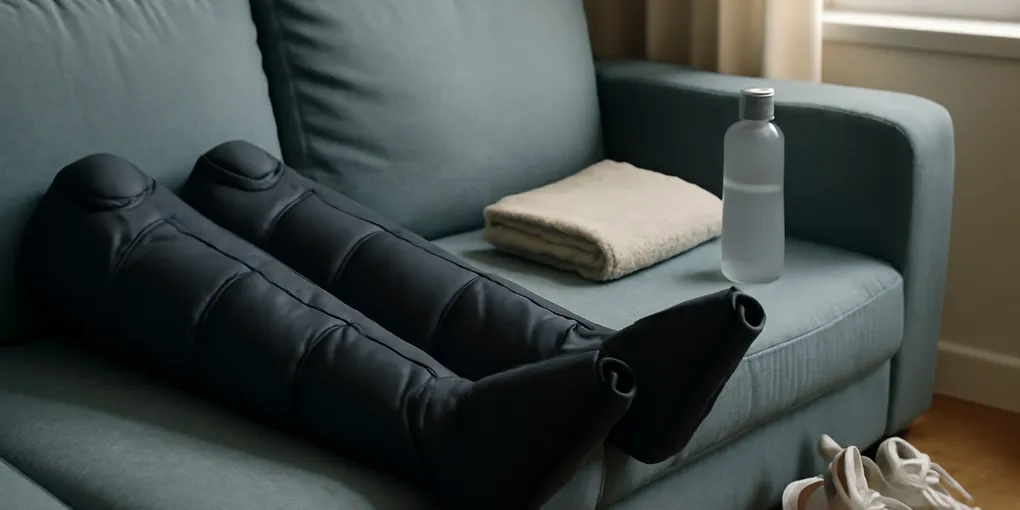
Therabody RecoveryAir JetBoots Review: Portable Compression Upgrade or Expensive Recovery Theater?
ReviewTherabody RecoveryAir JetBoots
Best cordless premium pickBest Use: Athletes who want a portable no-hose compression setup
Quick picks
| Product | Key Specs |
|---|---|
| See price on Amazon |
|
| See price on Amazon |
|
| See price on Amazon |
|
Product availability, certifications, and retailer details can change; check the current Amazon page before buying.
Bottom line
Therabody RecoveryAir JetBoots are a premium convenience product, not a guaranteed recovery upgrade. The best reason to buy them is the cordless boot design: no separate hoses spread across the couch, no big controller on the floor, and an easier setup after training or travel. The weakest reason is believing compression boots will rescue poor sleep, aggressive training jumps, or an injury that needs diagnosis.
If the price is acceptable and you will use them several times per week, compare Search Amazon for Therabody RecoveryAir JetBoots. If you want the category benefit without the premium spend, compare Search Amazon for RENPHO leg compression massagers. If you are cross-shopping premium systems, compare Search Amazon for Hyperice Normatec 3 Legs.
Quick verdict
- Buy if: you train often, travel with heavy legs, hate hose/controller clutter, and already handle the basics of recovery.
- Skip if: you are looking for a cheap soreness cure, have medical compression restrictions, or will use them twice and store them.
- Best rival: Normatec 3 if you do not need the same cordless all-in-one boot format.
- Budget path: RENPHO-style leg compression massagers for occasional light use, with lower expectations.
Practical score
| Factor | Weight | Score | Rationale |
|---|---|---|---|
| Research | 30% | 6.5/10 | Pneumatic compression has some recovery evidence, but product-specific superiority is not established. |
| Evidence Quality | 25% | 6.0/10 | Studies vary by pressure, timing, outcome, sport, and comparison condition. |
| Value | 20% | 5.5/10 | Convenience is strong, but the price is high compared with sleep, programming, walking, and cheaper tools. |
| User Signals | 15% | 8.0/10 | Comfort, setup speed, fit, and battery convenience are easy for buyers to evaluate. |
| Transparency | 10% | 8.0/10 | The honest pitch is convenience and perceived recovery, not a clinical treatment promise. |
| Composite | 100% | 6.6/10 | A polished premium recovery tool for frequent users, but not a must-buy. |
What JetBoots are trying to solve
Traditional recovery boots use inflatable chambers connected to a controller by hoses. They can feel useful, but setup friction is real. The JetBoots appeal is that each boot contains the pump and controls, which makes the system easier to move, pack, and use on a couch. That convenience matters if a product is supposed to be used after training when motivation is low.
The buyer question is frequency. A runner, cyclist, field-sport athlete, or strength athlete who does hard lower-body work several times per week may get enough use to justify a premium system. A casual exerciser with occasional soreness probably will not. Compression boots are not like a dumbbell you can use for dozens of exercises; they have one job.
Recovery evidence in plain English
Intermittent pneumatic compression can influence fluid movement and may improve some subjective recovery markers. A 2022 systematic review and meta-analysis found that pneumatic compression may reduce delayed-onset muscle soreness and improve some recovery outcomes, but the evidence is not clean enough to promise a universal effect (review).
That distinction matters. Feeling fresher after compression is useful if it helps you relax, elevate legs, and avoid extra stress. It does not prove that muscle repair, adaptation, or performance readiness dramatically changed. For soreness tools more broadly, our Theragun Mini 2 review reaches a similar conclusion: convenience and perceived relief can be real without making the tool essential.
Fit, sizing, and pressure checks
Compression boots fail when the fit is wrong. Check boot size against height, inseam, thigh circumference, and calf circumference. If the boot gaps badly, pressure will feel uneven. If it is too tight before inflation, the session can feel unpleasant or unsafe.
Start at lower pressure. More squeeze is not automatically more recovery. If the sensation becomes painful, numb, tingly, or asymmetric, stop. Do not use compression boots over acute swelling after an injury unless a clinician has cleared the situation.
Battery and charging details also matter. Cordless boots are convenient only if you keep them charged. If you always use recovery tools in one room, a hose-and-controller system may not bother you.
Who should not use them casually
Do not use compression boots as a workaround for symptoms that need medical care. Avoid use without clinician guidance if you have suspected or known blood clots, severe peripheral vascular disease, uncontrolled heart failure, active skin infection, severe neuropathy, unexplained calf pain or swelling, or recent surgery restrictions. Medical compression and consumer recovery compression are not the same buying decision.
If you have normal post-workout soreness, the basics still rank first: sleep, food, hydration, training progression, and easy movement. Compression boots sit after those basics, not before them.
Alternatives worth considering
Normatec 3 Legs are the obvious premium comparison. They have strong brand recognition and a more traditional controller system. Choose based on fit, warranty, return terms, controls, and whether cordless boot convenience is worth the price difference.
Budget leg compression massagers can be reasonable if you want occasional relaxation. Expect less precise compression, fewer zones, more wires, and weaker materials. They can still be useful for someone who would never spend near a thousand dollars on recovery boots.
A simple walk is the cheapest alternative. Active recovery has evidence for short-term soreness and perceived recovery in some contexts, and it costs nothing. See our active recovery for sore muscles guide before assuming recovery requires a device.
FAQ
Are JetBoots good for runners?
They can be useful for runners who like post-run compression and will use them consistently. They are not a fix for training load errors, shoe problems, or unresolved pain.
Can I sleep in compression boots?
No. Use them while awake and attentive so you can stop if pressure feels wrong, numbness appears, or symptoms change.
Should I buy JetBoots or Normatec?
Choose JetBoots if cordless setup is the main reason you will actually use the product. Choose Normatec if you prefer its ecosystem, controls, fit, or pricing.
Do I need full-leg boots?
Full-leg boots make sense if quads, hamstrings, and calves are the target. Calf-only devices are cheaper but do not match the same use case.
Sources
- Pneumatic compression recovery review: https://pmc.ncbi.nlm.nih.gov/articles/PMC8875822/
- Compression and recovery review: https://pmc.ncbi.nlm.nih.gov/articles/PMC11654844/
- Body Science Review Theragun Mini 2 review: /blog/theragun-mini-2-review/
- Body Science Review active recovery guide: /blog/active-recovery-sore-muscles-evidence/