Quick picks
| Product | Key Specs |
|---|---|
| See price on Amazon |
|
| See price on Amazon |
|
Product availability, certifications, and retailer details can change; check the current Amazon page before buying.
RecoveryAir JetBoots vs Therabody PowerDot Smart: Compression vs EMS
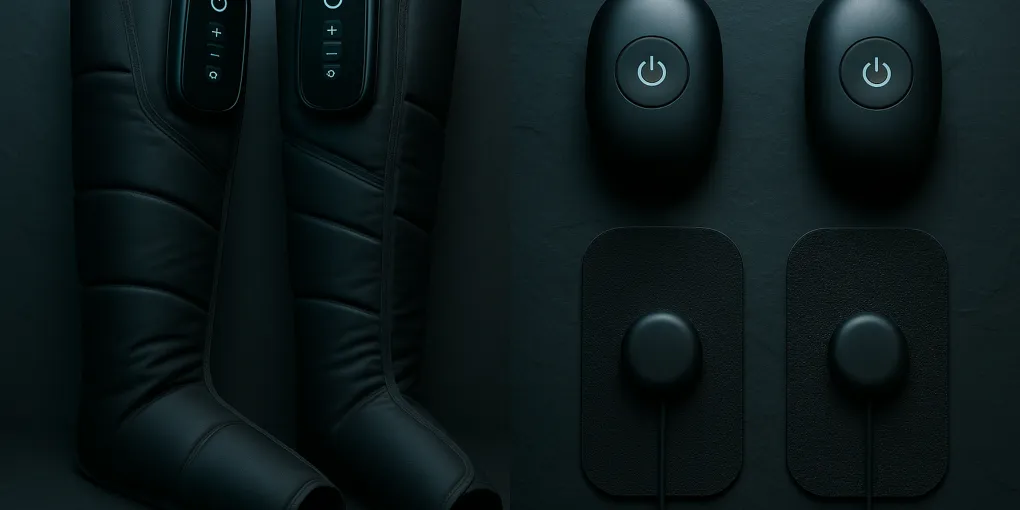
Both devices come from Therabody’s recovery lineup — but they work through entirely different mechanisms. The RecoveryAir JetBoots apply external pneumatic compression to both legs simultaneously, driving venous and lymphatic clearance of metabolic waste. The PowerDot Smart uses wireless EMS to electrically stimulate muscle contractions in a targeted area, producing the physiological equivalent of light active recovery without requiring physical movement.
This is less a competition than a comparison of two complementary tools — one systemic and passive, one targeted and active.
Offer and CTA notes
Therabody device links use tagged marketplace URLs already present in the comparison table. Because prices and model generations can change, verify the exact RecoveryAir JetBoots or PowerDot Smart model before checkout.
The Science Behind Each Recovery Modality
How Pneumatic Compression Works (RecoveryAir JetBoots)
Sequential pneumatic compression applies controlled air pressure in a wave pattern from the foot upward, mimicking the natural venous return and lymphatic drainage that occurs during walking. This “artificial muscle pump” effect has been studied for decades in clinical and athletic populations.
The research:
- Brown et al. (2017, International Journal of Sports Physiology and Performance, doi:10.1123/ijspp.2017-0131) confirmed that post-exercise pneumatic compression significantly reduced DOMS and accelerated return of muscular strength across multiple study designs in endurance athletes.
- Cochrane (2004, Physiotherapy Research International, PMID: 15202381) demonstrated that 20-minute pneumatic compression sessions post-exercise reduced blood lactate and creatine kinase more effectively than passive recovery.
- The sequential (distal-to-proximal) pattern used in the RecoveryAir JetBoots is specifically more effective for lymphatic clearance than uniform compression (Morris & Woodcock, 2004, Annals of Surgery, PMID: 15514468).
Who benefits most: Endurance athletes (runners, cyclists, triathletes) who accumulate metabolic waste throughout the full leg musculature. The RecoveryAir JetBoots compress the entire leg — from foot to upper thigh — bilaterally and simultaneously. You get both legs done in one 20–30 minute session.
How EMS Works (PowerDot Smart)
EMS (Electrical Muscle Stimulation) devices deliver controlled electrical current through electrode pads placed on skin over a target muscle. In “active recovery” mode — the primary use case for the PowerDot Smart — the device delivers low-frequency (1–10 Hz) stimulation that produces gentle, rhythmic muscle contractions.
These contractions produce the muscle pump effect: rhythmic contraction and relaxation of treated muscles increases local blood flow and lymphatic drainage in that specific area — delivering oxygen, removing inflammatory byproducts — without adding mechanical load.
The research:
- Filipovic et al. (2018, European Journal of Applied Physiology, doi:10.1007/s00421-018-3778-0) meta-analyzed low-frequency EMS protocols and confirmed significant reduction in DOMS and accelerated recovery of strength and power output post-exercise.
- Babault et al. (2011, Journal of Strength and Conditioning Research, PMID: 21297519) confirmed that EMS active recovery mode significantly increases local blood flow compared to passive recovery, equivalent to light exercise.
- A key practical advantage: EMS recovery works on muscles that cannot be mechanically loaded — injured muscles, post-surgical recovery — because electrical stimulation produces the muscle pump effect without requiring the muscle to generate force against resistance.
Who benefits most: Athletes who need targeted recovery on specific muscle groups — one or two areas that are significantly sorer than others. The PowerDot Smart is precise in a way that compression boots are not: you place the pod exactly where the soreness is.
How They Complement Each Other
The landmark meta-analysis by Dupuy et al. (2018, Frontiers in Physiology, doi:10.3389/fphys.2018.00403) analyzed 99 studies and multiple recovery modalities. Combined protocols (using two or more recovery tools) showed additive benefits over any single modality. The biological rationale: compression handles systemic venous/lymphatic clearance across the full limb; EMS handles targeted local blood flow in the most metabolically stressed tissue. They’re addressing the same problem from different angles.
RecoveryAir JetBoots — Product Profile
Therabody’s RecoveryAir JetBoots are the premium cordless compression boot option in the Therabody lineup. At 100 mmHg max pressure and 5 zones per leg, they deliver clinical-level compression in a fully wireless design controlled through the Therabody App.
What Makes Them Distinctive
100 mmHg maximum pressure. This is the full clinical range for pneumatic compression in athletic populations. The Normatec Go tops out at 80 mmHg; the RecoveryAir JetBoots reach the upper end of the evidence-supported pressure range. For athletes who specifically respond to higher-pressure compression, or for recovery from very high training volumes, the additional pressure ceiling is relevant.
5-zone sequential compression from foot to upper thigh. Each zone (foot, lower calf, upper calf, lower thigh, upper thigh) inflates independently in sequence. The Therabody App provides individual zone pressure adjustment — you can emphasize upper thigh recovery for leg press days and full-leg compression after running.
Cordless design. The RecoveryAir JetBoots have integrated batteries — no external control unit, no tethered cord. This is the same portability advantage that distinguishes the Normatec Go from the Normatec 3. True wireless operation means use while traveling, in a hotel room, or post-race.
Therabody App integration. The same app that controls the Theragun massage guns now integrates all Therabody recovery devices. Athletes who own both a Theragun and PowerDot can manage their entire recovery protocol through one platform.
What to Know
60-minute battery life. This is the notable limitation at the $699 price point. The Normatec Go, at $300 less, provides ~90 minutes per charge. At $699, a 90–120 minute battery would be more appropriate. At 60 minutes — approximately 2 full recovery sessions per charge — daily users will charge every other day.
Weight: 1.5 lbs per boot. Heavier than the Normatec Go (0.7 lbs per boot) but still manageable. The weight is from the integrated battery system. Travel-portable, but noticeably heavier than the lightest compression boot options.
Price premium. At $699, the RecoveryAir JetBoots are $300 more than the Normatec Go ($399) and $450 more than the Air Relax Plus ($249). The primary functional advantage over the Normatec Go is the higher pressure ceiling (100 vs. 80 mmHg). Whether that difference justifies the cost premium depends on your training intensity and specific recovery needs.
Scoring — RecoveryAir JetBoots
| Criterion | Weight | Score | Notes |
|---|---|---|---|
| Evidence Quality | 30% | 8.5 | Strong pneumatic compression evidence base; 100 mmHg in clinical range |
| Ingredient Transparency | 25% | 8.0 | Full spec disclosure; zone and pressure data published; 60-min battery limitation should be more prominent |
| Value | 20% | 7.5 | $699 is premium; higher-pressure ceiling and Therabody App integration justify some premium but 60-min battery reduces value proposition |
| Real-World Performance | 15% | 8.5 | Verified purchasers report effective recovery; Therabody App integration noted positively |
| Third-Party Verification | 10% | 8.5 | Therabody professional sports partnerships; used in major league sports facilities |
| Composite Score | 8.2/10 |
Therabody PowerDot Smart — Product Profile
The PowerDot Smart is Therabody’s entry-level wireless EMS device — a single-pod, app-controlled muscle stimulator providing targeted EMS recovery, activation, and pain management through the Therabody App.
What Makes It Distinctive
Wireless EMS with Therabody App integration. Traditional EMS devices use wired electrode leads. The PowerDot Smart connects via Bluetooth to the Therabody App, which guides session selection (recovery, activation, pain management), intensity adjustment, and session timing. The wireless design removes the cable management friction that makes wired EMS devices inconvenient for daily use.
$199 entry price for EMS recovery. The PowerDot Smart makes wireless EMS accessible at a significantly lower price than multi-channel professional devices (Compex Sport Elite at $449, Marc Pro at $649). For athletes who want to explore EMS recovery before committing to a professional system, the PowerDot Smart is the practical starting point.
Therabody ecosystem integration. Athletes who own a Theragun massage gun can manage both devices from the same Therabody App — recovery programs, usage tracking, and session pairing across devices. The PowerDot Smart becomes a more compelling product within the broader Therabody ecosystem.
App-guided programs. The Therabody App provides pre-programmed recovery, activation, and pain management sessions calibrated for specific use cases (post-run quad recovery, shoulder activation, knee pain management). For EMS newcomers, the guided programming removes the learning curve of manual protocol selection.
What to Know
Single pod (one channel). The PowerDot Smart is a single pod — it treats one area at a time. To treat bilateral quads simultaneously (both legs), you would need two pods or the PowerDot 2.0 Duo ($299). For most recovery use cases, treating one area at a time is acceptable — but the limitation is real for athletes who need bilateral treatment.
App required for operation. The PowerDot Smart has no standalone controls — it only operates through the Therabody App. This is the primary limitation vs. wired EMS devices with on-device controls. Reliable Bluetooth connectivity is required for every session.
70 mA max intensity. Lower than clinical EMS devices (Compex Sport Elite: 150 mA). For recovery mode EMS (1–10 Hz, gentle contractions), 70 mA is clinically appropriate. For strength EMS protocols used by professional athletes (50–80 Hz, high-intensity contraction), the PowerDot Smart’s intensity ceiling limits application scope.
Scoring — Therabody PowerDot Smart
| Criterion | Weight | Score | Notes |
|---|---|---|---|
| Evidence Quality | 30% | 8.5 | Strong EMS recovery evidence base; low-frequency recovery protocols well-studied |
| Ingredient Transparency | 25% | 7.5 | Single-pod limitation and app-dependency should be more prominent in marketing; max intensity somewhat underspecified |
| Value | 20% | 8.5 | $199 for wireless EMS is competitive; single pod limits vs. Duo at $299 |
| Real-World Performance | 15% | 8.0 | Amazon purchasers report effective targeted recovery; app connectivity issues noted by a minority of users |
| Third-Party Verification | 10% | 7.5 | Therabody professional partnerships; limited independent intensity/efficacy testing at PowerDot-specific level |
| Composite Score | 8.0/10 |
Head-to-Head Comparison
| Feature | RecoveryAir JetBoots | PowerDot Smart |
|---|---|---|
| Recovery mechanism | Pneumatic compression (venous/lymphatic) | EMS (neuromuscular/muscle pump) |
| Coverage | Full bilateral legs (both legs at once) | Single targeted area (one muscle group at a time) |
| Session type | Passive (no effort required) | Active (device generates contractions) |
| Session length | 20–30 min | 20–30 min |
| Battery | 60 min (~2 sessions) | No battery (powered via USB when needed) |
| App required? | Optional (Therabody App enhances but not required) | Yes (required for all operation) |
| Price | $699 | $199 |
| Best for | Endurance athletes, high-volume training, bilateral leg recovery | Targeted spot recovery, rehab support, EMS newcomers |
| Composite Score | 8.2/10 | 8.0/10 |
Verdict: Which Should You Buy?
Buy the RecoveryAir JetBoots if:
- Your primary training is endurance (running, cycling, triathlon) with metabolic accumulation across both legs
- You want passive systemic recovery that works while you rest
- You already own a massage gun or EMS device and need the complementary compression modality
- Higher pressure ceiling (100 mmHg) matters for your specific recovery protocol
Buy the Therabody PowerDot Smart if:
- Your recovery needs are targeted — one or two specific muscle groups significantly sorer than others
- Budget is a priority ($199 vs. $699)
- You’re new to EMS and want an accessible entry point into electrical stimulation recovery
- You already own Therabody products and want ecosystem integration
Consider both if:
- You train at high volume and want the full Therabody recovery ecosystem
- Your sport demands both systemic endurance recovery (compression) and targeted muscle rehabilitation (EMS)
- You’re building a comprehensive recovery toolkit from scratch
The RecoveryAir JetBoots score higher overall (8.2 vs. 8.0) but at 3.5× the price of the PowerDot Smart, the value equation clearly favors the PowerDot for most athletes unless full-leg compression is specifically the missing piece in their recovery. If the choice is purely between these two devices, the PowerDot Smart’s price-to-utility ratio is difficult to beat for targeted recovery.
How We Evaluated These Products
We reviewed peer-reviewed clinical literature on pneumatic compression and EMS recovery, analyzed published Therabody device specifications, and synthesized verified purchaser feedback from Amazon. Our 5-factor composite scoring (Evidence Quality 30%, Ingredient Transparency 25%, Value 20%, Real-World Performance 15%, Third-Party Verification 10%) applies consistent weights across all BSR reviews. We do not physically test products; evaluations are based on published specifications, peer-reviewed research, and documented user reports.
Evidence references
- Recovery modality effects vary; meta-analytic evidence supports some benefits for compression garments, massage, and active recovery while individual response differs: Dupuy et al., 2018, Frontiers in Physiology, doi:10.3389/fphys.2018.00403.
- EMS/NMES protocols depend on frequency, intensity, and electrode placement; do not extrapolate medical-rehab outcomes to every consumer recovery session without caution: Filipovic et al., 2012, Sports Medicine, doi:10.2165/11597240-000000000-00000.
Frequently Asked Questions
- Compression therapy (RecoveryAir JetBoots) uses pneumatic air pressure applied to the outside of your limb to increase venous return and lymphatic drainage — physically moving metabolic waste from your muscles into your circulatory system for clearance. EMS (PowerDot Smart) uses electrical current delivered through electrode pads on your skin to cause involuntary muscle contractions, mimicking the muscle pump during light exercise. Both increase local blood flow and accelerate recovery, but via different pathways. Compression acts on the vasculature; EMS acts on the neuromuscular system.
- Yes — they're complementary, not redundant. Use the PowerDot Smart first for targeted EMS recovery on specific sore muscle groups (quads, hamstrings) at 20–30 minutes in active recovery mode, then follow with 20–30 minutes in the RecoveryAir JetBoots for systemic venous/lymphatic clearance across both legs. The combined protocol has additive effects — EMS improves local muscle pump function while compression handles full-leg metabolite drainage.
- The RecoveryAir JetBoots offer 100 mmHg max pressure (vs. Normatec Go's 80 mmHg) and 5 zones per leg on a cordless platform. The Normatec Go is lighter (0.7 lbs vs. 1.5 lbs per boot) and less expensive at $399. If maximum compression pressure matters (serious endurance athletes, post-surgical limb recovery), the JetBoots edge is relevant. For most athletes, the Normatec Go delivers comparable recovery at the lower price point. The JetBoots' 60-min battery vs. the Normatec Go's ~90 min is a meaningful limitation at this price tier.
- Yes — the PowerDot Smart requires the Therabody App (iOS/Android) for all program selection and operation. The device does not have standalone controls. This is the key limitation vs. wired EMS devices like the Compex Sport Elite, which have on-device controls. If you train in areas without reliable Bluetooth connectivity, or prefer standalone operation, the PowerDot's app-dependency is worth noting.
- Post-workout recovery EMS sessions of 20–30 minutes can be used daily. Most athletes use EMS recovery on the same day as intense training, either immediately post-workout or in the evening. Research shows no harm from daily recovery-mode EMS use in healthy adults. Do not use EMS over the head, neck front, or chest; avoid use with pacemakers, pregnancy, epilepsy, or metal implants in the treatment area.