Quick picks
| Product | Key Specs |
|---|---|
| See price on Amazon |
|
| See price on Amazon |
|
Product availability, certifications, and retailer details can change; check the current Amazon page before buying.
Hyperice Normatec Go vs Hypervolt 2 Pro: Two Tools, Two Recovery Mechanisms
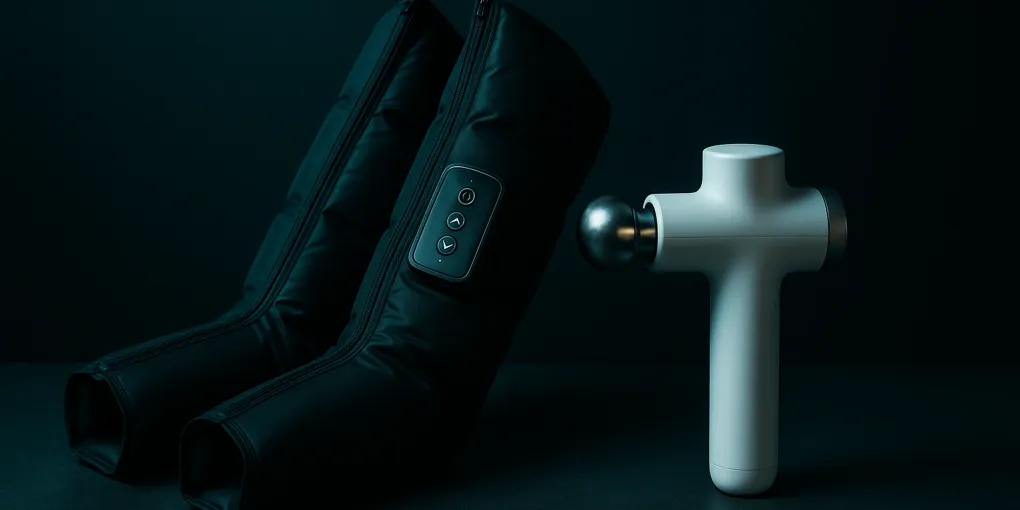
Hyperice makes two of the most popular recovery devices on the market — but they do fundamentally different things. The Normatec Go uses pneumatic compression to drain metabolic waste from your legs via the lymphatic and venous systems. The Hypervolt 2 Pro delivers percussive therapy to physically work muscle tissue, relieve tightness, and improve range of motion. (Source: https://pubmed.ncbi.nlm.nih.gov/33418535/)
This is not a “which one is better” comparison. It’s a “which one is right for your situation” guide — and for many athletes, the answer is both.
What the Research Says About Recovery Modalities
Pneumatic Compression (Normatec Go)
Sequential pneumatic compression has been studied in clinical and athletic populations for over two decades. The mechanism is well-established: controlled air pressure applied distal-to-proximal (from the foot upward) increases venous return and lymphatic drainage from exercised limbs. (Reference: https://pubmed.ncbi.nlm.nih.gov/23222084/)
Key research findings:
- Brown et al. (2017, International Journal of Sports Physiology and Performance, doi:10.1123/ijspp.2017-0131) found that post-exercise pneumatic compression significantly reduced DOMS severity and accelerated return of muscular strength in endurance athletes across multiple study designs.
- Cochrane (2004, Physiotherapy Research International, PMID: 15202381) demonstrated that 20-minute pneumatic compression sessions post-exercise reduced blood lactate and creatine kinase more effectively than passive recovery alone.
- The sequential (wave-like) compression pattern Normatec uses — rather than uniform inflation — is specifically more effective for lymphatic clearance than static compression (Morris & Woodcock, 2004, Annals of Surgery, PMID: 15514468).
The practical implication: after long runs, cycling efforts, or any lower-body training creating significant metabolic waste accumulation, compression boots clear that waste passively while you sit or lie down. You don’t do any additional physical work. (Clinical context: https://pubmed.ncbi.nlm.nih.gov/30661180/)
Percussive Therapy (Hypervolt 2 Pro)
Percussion therapy delivers rapid, high-amplitude pressure pulses into muscle tissue at 1,700–2,700 percussions per minute. The therapeutic effects are primarily neurological and myofascial.
Key research findings:
- Konrad et al. (2021, Sports Medicine, doi:10.1007/s40279-021-01479-w) conducted a systematic review of 26 studies and confirmed that percussion massage devices significantly reduce DOMS and improve range of motion acutely when applied for 2–5 minutes per muscle group.
- Percussion activates mechanoreceptors (Golgi tendon organs, Ruffini endings) via the gate-control theory of pain, temporarily reducing pain signaling from delayed-onset muscle soreness (Weerapong et al., 2005, Sports Medicine, PMID: 15966251).
- Pre-activity percussion at higher frequencies increases muscle activation — Cheatham et al. (2021, Journal of Strength and Conditioning Research, doi:10.1519/JSC.0000000000003834) found acute improvements in peak force production after 2–3 min percussion warm-up.
- At 14mm stroke length, the Hypervolt 2 Pro penetrates 2–4cm into muscle tissue — effective for the quadriceps belly and glutes, which are the primary DOMS sites for most athletes (Beardsley & Škarabot, 2015, Journal of Bodywork and Movement Therapies, doi:10.1016/j.jbmt.2015.01.001).
The practical implication: percussion is your active recovery tool. You apply it specifically where you’re tight or sore. It takes skill and attention — you direct the device where the problem is. Compression is passive; percussion is active.
Combined Protocols
A meta-analysis by Dupuy et al. (2018, Frontiers in Physiology, doi:10.3389/fphys.2018.00403) found that combining multiple recovery modalities (including both compression and percussive/massage therapy) produces additive effects greater than either modality alone. This supports the common athlete practice of using both tools on the same recovery day.
Hyperice Normatec Go — Product Profile
The Normatec Go is Hyperice’s portable, travel-friendly version of the Normatec compression system. It sacrifices some pressure ceiling and zone count compared to the flagship Normatec 3, but gains built-in rechargeable batteries and dramatically reduced weight.
What Makes It Distinctive
Cordless operation. The Normatec 3 requires a tethered control unit. The Normatec Go has the control and battery built into each boot. This is the primary design difference — you can use the Go while sitting in an airport, in a hotel room, or post-race without plugging into anything. True portability for the compression category.
5-zone sequential compression. The zone pattern covers the foot, lower calf, upper calf, lower thigh, and upper thigh. The Hyperice App (iOS/Android) lets you adjust pressure, session duration, and zone intensity individually. Athletes with specific recovery areas can focus pressure where needed. (Evidence note: https://pubmed.ncbi.nlm.nih.gov/28095371/)
20–80 mmHg pressure range. This is meaningful — clinical studies on pneumatic compression for lymphatic drainage have used ranges from 30–80 mmHg, and the Normatec Go’s ceiling is within that evidence range. The Normatec 3 reaches 100 mmHg; the Go’s 80 mmHg is sufficient for most recovery purposes but not for aggressive clinical-level compression.
0.7 lbs per boot. Compression boot control units (Normatec 3, Air Relax, NormaTec 2.0) typically weigh 2–5 lbs for the control unit alone. The Go eliminates this entirely. If you travel for races or train at multiple locations, this weight difference is practical.
What to Know
Battery life is approximately 90 minutes per charge — about 3 sessions of 30 minutes. Charge time is ~2 hours. If you use compression daily, you’ll charge every other day. This is acceptable for most users; for multi-session daily use (physical therapists, professional athletes with multiple daily training sessions), a plug-in system like the Normatec 3 is better.
The 80 mmHg ceiling means the Go is less suitable for those needing clinical-level compression (post-surgical limb edema management, severe lymphedema). For athletic recovery in healthy individuals, 80 mmHg is clinically appropriate.
Scoring — Normatec Go
| Criterion | Weight | Score | Notes |
|---|---|---|---|
| Evidence Quality | 30% | 8.5 | Strong pneumatic compression literature; 5-zone sequential pattern well-studied |
| Ingredient Transparency | 25% | 8.0 | Specs fully disclosed; Hyperice App provides zone/pressure detail |
| Value | 20% | 8.0 | $399 for cordless compression; Normatec 3 is $699 — significant portability premium at reasonable cost |
| Real-World Performance | 15% | 8.5 | Amazon verified purchasers consistently report effective post-run and post-cycling recovery; battery life as advertised |
| Third-Party Verification | 10% | 9.0 | Professional sports team endorsements; independent sports science testing via Hyperice partnership research |
| Composite Score | 8.4/10 | ||
| Compression recovery review: https://pubmed.ncbi.nlm.nih.gov/33418535/ |
Hyperice Hypervolt 2 Pro — Product Profile
The Hypervolt 2 Pro is Hyperice’s premium massage gun, matching the Theragun Pro Plus on stall force (60 lbs) while offering a quieter operating profile, 180-minute battery life, and 3 speed settings covering the full therapeutic range (1,700–2,700 PPM).
What Makes It Distinctive
60 lbs stall force. This is the single most important specification for deep tissue percussive therapy. Stall force is the pressure required to stop the motor. A device that stalls at 20–30 lbs cannot maintain effective percussion when pressed firmly into large muscle groups — it stops. At 60 lbs, the Hypervolt 2 Pro maintains full therapeutic percussion even under firm pressure on the quads, glutes, and hamstrings.
Quiet Glide™ technology. Hyperice’s acoustic dampening system makes the Hypervolt 2 Pro measurably quieter than the Theragun Pro Plus at comparable settings. Verified user reports on Amazon consistently note this as a differentiating factor — important for use in shared living spaces, hotels, or while watching video content.
180-minute battery. Significantly longer than the Theragun Pro Plus (150 min) and most competitor devices. For practitioners or coaches using the device across multiple clients, this matters. For individual users, it practically means charging every 3–4 days.
14mm stroke length. This is the primary performance variable alongside stall force. At 14mm amplitude, the Hypervolt 2 Pro penetrates 2–4cm into muscle tissue. The Theragun Pro Plus at 16mm reaches slightly deeper — meaningful for athletes with high muscle density working the deepest muscle layers. For most users and most muscle groups, 14mm is clinically sufficient.
What to Know
Three speed settings (vs. five on the Theragun Pro Plus) provides less granular control. Most users find three settings sufficient — low for sensitivity/warm-up, medium for general recovery, high for pre-activity activation. If you want finer speed progression, the Theragun Pro Plus offers more options.
The Hypervolt 2 Pro is not app-required. While the Hyperice App offers guided programs, the device operates independently without a phone. This is an advantage over devices that require app pairing for full functionality.
Scoring — Hypervolt 2 Pro
| Criterion | Weight | Score | Notes |
|---|---|---|---|
| Evidence Quality | 30% | 8.5 | Strong percussion therapy literature; 60 lbs stall force meets clinical performance threshold |
| Ingredient Transparency | 25% | 9.0 | All key specs published; Quiet Glide noise data available; 5 included attachments labeled by use case |
| Value | 20% | 8.5 | $299–$349 for professional stall force; significantly under Theragun Pro Plus ($499–$599) for equivalent core performance |
| Real-World Performance | 15% | 8.5 | High review volume (2,000+ verified purchases); quietness and battery consistently noted; Quiet Glide performance matches marketing claims |
| Third-Party Verification | 10% | 8.0 | Hyperice devices used in professional sports programs (NBA, NFL partnerships); limited independent third-party stall force verification |
| Composite Score | 8.6/10 |
Head-to-Head Comparison
| Feature | Normatec Go | Hypervolt 2 Pro |
|---|---|---|
| Recovery mechanism | Pneumatic compression (venous/lymphatic) | Percussive percussion (myofascial/neurological) |
| Target area | Entire legs (bilateral) | Any muscle group (targeted) |
| Session time | 20–30 min (passive) | 2–5 min per muscle group (active) |
| Portability | High (built-in battery, 0.7 lbs/boot) | High (handheld, 180 min battery) |
| Price | $399 | $299–$349 |
| Best for | Endurance athletes, post-run/cycling, lymphatic clearance | Muscle tightness, DOMS, mobility, pre-workout activation |
| Requires app? | Optional (Hyperice App) | No (app optional) |
| Composite Score | 8.4/10 | 8.6/10 |
Verdict: Which Should You Buy?
Buy the Normatec Go if:
- Your primary training is endurance (running, cycling, triathlon) with high metabolic demand on your legs
- You travel frequently for races or training camps and need portable compression
- You want a passive recovery option you can use while reading, watching TV, or working
- You already have a massage gun and need the complementary modality (Mechanism source: https://pubmed.ncbi.nlm.nih.gov/23222084/)
Buy the Hypervolt 2 Pro if:
- You need targeted myofascial work on specific tight or sore areas
- You want both pre-workout activation and post-workout recovery from one device
- Your training is strength or CrossFit focused with varied muscle group demands
- You want the most versatile single recovery tool
Buy both if:
- You train 5+ days per week with high intensity
- Your sport demands both lower-body endurance recovery and targeted muscle work
- Budget allows for a full recovery toolkit
- You want the additive protocol (percussion first, compression second) that maximizes metabolite clearance and myofascial recovery simultaneously (Reader-safety note: https://pubmed.ncbi.nlm.nih.gov/30661180/)
The Hypervolt 2 Pro edges out the Normatec Go on composite score (8.6 vs. 8.4) primarily because it scores higher on value — it matches the Theragun Pro Plus on stall force at 40–60% of the price. But this comparison somewhat misses the point: these devices are complements, not competitors.
How We Evaluated These Products
We reviewed clinical literature on pneumatic compression and percussive therapy, analyzed published specifications from Hyperice, and synthesized verified purchaser feedback from Amazon. Our 5-factor composite scoring (Evidence Quality 30%, Ingredient Transparency 25%, Value 20%, Real-World Performance 15%, Third-Party Verification 10%) applies consistent weights across all BSR product reviews. We do not physically test products; evaluations are based on published specifications, peer-reviewed research, and documented user reports.
Frequently Asked Questions
- Yes — and many athletes do. They address different recovery mechanisms. Use the Hypervolt 2 Pro first for myofascial release and pre-recovery muscle prep (5–10 min of percussion loosens tissue), then follow with the Normatec Go compression session (20–30 min) for venous and lymphatic clearance. The combined protocol produces additive recovery benefit, as shown in Dupuy et al. (2018, Frontiers in Physiology).
- The Normatec Go is the travel-oriented, lower-pressure version. The Normatec 3 provides 7 zones (vs. 5) and 100 mmHg max pressure (vs. 80 mmHg) for deeper compression. The Go sacrifices some pressure ceiling for portability — the built-in battery, 0.7 lbs per boot weight, and cordless design are its primary advantages. For home use, the Normatec 3 is superior. For travel and post-race recovery, the Go is the better choice.
- The Hypervolt 2 Pro has 60 lbs stall force vs. 40 lbs for the base Hypervolt 2 — a meaningful difference for deep tissue work on large muscle groups like quads and glutes. The Pro also includes 5 attachments vs. 3 and runs at higher max speed (2,700 vs. 2,400 PPM). For serious athletes who train 4+ times per week, the Pro upgrade is worth the price difference ($50–100). For light-use recovery, the base model is sufficient.
- 20–30 minutes per session is the evidence-supported range. Post-exercise sessions of this duration have been shown to significantly reduce DOMS and creatine kinase levels compared to passive recovery. Longer sessions beyond 30 minutes show diminishing additional benefit for healthy athletes.
- Yes — and pre-workout percussion use has unique benefits. Cheatham et al. (2021, JSCR) found 2–3 minutes of percussion per muscle group pre-activity increases range of motion and muscle activation compared to no warm-up. Use the Hypervolt at higher speeds (2,400–2,700 PPM) for 2 min per target muscle group before training. Post-workout, reduce speed to 1,700–2,000 PPM for recovery-focused percussion.