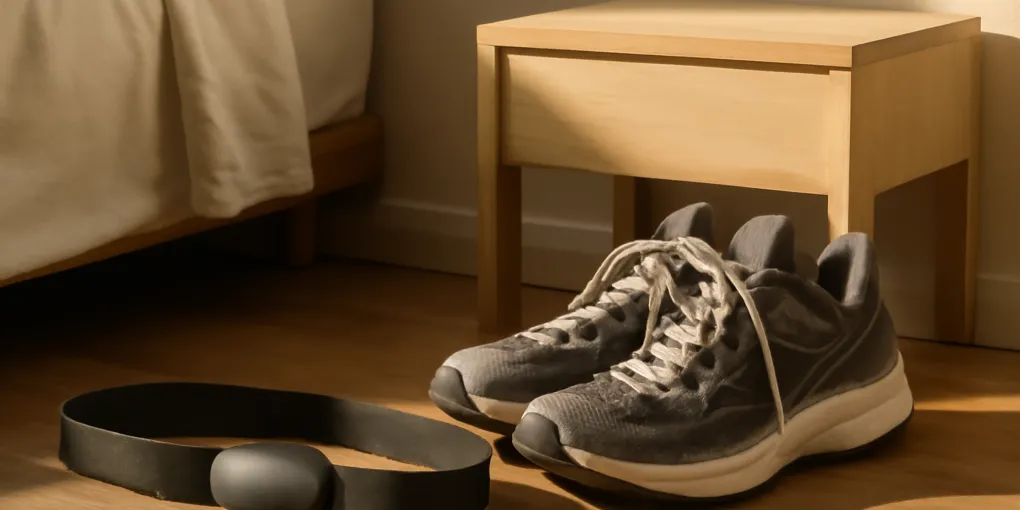
Heart Rate Variability for Training Readiness: What the Morning Number Can and Cannot Tell You
Evidence ExplainerQuick picks
Polar H10 Heart Rate Sensor
★ Top pick Best chest-strap search- Best Use: Users who want a chest strap for controlled morning HRV checks and exercise heart-rate tracking
- Caveat: Requires compatible apps and consistent measurement habits
Garmin HRM-Pro Plus
Best Garmin ecosystem search- Best Use: Garmin users who want a strap that also supports run dynamics and workout data
- Caveat: HRV interpretation still depends on baseline trends, not one morning score
Elite HRV Compatible Chest Strap
Best app-pairing search- Best Use: Morning readiness tracking with apps that support validated strap measurements
- Caveat: Confirm Bluetooth compatibility before buying
Bottom line
Heart rate variability can be useful for training readiness if you treat it as a trend, not a command. A low morning HRV reading can be a nudge to check sleep, stress, soreness, illness, and recent training load. It should not be the only reason you skip or attack a workout. For consistent measurements, start by comparing a Search Amazon for Polar H10 Heart Rate Sensor, Search Amazon for Garmin HRM-Pro Plus, or a Search Amazon for Elite HRV compatible chest strap with the app you plan to use.
The real value is not the number. The value is the routine: measure under similar conditions, watch your baseline, and make calmer training decisions. If the recovery question is soreness rather than readiness, pair this with our foam rolling recovery evidence guide instead of treating HRV as a pain score.
Quick picks
- Controlled morning readings: Search Amazon for Polar H10 Heart Rate Sensor if you want a chest strap for repeatable short HRV checks.
- Garmin ecosystem users: Search Amazon for Garmin HRM-Pro Plus when run dynamics and Garmin workout data also matter.
- App-pairing search: Search Amazon for Elite HRV Compatible Chest Strap if your first constraint is Bluetooth/app compatibility.
What HRV measures
Heart rate variability describes the variation in time between heartbeats. Higher or lower is not universally good or bad. HRV is influenced by autonomic nervous system activity, sleep, alcohol, illness, psychological stress, hydration, menstrual cycle phase, training load, and measurement method.
Most consumer readiness scores simplify that physiology into a color, percentage, or recommendation. That can help with behavior, but it can also create false certainty. Two apps may interpret the same morning differently.
Why athletes track HRV
Endurance and strength athletes use HRV because training stress and life stress overlap. A hard interval session, poor sleep, and a stressful workday can all affect readiness. HRV gives one more signal to compare against subjective notes.
Research on HRV-guided training suggests that individualized endurance plans can perform as well as or sometimes better than fixed plans in some groups. The strongest practical lesson is not that HRV is magical. It is that autoregulation can help when athletes respond to accumulated stress instead of forcing the calendar.
The measurement protocol
Use the same device, same app, and same timing for at least two to four weeks before making strong decisions.
- Measure soon after waking.
- Use the bathroom first if needed, then sit or lie in the same position each day.
- Keep the room quiet and avoid checking messages during the reading.
- Record HRV, resting heart rate, sleep quality, soreness, mood, and planned training.
- Watch the rolling baseline, not one isolated number.
A chest strap is often preferred for short controlled readings because optical sensors can be more sensitive to movement and fit. Some wearables estimate overnight HRV, which can be convenient, but you should still judge consistency and context.
How to interpret a low morning
A single low reading is a question, not a verdict. Ask:
- Did I sleep poorly?
- Did I drink alcohol or eat unusually late?
- Am I getting sick?
- Did yesterday include a hard workout or unusual heat exposure?
- Is resting heart rate also elevated?
- Do I feel unusually flat during warm-up?
If several answers point the same direction, reduce intensity. Swap intervals for easy zone 2, technique work, mobility, or rest. If the number is low but you feel good and the warm-up is normal, proceed conservatively and reassess.
How to use HRV for strength training
Strength training creates neuromuscular fatigue that HRV may not capture perfectly. A powerlifter can have a normal HRV reading and still be locally fatigued from heavy squats. Use HRV alongside bar speed, warm-up feel, joint symptoms, and recent volume.
A practical rule: if HRV is below baseline and warm-up sets feel unusually slow, cut top-set intensity or reduce accessory volume. If HRV is normal but a joint feels irritated, respect the joint.
How to use HRV for endurance training
Endurance athletes can use HRV to decide whether a hard session should stay hard. If HRV is suppressed, resting heart rate is up, and legs feel heavy, turn intervals into easy aerobic work. If HRV is stable and warm-up heart rate behaves normally, the planned session is more defensible.
This fits well with polarized or pyramidal training because easy days stay easy. HRV should not become an excuse to make every green day maximal.
Device features that matter
Raw consistency
A simple consistent measurement beats a fancy score you do not understand. Check whether the app shows trends and lets you add notes.
Sensor fit
Chest straps need moisture and snug contact. Wrist devices need stable placement. Loose sensors create noise.
App compatibility
Before buying a strap, verify Bluetooth or ANT+ support for your phone, watch, or HRV app. Some straps pair with watches but not the app you prefer.
Export and privacy
Health data is sensitive. Review app privacy settings, export options, and account requirements before committing years of data.
Common mistakes
- Changing devices and comparing numbers as if they are interchangeable.
- Reacting to one reading instead of trends.
- Measuring after coffee, messages, or a stressful rush.
- Treating a green score as permission to ignore pain.
- Treating a red score as a diagnosis.
HRV is most useful when it reduces impulsive training decisions. If it makes you anxious every morning, simplify the routine.
HRV FAQ
Is higher HRV always better?
No. Your own baseline matters. Extremely high or unusual readings can also appear during fatigue or measurement error.
Can HRV predict overtraining?
It can contribute to monitoring, but it cannot diagnose overtraining by itself. Persistent performance decline, mood changes, sleep disruption, illness, and training history all matter.
Do I need a chest strap?
Not always. Overnight wearables are convenient. A chest strap is useful when you want a controlled short morning reading with fewer optical-sensor issues.
Should beginners track HRV?
Only if it supports better habits. Beginners often gain more from consistent sleep, progressive training, and easy-day discipline than from another metric.
Sources
- Plews DJ, Laursen PB, Stanley J, Kilding AE, Buchheit M. Training adaptation and heart rate variability in elite endurance athletes. Sports Medicine. 2013. https://pubmed.ncbi.nlm.nih.gov/23852425/
- Vesterinen V, Nummela A, Heikura I, et al. Individual endurance training prescription with heart rate variability. Medicine & Science in Sports & Exercise. 2016. https://pubmed.ncbi.nlm.nih.gov/27015324/
- Buchheit M. Monitoring training status with HR measures: do all roads lead to Rome? Frontiers in Physiology. 2014. https://www.frontiersin.org/articles/10.3389/fphys.2014.00073/full
- Task Force of the European Society of Cardiology and the North American Society of Pacing and Electrophysiology. Heart rate variability standards of measurement. Circulation. 1996. https://pubmed.ncbi.nlm.nih.gov/8598068/