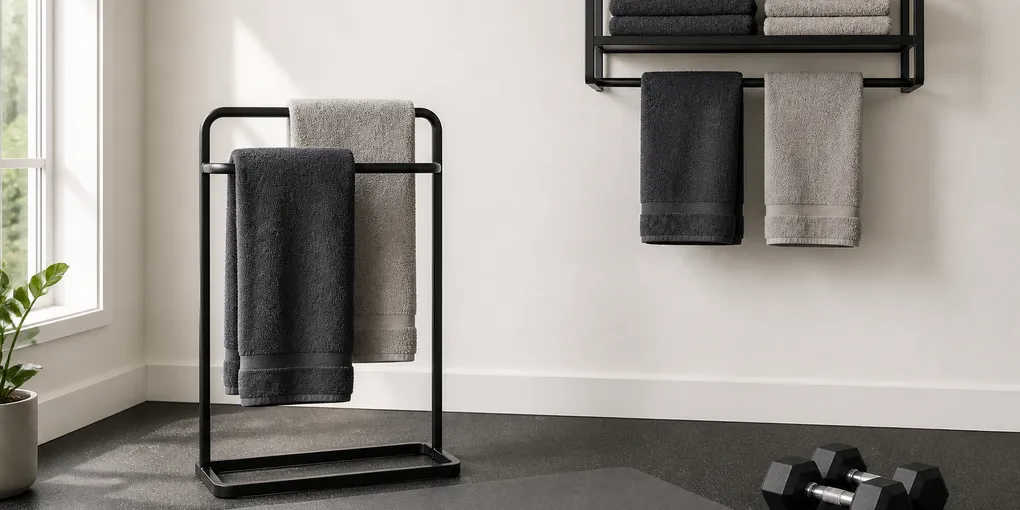
Home-Gym Towel Racks: Freestanding vs. Wall-Mounted
Evidence ExplainerIf clean towels keep landing on the bench because the nearest storage is across the room, choose a rack by the surface your gym can spare. A freestanding rack uses a rectangle of floor and can move when the room changes. A wall-mounted rack preserves that floor but needs uninterrupted wall width and still projects into the room. Measure both spaces before comparing styles.
Find the reach point first
Stand where you usually need a towel: beside the mat, near the bench, or on the way into the room. The useful rack location is close enough to reach without putting its base or shelf in the normal path.
Mark four things on a quick room sketch:
- The mat, bench, or equipment area that must remain clear.
- The walking line from the door to the workout area.
- An open floor rectangle where a stand could park.
- An uninterrupted wall span for a rail or shelf.
This often settles the first part of the choice. A small gym with open wall but crowded floor points toward a mounted format. A multipurpose room with little clear wall and a floor corner that changes jobs may favor a stand that can be repositioned.
Compare the whole outline
The word “stand” says little about size. Valsan lists its Sensis rail at 18 inches long, 7 1/2 inches deep, and 35 1/2 inches high. VASAGLE lists a larger freestanding rack at 23.6 inches wide, 11.8 inches deep, and 41.3 inches high. Those examples describe two products rather than a standard size.
The same caution applies on the wall. KWC’s CUBUS double rack technical sheet lists a 600 mm width and a 220 mm depth for one shelf-and-rail arrangement. A mounted rack leaves the floor open while its shelf and rails still extend into the room.
Use the largest dimensions on the current product drawing:
| Space to protect | Freestanding rack | Wall-mounted rack |
|---|---|---|
| Floor | Base depth, overall width, and any rail overhang | Floor remains open; keep the route below the rack usable |
| Wall | Clearance behind and around the stand | Full rack width between mirrors, switches, doors, and windows |
| Room projection | Furthest rail or shelf edge | Published depth from the wall |
| Reach | Rail height and access from the workout area | Mounted position and shelf or rail layout |
A narrow base can sit beneath wider rails. A simple-looking wall rail can have a shelf that projects farther than expected. Copy the dimensions instead of tracing the product photo.
Match the rack to the towels you keep there
A rail handles a draped towel. A shelf handles folded towels. A shelf-and-rail combination can separate the two, but only if the shelf depth and rail arrangement match the way you plan to use them.
Count the actual towels and note whether they will be folded or draped. Marketing photos show styling; towel thickness, rail length, space between rails, and the fold determine how much room each one uses.
Then picture the two moments that matter. Where will a clean towel wait before a session? Where will a used towel go afterward? A rack that is convenient for the first moment but awkward for the second may simply move the pile from the bench to another surface.
Protect the floor path
The open corner beside a mat may already be working floor. Unroll the mat, adjust the bench, and open the nearby door or cabinet while the proposed rack outline is marked.
- A stand near the mat may be easy to reach but share the mat’s edge when it is in use.
- A stand by the entry may fit against the wall while its rails reach into the doorway.
- A mounted rack above a low cabinet can preserve floor space, but the shelf must remain reachable around the cabinet depth.
- In a guest room or office that doubles as a gym, a freestanding rack can move with the furniture; a mounted rack keeps the selected wall position.
Painter’s tape can show the floor rectangle for a stand and the outward edge of a wall shelf. Walk the room with the outline in place. Choose the rack that preserves the movements you already make instead of chasing an abstract “small footprint.”
Put the two choices on one record
Use the same notes for any freestanding and wall-mounted candidates:
| Record | What to copy or measure |
|---|---|
| Clear floor rectangle | Width and depth after equipment and the walking path are in place |
| Clear wall span | Width between fixtures, trim, mirrors, doors, and windows |
| Product projection | Stand depth or mounted depth from the wall |
| Total outline | Overall width and height, including overhanging rails or shelves |
| Towel arrangement | Folded, draped, or both |
| Reach point | Where clean and used towels enter the routine |
If both formats fit, choose the one that keeps the reach point convenient with fewer conflicts. If only one outline fits, the room has already made most of the decision.
Evidence boundary
This comparison uses current manufacturer dimensions as examples; it does not test the racks, measure a particular home gym, establish capacity, or provide mounting advice. Dimensions and included parts can change. Check the current technical information and instructions for the exact product, especially before any wall-mounted installation.
Frequently asked questions
Does a freestanding towel rack take more room than a wall-mounted rack?
A freestanding rack has a floor footprint, while a wall-mounted rack uses wall width and projection. Compare the published width, depth, and height of the specific format with the room’s clear floor and wall space.
What should I measure before choosing a home-gym towel-rack format?
Measure the floor rectangle available for a stand, the usable wall span for a mounted format, how far either option projects into the room, and the path to the equipment and exit.
Can the same towel rack work for folded and hanging towels?
It depends on the product layout. A rail is for hanging, while a shelf can hold folded towels. Check the product’s published dimensions and layout rather than assuming every rack supports both arrangements.