Infrared Thermometer Heat-Training Protocol: Measure the Room Before You Trust the Workout
ProtocolQuick picks
Etekcity infrared thermometer style temperature gun
★ Top pick- Best for: Checking floor, bench, mat, and surface heat before garage or patio training
- Check first: Measures surface temperature, not core body temperature or full heat stress
Govee or ThermoPro room temperature humidity monitor
- Best for: Tracking room temperature and humidity across hot home-gym sessions
- Check first: Does not replace wet-bulb globe temperature for occupational heat-risk assessment
Bottom line
An infrared thermometer can make hot-weather training more concrete, but it is not a safety shield. It tells you whether the rubber floor, metal dumbbell handle, sauna bench, or patio surface is hotter than expected. It does not measure your core temperature, dehydration status, or heat-illness risk.
For a garage gym, pair See current Etekcity-style infrared thermometer prices on Amazon with See current Govee or ThermoPro temperature monitor prices on Amazon. The useful setup is surface temperature plus room heat plus symptoms, not one gadget number.
Quick picks
- Surface check: Search Amazon for an Etekcity infrared thermometer to spot hot mats, handles, benches, and patio surfaces.
- Room trend check: Search Amazon for a Govee or ThermoPro temperature humidity monitor to track the air you are actually training in.
- Skip the gadget-first approach if you have heat illness history, concerning symptoms, or medication questions that need clinician guidance.
The three-number heat check
Before a hot session, write down three numbers:
- Room temperature and humidity from a small monitor.
- Surface temperature from the mat, bench, and handles you will touch.
- Your starting body weight if the session will be long or sweaty.
The CDC and NIOSH heat-stress materials emphasize that heat risk is not just air temperature. Work intensity, humidity, clothing, acclimatization, hydration, and medical factors all matter. A small room sensor and surface thermometer cannot replace wet-bulb globe temperature, but they are better than guessing from vibes.
When to use the infrared thermometer
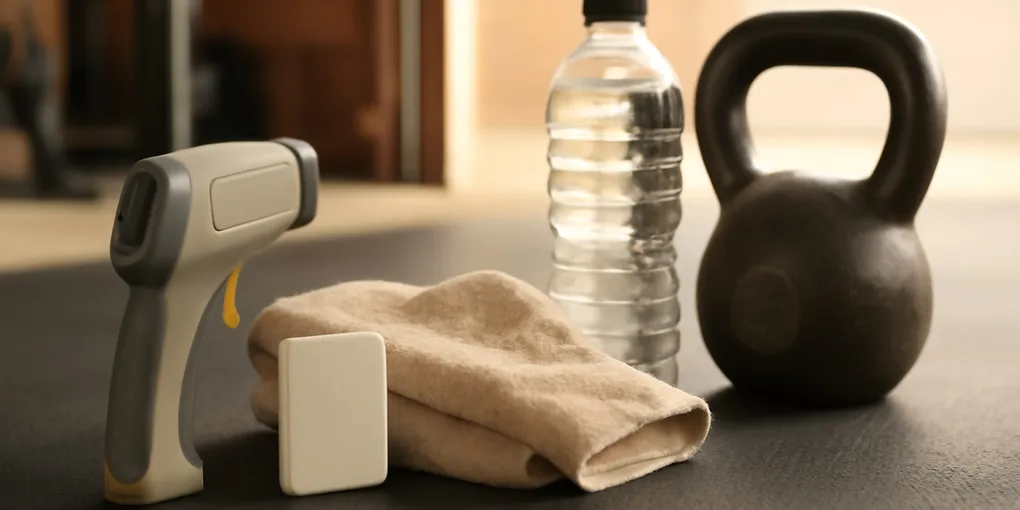
Use it before sessions in garages, sheds, patios, saunas, and sun-exposed home gyms. Check black rubber flooring, metal dumbbells, kettlebell handles, benches, and any surface your skin may touch. Dark equipment can be much hotter than the air.
Use it after cooling changes too. If opening the door, adding a fan, or moving a mat into shade lowers surface temperature, you have changed the training environment in a measurable way. That is more useful than arguing whether the room feels fine.
What the thermometer cannot tell you
It cannot tell you whether you are acclimated. It cannot tell you whether medication, poor sleep, illness, alcohol, or dehydration has changed your tolerance. It cannot approve hard intervals in a hot garage. It also cannot measure shiny metal accurately unless you understand emissivity and reflective surfaces.
If you feel chills, confusion, unusual weakness, severe headache, stopped sweating with heat symptoms, chest pain, faintness, or vomiting, stop the session and seek urgent help. Do not keep checking the thermometer while symptoms escalate.
Practical score
A surface thermometer plus room monitor scores 8.1/10 for hot home-gym decision support. Surface-risk visibility is 25% of the score, room trend tracking 25%, ease of use 20%, price 15%, limitations clarity 10%, and durability 5%.
The score drops if you treat the gadget as permission to train harder. The best use is conservative: shortening sessions, moving equipment, adding shade, or choosing an indoor workout when the room is too hot and humid.
First-week protocol
Run this for one week before deliberately adding heat stress.
- Day 1 to 2: Measure the room and surfaces, then train at normal intensity only if symptoms are absent.
- Day 3 to 4: Compare morning, afternoon, and evening room readings. Pick the cooler training slot when possible.
- Day 5: Weigh before and after a normal sweaty session. Large body-weight drops suggest you need a hydration plan before harder heat exposure.
- Day 6 to 7: Decide whether heat adds anything useful. Many people get a better workout by cooling the room instead of proving toughness.
For actual heat acclimation, use a planned progression, lower intensity at first, and recovery days. Our heat acclimation protocol for summer workouts covers that bigger training decision.
Buying details
Choose an infrared thermometer with a clear display, adjustable emissivity if you will measure mixed materials, and a temperature range that covers hot surfaces. For room monitoring, choose a sensor that shows both temperature and relative humidity. App history is convenient but not essential.
Do not pay extra for a forehead thermometer if your use case is equipment and surface checks. Do not use a hardware temperature gun for medical fever decisions unless the manufacturer specifically designed it for that purpose.
Product setup that actually helps
Put the room monitor where you train, not beside an open door or fan. If the sensor sits in the coolest corner, it will understate the workout environment. Check it before warm-up and again halfway through longer sessions. Heat can climb in a closed garage even after the sun moves.
For the infrared thermometer, measure the same surfaces each time: rubber mat, dumbbell handle, bench pad, and floor near the door. A repeatable checklist shows trends. Random readings from different angles do not. If a kettlebell handle is too hot to grip comfortably, switch equipment or delay the session.
How to pair heat data with training choices
Use the readings to make one conservative decision. Shorten the workout, lower intensity, add rest, move indoors, or train earlier. Do not add hard intervals because the numbers look acceptable. Heat strain rises when intensity and environment stack together, which is why the safest change is often reducing the workout demand.
If your goal is aerobic fitness rather than heat adaptation, a cooler session may be better. Our incline walking zone 2 protocol is a useful alternative when outdoor heat makes running or garage conditioning a poor tradeoff.
Heat-Training Thermometer FAQ
Is a fan enough for garage-gym heat?
A fan helps sweat evaporate, but it does not erase high humidity or extreme room heat. Track symptoms and session difficulty, not just airflow.
Should I train in a sauna?
Exercise in a sauna adds heat stress quickly and is not a default recovery practice. If you use a sauna, keep exercise minimal, avoid hard intervals, and leave at the first concerning symptom.
Does a room sensor replace wet-bulb globe temperature?
No. Wet-bulb globe temperature is a more complete heat-stress measure. A consumer room sensor is a practical home screen, not an occupational heat-safety instrument.
Sources
- CDC/NIOSH: Heat stress
- CDC: Heat and athletes
- National Athletic Trainers’ Association: Exertional heat illnesses position statement
Frequently Asked Questions
- Most hardware-style infrared guns are for surfaces, not clinical core temperature. Use them for benches, floors, walls, and equipment, not medical decisions.
- Track room temperature, humidity, session duration, perceived exertion, body-weight change, symptoms, and whether surfaces are hot enough to burn or impair grip.
- People with heat illness history, cardiovascular disease, pregnancy, fever, certain medications, or clinician restrictions should avoid unsupervised heat stress.