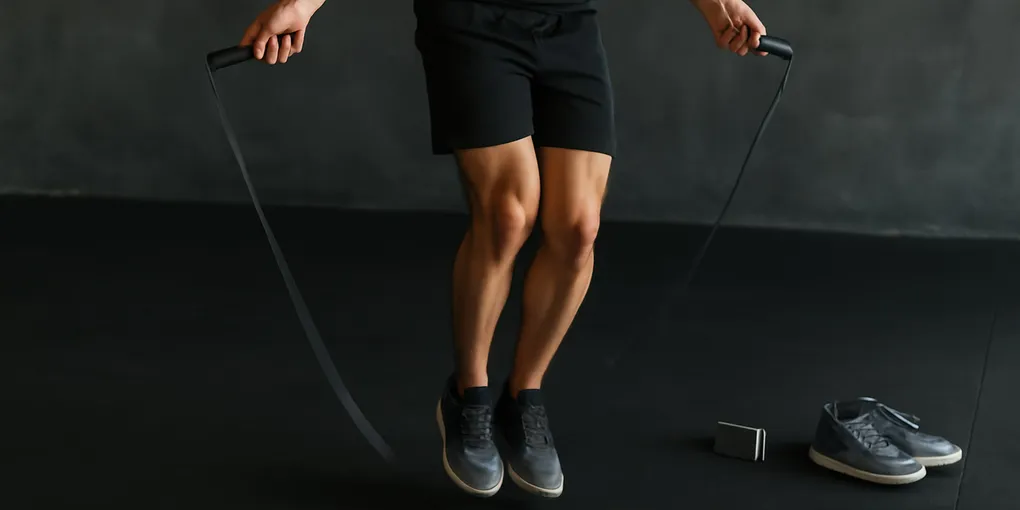
Jump Rope Interval Protocol: Conditioning Without Turning Your Calves Into a Complaint Department
ProtocolQuick picks
| Product | Key Specs |
|---|---|
| See price on Amazon |
|
| See price on Amazon |
|
| See price on Amazon |
|
Product availability, certifications, and retailer details can change; check the current Amazon page before buying.
Jump rope is efficient because it is unforgiving. A few minutes can raise heart rate, sharpen rhythm, and expose lower-leg capacity. That is also the problem. Beginners often treat it like harmless cardio, then wonder why calves, arches, or Achilles tendons complain two days later.
If you are learning rhythm, search Amazon for beaded jump ropes. If you already have timing and want a simple conditioning tool, search Amazon for PVC speed ropes. If shin strength is your limiting factor, compare loading tools in our tib bar buyer guide rather than adding more jumps.
Practical score
| Factor | Weight | Score | Rationale |
|---|---|---|---|
| Research | 30% | 6.0 | Rope skipping can improve conditioning and coordination, but protocols vary and injury risk depends heavily on dose. |
| Evidence Quality | 25% | 5.7 | Evidence supports jump rope as vigorous activity, not one perfect interval recipe. |
| Value | 20% | 9.0 | A rope is cheap, portable, and easy to store. |
| User Signals | 15% | 7.0 | People quit when the rope is too light, the surface is bad, or calf soreness spikes. |
| Transparency | 10% | 8.0 | Length, cable material, and handle style are easy to check before buying. |
| Composite | 100% | 6.8 | Excellent low-cost conditioning if progression is slower than your lungs want. |
The beginner interval plan
Use this twice per week for the first three weeks.
- Warm up with 5 minutes of brisk walking, easy cycling, or light bodyweight movement.
- Do 10 rounds of 20 seconds jumping and 40 seconds rest.
- Keep jumps low. Think quiet feet and soft knees.
- Stop the session if form collapses, calf tightness changes your landing, or foot pain appears.
- Finish with easy walking for 3 to 5 minutes.
That is only 3 minutes and 20 seconds of actual jumping. It may feel too easy while you are breathing hard enough to want more. Resist that urge for the first two weeks. Lower-leg tissues often complain later, not during the first session.
After three symptom-stable weeks, progress to 12 rounds, then 15 rounds. Another option is 30 seconds jumping and 30 seconds rest for 8 to 12 rounds. Do not increase both interval length and total rounds in the same week.
How to size and choose a rope
Step on the center of the rope and pull the handles upward. For many beginners, handles reaching roughly armpit height is a useful starting point. Too long forces a big arc and sloppy shoulders. Too short punishes timing before you have rhythm.
A beaded rope is easiest to feel. The beads provide feedback as the rope turns and hits the floor. That helps beginners learn timing. A PVC speed rope is lighter and faster but can be harder to sense. A wire speed rope is not the first buy for general fitness unless double-unders are the specific goal.
For most home users, a beaded rope or PVC rope is enough. Avoid weighted ropes until your calves and shoulders tolerate regular sessions. Heavier ropes turn conditioning into a grip and shoulder workout quickly.
Surface and shoe rules
Concrete is harsh on ropes and legs. A wood gym floor, rubber gym floor, outdoor track surface, or stable exercise mat is friendlier. If you jump at home, search Amazon for rubber exercise mats and choose a mat that will not slide.
Shoes should feel stable and not overly tall. Very soft running shoes can feel wobbly for repeated bouncing. Barefoot jumping is not a beginner shortcut; it raises the load on feet and calves.
The American College of Sports Medicine classifies rope jumping as vigorous activity in many contexts and recommends adults accumulate aerobic and strengthening activity over the week (https://www.acsm.org/education-resources/trending-topics-resources/physical-activity-guidelines). Use jump rope as one conditioning option, not the only weekly movement.
Who should be cautious
Be careful if you have Achilles tendinopathy, plantar fasciitis, stress-fracture history, uncontrolled joint pain, balance problems, or recent lower-limb injury. You may still use rope later, but the first step may be walking, cycling, calf raises, or clinician-guided loading.
Pain location matters. General calf fatigue is expected. Sharp Achilles pain, focal shin pain, arch pain that changes your gait, numbness, or swelling is a stop sign. The AAOS shin-splints guidance links repeated impact and sudden training changes to lower-leg pain patterns (https://orthoinfo.aaos.org/en/diseases—conditions/shin-splints/). Jump rope is exactly the kind of repeated impact that needs careful ramping.
Four-week progression
Week 1 is practice: 10 rounds of 20 seconds on and 40 seconds off, twice weekly. Week 2 repeats the same structure unless soreness was minimal. Week 3 can move to 12 rounds. Week 4 can move to 15 rounds or to 30 seconds on and 30 seconds off for 8 rounds, but not both.
Keep one day between rope sessions at first. If you also sprint, play court sports, or hike hills, count those as lower-leg loading days. Rope contacts are not free just because the tool is small enough to fit in a drawer.
Jump rope FAQ
Is jump rope better than running?
It is different. Jump rope is space-efficient and coordination-heavy. Running is easier to scale for longer aerobic work. Many people use rope for short conditioning blocks and running or walking for volume.
Why do my calves get sore from jump rope?
Every jump uses the calf-Achilles complex to store and release force. Beginners often jump too high, stay too stiff, or add too many contacts before tissues adapt.
Should I learn double-unders first?
No. Build single-bounce rhythm, quiet landings, and calf tolerance first. Double-unders add speed and impact before many beginners have the basics.
Frequently Asked Questions
- Start with two days weekly and short intervals. Add minutes only if calves, Achilles tendons, and feet tolerate the dose.
- Yes, it can raise heart rate quickly, but the limiting factor for beginners is often lower-leg tolerance rather than lungs.
- A beaded or slightly heavier PVC rope is usually easier to learn than an ultralight speed rope.