How to Use Protein Powder for Satiety Without Overdoing Calories
ProtocolQuick picks
| Product | Key Specs |
|---|---|
| See price on Amazon |
|
| See price on Amazon |
|
| See price on Amazon |
|
Product availability, certifications, and retailer details can change; check the current Amazon page before buying.
The goal: fullness, not a bigger smoothie
Use this protein powder satiety protocol product comparison as the buying shortlist, then read the article sections for the evidence limits, fit notes, and safety caveats that decide whether a pick belongs in your routine.
Protein powder can be helpful for satiety because protein is generally more filling per calorie than refined carbohydrate or fat. Higher-protein diets can also help preserve lean mass during weight loss when paired with resistance training. (PMID: 18469287)
But a shake can quietly become a 700-calorie dessert if you add nut butter, honey, whole milk, oil, and oversized scoops. The protocol below uses protein powder as a structured ingredient, not a permission slip to drink unlimited calories. (PMID: 25926512)
How we score this protocol
We use a 100-point composite score for nutrition protocols: Research fit 30%, evidence quality 25%, value 20%, user signals 15%, and transparency 10%. Research fit is high because protein, satiety, lean-mass retention, and resistance training are well-studied together. Evidence quality is moderate to high because the direction is consistent, while exact protein targets vary by body size, age, calorie deficit, and training. Value is high because protein powder can be cost-effective when it replaces more expensive convenience foods. User signals are practical: fullness after three hours, digestive tolerance, taste fatigue, and ease of preparation. Transparency is high because this article treats powder as food, not as a magic appetite suppressant, and tells readers to verify labels, servings, testing claims, and return policy before buying. (PMID: 23107521)
Step 1: Set the meal protein target
For satiety, a useful starting target is 25 to 35 grams of total protein at breakfast or a snack-replacement meal. That does not mean 35 grams from powder alone. Greek yogurt plus half a scoop may get you there. Eggs plus a small shake may get you there. A plant-based breakfast may need a full serving of powder. (PMID: 21452477)
If you are older, dieting, or lifting weights, protein distribution across meals becomes more important. Research on protein and muscle protein synthesis suggests that evenly distributed protein meals can be more useful than saving most protein for dinner. (PMID: 24038242)
Step 2: Choose the powder for your tolerance
Whey is popular because it is leucine-rich, mixes well, and has strong sports-nutrition evidence. Whey isolate may be easier for some people with lactose sensitivity, though it is not automatically lactose-free for everyone.
Plant proteins can work well too, especially blends based on pea, rice, soy, pumpkin seed, or other complementary sources. The tradeoff is texture. Some blends are chalky, some are sweetened heavily, and some require a larger serving to match the amino acid profile of whey.
Useful search links:
Step 3: Add volume and fiber
A water-only protein shake may be convenient after training, but it is not always the most filling option. Satiety often improves when you add volume, viscosity, and chewing. (PMID: 28919842)
Try one of these templates:
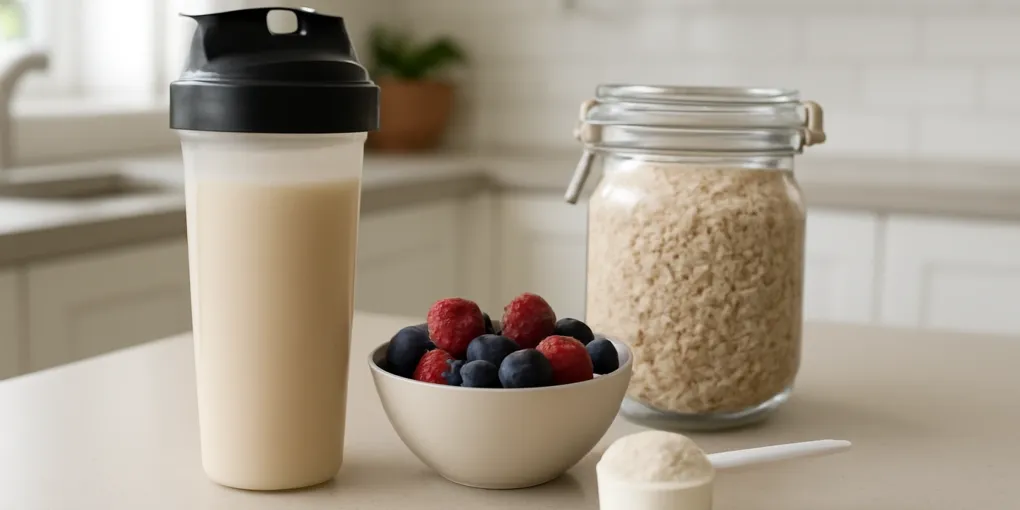
Breakfast bowl
- 1 serving Greek yogurt or soy yogurt
- 1/2 to 1 serving protein powder
- Berries
- Oats or high-fiber cereal
- Cinnamon
Simple shake
- 1 serving protein powder
- Unsweetened milk or water
- Frozen berries
- 1 tablespoon chia or ground flax
- Ice for volume
High-fiber add-on
Psyllium can increase viscosity, but it must be used carefully. Start with a small amount, drink enough fluid, and separate it from medications when appropriate.
Search link: psyllium husk powder on Amazon
Step 4: Audit the hidden calories
Protein powder is rarely the problem by itself. The add-ins are where plans drift:
- 2 tablespoons peanut butter: about 180 to 200 calories
- 1 tablespoon oil: about 120 calories
- 1 cup whole milk: about 150 calories
- Honey or syrup: easy to overshoot
- Large smoothie-shop portions: often meal-sized or larger
If the goal is weight management, build the shake in a tracker once. You do not need to track forever, but a single audit helps calibrate portions.
Step 5: Use a three-hour hunger check
After the meal, ask one practical question: am I comfortably satisfied for the next three hours?
If hunger returns quickly, add fiber or whole-food volume before adding more fat. If you feel overly full or sluggish, reduce add-ins. If the shake triggers cravings, use a less dessert-like flavor or turn the protein into a bowl with fruit and yogurt. (PMID: 30822749)
Step 6: Pair it with resistance training
Protein works best when your body has a reason to use it. Resistance training provides that signal. If you are using protein powder during weight loss, two to four strength sessions per week can help preserve lean mass and support long-term metabolic health. (PMID: 32183423)
Why liquid calories can be tricky
Protein is filling, but drinking calories is not always as satisfying as chewing food. A thin shake can disappear in two minutes, while a bowl with yogurt, fruit, oats, and protein powder takes longer to eat and provides more sensory feedback. (PMID: 34201703)
That does not mean shakes are bad. It means the form should match the goal. If the goal is post-workout convenience, a simple shake is fine. If the goal is appetite control until lunch, build more structure around it.
The 25 to 35 gram protein target in context
A smaller adult may feel satisfied with the low end of the range. A larger adult, older adult, or resistance-trained person may need more total daily protein. The point is not to hit one universal number. The point is to avoid the common pattern of a low-protein breakfast followed by intense afternoon hunger. (PMID: 37030593)
If you already eat a high-protein breakfast, powder may be unnecessary. If breakfast is toast and coffee, adding protein can be a major improvement. (PMID: 41063276)
Better shake formulas
The lean convenience shake
Use this when you need fast protein with minimal calories:
- Water or unsweetened almond milk
- One serving protein powder
- Ice
- Cinnamon or unsweetened cocoa
This is not the most filling option, but it is simple.
The satiety shake
Use this when the shake needs to act like a small meal:
- One serving protein powder
- Unsweetened milk or soy milk
- Frozen berries
- Chia, flax, or oats
- Ice for volume
The fiber and volume slow the experience down and often improve fullness.
The high-calorie athlete shake
Use this only when gaining weight or fueling heavy training:
- Protein powder
- Milk
- Banana
- Peanut butter
- Oats
This can be useful for athletes, but it is not the right default for weight management.
Digestive tolerance checklist
Protein powder can fail because of digestion, not because the idea is wrong. If you feel bloated, try one change at a time:. (PMID: 18469287)
- Switch from whey concentrate to whey isolate
- Try a plant blend instead of dairy
- Reduce sugar alcohols
- Use half a serving twice per day
- Mix with water instead of milk
- Reduce added fiber, then rebuild slowly
Do not add psyllium, chia, flax, and a new protein powder all on the same day. If your stomach rebels, you will not know which ingredient caused it.
How to use this during weight loss
The simplest strategy is replacement, not addition. Replace a low-protein snack or breakfast with a structured high-protein option. Do not add a shake on top of your usual intake and expect fat loss automatically.
A useful check is the three-day average. If protein powder helps you eat fewer calories across the day without feeling deprived, it is working. If it simply adds calories, it is not. (PMID: 25926512)
How to use this for muscle retention
During a calorie deficit, resistance training and adequate protein help protect lean mass. Protein powder can make the protein target easier, especially when appetite is low or schedules are chaotic. Pair the shake with training, but do not obsess over a narrow anabolic window. Total daily intake and consistency matter more. (PMID: 23107521)
Buying tips
Choose a powder with a clear serving size, protein grams per serving, and ingredient list. If you compete in tested sports, look for third-party certification. If sweetness triggers cravings, choose unflavored or lightly sweetened options.
Most people do not need collagen as their primary protein powder for satiety or muscle retention because collagen is not a complete protein. It can have other uses, but it is not the best default here. (PMID: 21452477)
Example day templates
Weight-management breakfast
A practical breakfast could be Greek yogurt, berries, a half serving of protein powder, and oats. This gives protein, fiber, and chewing. It is more likely to carry someone to lunch than a sweet coffee drink and pastry.
Post-workout convenience
After training, use one serving of protein powder with water or milk, then eat a normal meal later. This is useful when appetite is low immediately after exercise. It is not mandatory if a protein-rich meal is already planned.
Travel backup
Pack single-serving protein powder and buy fruit or yogurt at the destination. This prevents the common travel pattern of skipping protein early, then overeating later because hunger becomes urgent. (PMID: 24038242)
How to choose between whey, casein, and plant protein
Whey mixes easily and is leucine-rich, which makes it a strong default for muscle protein synthesis. Casein digests more slowly and can work well in thicker bowls or evening snacks. Plant proteins are best for dairy-free diets, but the blend matters. Soy, pea-rice blends, and other mixed sources can be practical. (PMID: 28919842)
Taste matters because adherence matters. The most evidence-based powder is useless if it sits in the pantry. Buy small tubs or sample packs first when possible.
Sweeteners, flavors, and cravings
Some people do fine with sweet flavors. Others find that dessert-like shakes increase cravings. If that is you, switch to vanilla, unflavored, or lightly sweetened options. Add cinnamon, cocoa, or berries instead of turning the shake into a milkshake.
Sugar alcohols can cause gas or bloating. If digestion is a problem, compare labels. A shorter ingredient list may work better than a product marketed with many functional add-ins.
Common mistakes
The first mistake is treating protein powder as negative calories. It still counts. The second is replacing balanced meals with low-fiber shakes too often. The third is using collagen as the main protein source for muscle goals. The fourth is ignoring total daily eating patterns.
A better approach is boring: decide when powder solves a real problem, use the smallest effective serving, add fiber when fullness matters, and keep whole foods as the default.
When not to use protein powder
Skip it if it crowds out foods you tolerate and enjoy, worsens digestion, or becomes a way to avoid addressing meal structure. People with kidney disease, complex medical conditions, eating-disorder history, or medically prescribed diets should get individualized advice before raising protein intake substantially. (PMID: 30822749)
Evidence notes
Key sources:
- Westerterp-Plantenga MS et al. Dietary protein, weight loss, and weight maintenance. Annual Review of Nutrition. 2009. https://doi.org/10.1146/annurev-nutr-080508-141056
- Morton RW et al. Protein supplementation and resistance training: systematic review and meta-analysis. British Journal of Sports Medicine. 2018. https://doi.org/10.1136/bjsports-2017-097608
- Leidy HJ et al. The role of protein in weight loss and maintenance. American Journal of Clinical Nutrition. 2015. https://doi.org/10.3945/ajcn.114.084038
Related reading
- For breakfast use cases, start with our morning smoothie protein powder guide.
- Compare digestion speed and meal timing in our whey vs casein protein breakdown.
- If digestive tolerance is the limiting factor, see our protein powders for sensitive stomachs guide.
Bottom line
Protein powder can support satiety when it helps you hit a reasonable protein target with fewer decision points. Keep the dose boring, add fiber or whole-food volume, audit the calorie-dense extras, and judge success by how you feel several hours later. (PMID: 32183423)
Frequently Asked Questions
- Usually no. Whole foods often provide more chewing, volume, and micronutrients. Protein powder is useful when convenience helps you hit a protein target.
- Most adults can start with one serving that provides about 20 to 30 grams of protein, then adjust based on meal protein, body size, training, and clinician guidance.
- Yes, but increase slowly. Psyllium, chia, oats, berries, and ground flax can improve fullness for some people, but too much too quickly can cause bloating.