Quick picks
| Product | Key Specs |
|---|---|
| See price on Amazon |
|
| See price on Amazon |
|
Product availability, certifications, and retailer details can change; check the current Amazon page before buying.
The goal is protected sleep, not a perfect circadian clock
Night shifts ask the body to sleep when daylight, household activity, and social obligations are pulling the other way. The realistic goal is not to “hack” yourself into loving a 9 a.m. bedtime. It is to protect enough predictable sleep that work, driving, mood, and metabolic health do not steadily deteriorate.
Light is the strongest timing cue you can control, but it needs a schedule. Bright light at the wrong time can make daytime sleep harder. Darkness after the shift can help, but it cannot fully undo a rotating roster or repeated short sleep. The most useful plan is built around your actual shift start, commute, and next required wake time.
For an indoor light option, check current 10,000-lux lamp options. For a portable darkness layer, check blackout sleep mask options. Confirm the product instructions, return policy, fit, and any eye-health precautions before buying.
Start by naming your shift pattern
A stable run of nights is different from a single overnight shift followed by days off. Write down the start and end times for the next seven days, including commute, childcare, meals, and the earliest time someone can wake you. If shifts rotate every few days, full circadian adaptation may be unrealistic; the safer aim is often damage control: a protected core sleep block, a planned nap, and less morning light on the way home.
The American Academy of Sleep Medicine identifies shift-work disorder as insomnia or excessive sleepiness tied to a work schedule that overlaps normal sleep time. That diagnosis belongs with a clinician. Persistent drowsy driving, near misses, falling asleep unintentionally, or insomnia despite a genuine protected sleep opportunity are reasons to ask for evaluation rather than buy another lamp.
A repeatable night-shift sequence
Before work, wake at a planned time rather than drifting until the last possible minute. Get light while you are preparing for work or eating. A bright-light device can be useful before or in the earlier portion of a night shift when outdoor light is not available. Position it as the manufacturer directs; do not stare into it.
During the shift, use the brightest environment earlier rather than immediately before the commute home. Caffeine can be useful at the start of a shift, but set a cutoff early enough that it is less likely to follow you into the sleep block. The correct cutoff varies by person and shift time; it is not automatically “none after midnight.” Track what happens to your sleep onset when you change it.
After work, reduce light exposure for the commute and arrival home when that can be done safely. Dark wraparound glasses may be practical outdoors, but driving visibility comes first. Eat a light, familiar meal if hungry, complete a short wind-down routine, and enter a cool, dark room. Avoid turning the post-shift hour into scrolling, errands, or a difficult conversation when possible.
Build the room for daytime sleep
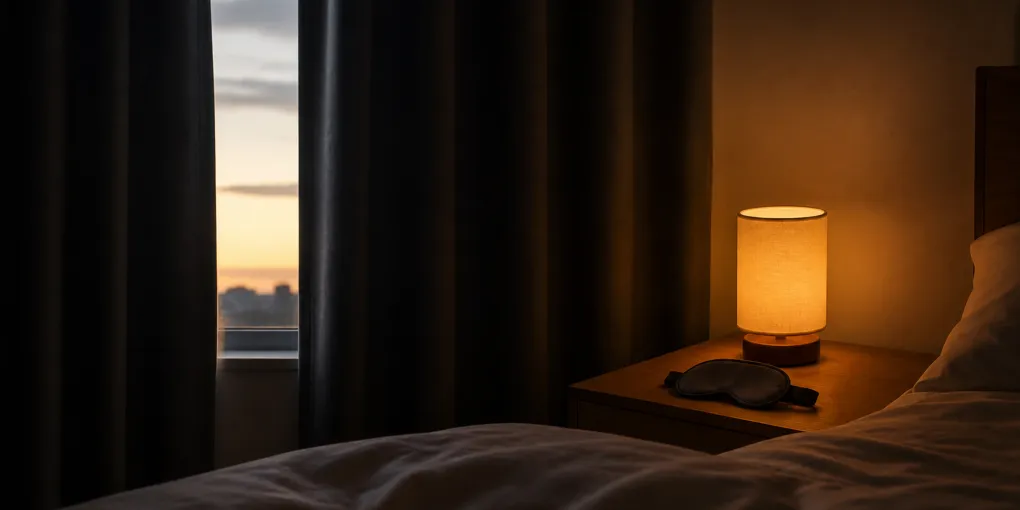
Blackout curtains deal with windows; an eye mask helps with gaps, travel, or a shared household. Neither solves a hot room, door slams, notification sounds, or a phone vibrating beside the pillow. Use the combination that fits the real problem: curtains or temporary window coverage, a quiet-mode phone, a fan or steady sound source if it helps, and a household agreement about the protected hours.
Do not use alcohol as a sleep aid after a shift. It can make sleep onset feel easier while fragmenting sleep later and worsening dehydration or reflux. Heavy meals immediately before bed may do the same. If hunger is the issue, make the meal smaller and predictable rather than treating sleep as a reward for skipping food.
Naps and days off
A short pre-shift nap can be more useful than trying to bank sleep with an all-day lie-in. Give yourself time to clear sleep inertia before driving or handling safety-critical work. If you wake confused or groggy after long naps, shorten the experiment rather than assuming more sleep is the answer.
Days off create the hardest tradeoff. A full flip back to daytime life can be socially appealing but may leave the next night shift painful. Some workers do better with an “anchor” sleep block kept at a similar time on workdays and off days, then add a second sleep period or nap. Try one pattern for a week before judging it; changing every day makes it impossible to tell what helped.
For a non-shift schedule, our morning bright light protocol explains why the standard advice is different. For bedroom darkness, see sleep mask protocol for light blocking.
When a product is the wrong next step
Avoid self-directed bright-light treatment until you have clinical advice if you have bipolar disorder, retinal disease, recent eye surgery, a photosensitizing medication, or light-triggered migraine. Stop if it causes eye pain, agitation, unusual mood elevation, or severe headache. A lamp also cannot fix untreated sleep apnea, restless legs, depression, or a schedule with no adequate sleep opportunity.
If you feel sleepy while driving home, do not treat that as a willpower test. Use a safe alternative: a ride, a rest before driving, or a supervisor-supported fatigue plan. Repeated drowsy driving is a medical and occupational-safety problem.
Shift-work sleep FAQ
Should I use bright light after a night shift?
Usually that is the time to reduce light on the way toward daytime sleep, not add it. The correct plan depends on whether you are trying to stay on nights or rapidly return to days, so use a schedule-specific approach.
Does a sleep mask replace blackout curtains?
No. A mask is portable and helpful for small leaks, but curtains control the whole room and may be more comfortable for long sleep periods. Use both if light is a recurring problem.
Can melatonin fix night-shift sleep?
It may be appropriate in some cases, but timing, dose, interactions, and next-day drowsiness matter. Ask a clinician or pharmacist rather than copying a social-media schedule.
Sources
- American Academy of Sleep Medicine, clinical practice guidance on circadian rhythm sleep-wake disorders: https://jcsm.aasm.org/doi/10.5664/jcsm.5100
- CDC/NIOSH, training for nurses on shift work and long work hours: https://www.cdc.gov/niosh/work-hour-training-for-nurses/about.html
- Related reading: morning bright light protocol and sleep optimization guide.