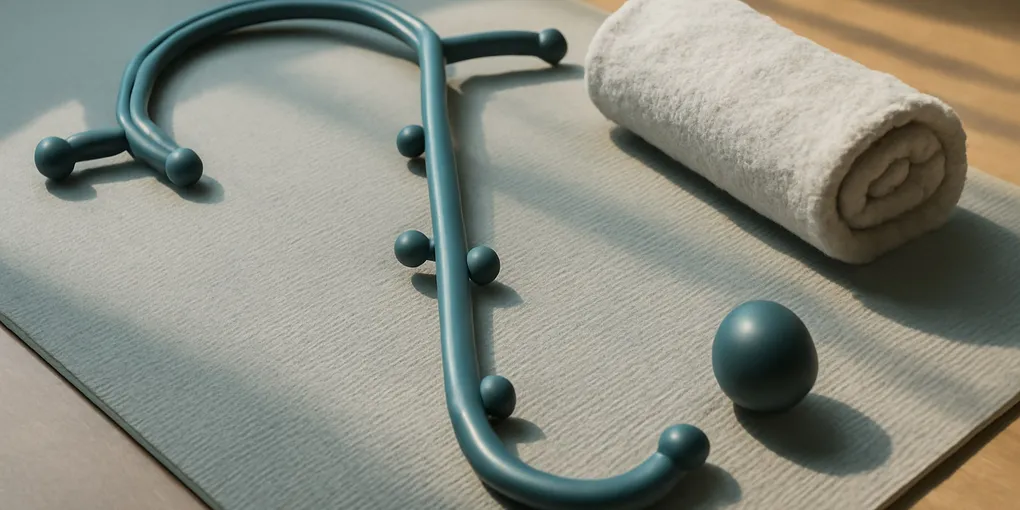
Thera Cane massager
Best classic hook toolBest Use: Upper traps, mid-back pressure, and hard-to-reach shoulder areas
$30-45
Quick picks
| Product | Key Specs |
|---|---|
| See price on Amazon |
|
| See price on Amazon |
|
| See price on Amazon |
|
Product availability, certifications, and retailer details can change; check the current Amazon page before buying.
The Thera Cane is a curved plastic self-massage tool with knobs placed so you can apply pressure to spots your hands cannot reach. It is simple, durable, and easy to misuse. The best buyer is not someone looking for a back-pain cure. It is someone who wants brief, controlled pressure for upper-back, trap, shoulder-blade, or hip comfort without asking another person to dig an elbow into the area.
If that sounds like your use case, search Amazon for Thera Cane massager. Compare options by reach, knob firmness, handle angle, storage space, return terms, and whether the tool lets you reduce pressure quickly. If you want more knobs and handle angles, search Amazon for Body Back Buddy tools. If you mainly need foot or glute pressure, our lacrosse ball foot mobility protocol is cheaper and easier to store.
Quick verdict
- Buy it if your main problem is reaching the upper back or shoulder-blade area with steady pressure.
- Skip it if you expect it to solve nerve symptoms, structural pain, or training-load mistakes.
- Choose a lacrosse ball if the target area is reachable against a wall or floor.
- Choose a multi-knob tool if you want more angles and do not mind bulkier storage.
Practical score
| Factor | Weight | Score | Rationale |
|---|---|---|---|
| Research | 30% | 5.6 | Massage and self-myofascial techniques have some evidence for short-term comfort and range of motion, but product-specific data are limited. |
| Evidence Quality | 25% | 5.2 | Most useful claims are about pressure access and user control, not proven tissue change. |
| Value | 20% | 7.8 | The tool is inexpensive and durable if you actually use the hook shape. |
| User Signals | 15% | 7.0 | Storage, handle comfort, knob firmness, and pressure control drive satisfaction. |
| Transparency | 10% | 8.0 | Shape, size, and use case are easy to judge from listings. |
| Composite | 100% | 6.3 | A useful reach tool for temporary relief when used gently and briefly. |
What it does well
The Thera Cane solves a reach problem. A ball can work well on the floor or wall, but some upper-back and shoulder-blade spots are awkward to pin cleanly. The cane gives leverage without twisting your neck, jamming your wrist, or begging someone else to press the spot. It also lets you reduce pressure quickly, which matters when a tender area suddenly feels too intense.
It is especially useful for desk workers, lifters with tight upper traps after pressing, runners who carry shoulder tension, and people who like a two-minute pressure break during travel. The tool is not subtle, but it is predictable. You put the knob where you want pressure and pull until the sensation is strong but manageable.
NCCIH notes that massage therapy may help some pain and stress-related symptoms, while appropriateness depends on the condition and practitioner or technique (https://www.nccih.nih.gov/health/massage-therapy-what-you-need-to-know). That is the right framing for a cane: temporary symptom modulation, not an anatomy reset.
Where it disappoints
The biggest downside is overconfidence. Because the handle gives leverage, it is easy to press harder than a therapist would. More pressure is not better if it causes bruising, guarding, numbness, tingling, headache, or symptoms traveling down the arm. The neck, front of the throat, armpit, spine, ribs, and injured tissue are poor targets.
It also takes up awkward space. The shape is great in the hand and annoying in a drawer. If you already own a ball, foam roller, and massage gun, ask whether the missing job is really reach. If it is not, the cane may become another recovery gadget leaning behind a door.
Best use protocol
Use the Thera Cane after training, during a desk break, or before easy mobility work. Place the knob on the muscle area, not directly on the spine or a joint. Apply mild to moderate pressure for 20 to 40 seconds while breathing normally. Release, move slightly, and repeat once or twice. Total work on one region should stay short at first.
The sensation should feel like pressure and easing, not a fight. If the area gets more irritable, reduce force or stop. For upper traps, keep the neck relaxed and avoid pulling the shoulder upward. For mid-back areas, stay beside the spine rather than on the bony centerline.
A review on foam rolling and self-myofascial release describes small short-term effects on range of motion and soreness, with protocol and tolerance influencing outcomes (https://www.ncbi.nlm.nih.gov/pmc/articles/PMC6465761/). That fits this tool: use it to make movement feel better for a while, then return to the exercise, posture, or workload issue that created the irritation.
Buying checklist
Check the handle length and knob layout. The classic Thera Cane is simpler and easier to understand. The Body Back Buddy style adds more contact points and can be useful if you want varied angles, but it is bulkier.
Check return terms if you have sensitive skin, fibromyalgia, nerve symptoms, or a low pressure tolerance. A tool that feels perfect to one person can feel too hard to another. Also check storage. If it will not live near your desk, mat, or bed, you probably will not use it.
Do not buy a cane to avoid care for red flags. New weakness, fever, unexplained weight loss, trauma, chest pain, progressive neurological symptoms, or pain that wakes you at night deserves medical assessment rather than a stronger knob.
Thera Cane FAQ
Is the Thera Cane better than a massage gun?
It is better for quiet, targeted pressure in hard-to-reach spots. A massage gun is easier for broad vibration on large muscles. Neither is a cure-all.
Can I use it every day?
Light daily use may be fine, but repeated hard pressure on the same sore spot can make tissue more irritable. Keep sessions short and judge by next-day response.
Should I use it before lifting?
A brief easy pass is fine if it helps you move comfortably. Do not turn pre-lift pressure work into a long pain hunt that tires your grip, shoulders, or nervous system before training.
Frequently Asked Questions
- It is worth considering if you repeatedly need controlled pressure on upper-back or shoulder areas that a ball cannot reach easily.
- No. It may provide temporary comfort, but persistent, radiating, or unexplained pain needs medical assessment.
- Use mild to moderate pressure that lets you breathe normally. Bruising, numbness, sharp pain, or symptoms down the arm are stop signs.