Theragun Mini
Best compact premium pickBest Use: Travel, gym bag warmups, quick calf and quad work
$150-220
Quick picks
| Product | Key Specs |
|---|---|
| See price on Amazon |
|
| See price on Amazon |
|
| See price on Amazon |
|
Product availability, certifications, and retailer details can change; check the current Amazon page before buying.
Bottom line
The Theragun Mini is a good buy if you want a small, polished massage gun that you will actually carry and use for short comfort sessions. It is not a magic recovery device. The best case for it is modest: easier warmups, short-term relief from tight-feeling muscles, and a portable option for travel days. The weak case is any promise that percussion massage repairs tissue, prevents injury, or replaces sleep, nutrition, progressive training, or rehab (https://pubmed.ncbi.nlm.nih.gov/35417265/).
If budget matters, start with a foam roller or a budget mini massage gun. If portability and build quality will make you use the tool three or four times per week, the Mini is defensible.
Product snapshot
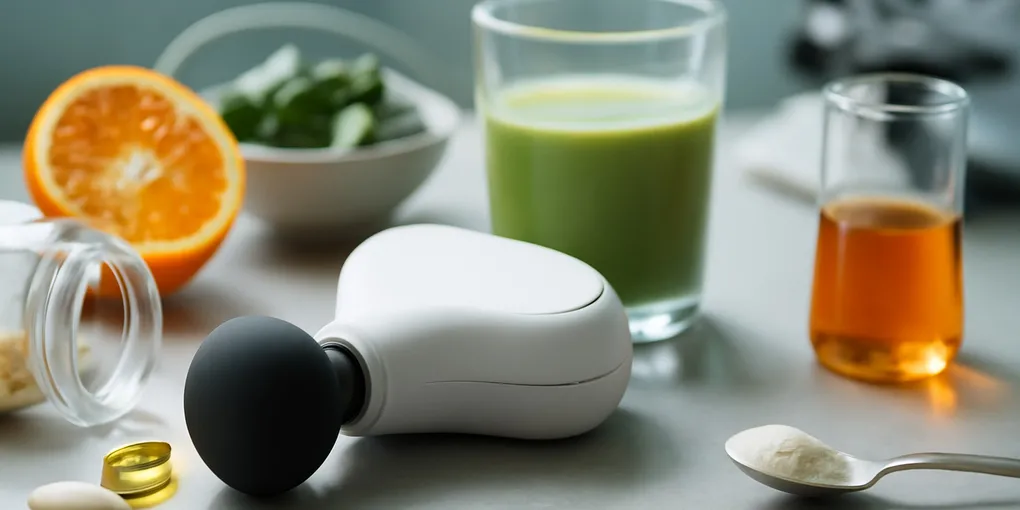
The Theragun Mini is the compact model in the Therabody line: a small triangular percussion device built for gym bags, desk drawers, and carry-on luggage. Compared with full-size massage guns, it gives up handle reach, attachment variety, and high-pressure leverage. Compared with manual tools, it is faster to use while seated and easier on the hands.
The evidence base is still narrow. Small trials and reviews suggest vibration or percussive massage may improve short-term range of motion and perceived soreness, but not enough to claim faster biological recovery. Feeling looser before a run is useful. Assuming the device has erased fatigue is not (https://pubmed.ncbi.nlm.nih.gov/35417265/).
Quick picks and buying comparison
- Premium compact: Check Theragun Mini options if you are paying for convenience, not a recovery miracle.
- Lower-cost test: Search budget mini massage guns if you are unsure percussion massage will become a habit.
- Low-tech alternative: Search foam rollers if your main targets are quads, calves, hamstrings, glutes, and upper back.
For a non-powered recovery routine, see our foam rolling protocol for soreness and mobility. It is the better starting point before deciding whether a massage gun adds anything.
Review score: what drives the verdict
The Theragun Mini earns its place when portability matters more than maximum power or a large attachment kit. The verdict turns on these checks:
- Portability: it is easier to keep in a gym bag or desk drawer than full-size massage guns.
- Coverage limits: the small handle and attachment set are less useful for large areas or hard-to-reach back work.
- Claim control: buy it for temporary comfort and warm-up convenience, not for guaranteed recovery, injury treatment, or performance gains.
What it is good for
The Mini makes the most sense for short sessions on large, easy-to-reach muscles: calves before a run, quads after travel, glutes before a lift, pecs after desk time, or upper traps during a break. Use it for 30 to 60 seconds per area, keep the head moving, and stop before the tissue feels numb.
It also reduces friction. A foam roller is cheaper, but not everyone wants to lie on the floor between meetings or in hotel rooms.
What it is not good for
Do not buy the Theragun Mini because you expect measurable gains in muscle repair, lactate removal, or injury prevention. It also is not ideal for hard-to-reach mid-back work, prolonged high-pressure sessions, or people who want many specialized heads. The compact shape is portable, but it gives you less leverage than a long-handled device.
It is also a poor solution for pain that changes your gait, wakes you at night, causes weakness, or appears with swelling and bruising. Those are evaluation problems, not gadget problems.
Battery, noise, attachments, and ergonomics checks
Battery: judge it by whether it handles several short sessions between charges. If you need long daily sessions, revisit training load before upgrading devices.
Noise: compact guns vary widely. The Mini is generally bought for a more refined feel than bargain devices, but any percussion tool can annoy in a quiet bedroom or office.
Attachments: the Mini is simpler than larger massage guns. That is fine for broad muscle comfort. If you want a fork head, wedge, or many tissue-specific options, compare full-size models.
Ergonomics: the triangular body is easy to pack and grip for calves, quads, pecs, and forearms. It is less natural for the mid-back, posterior shoulder, and deep hip angles. If reach is your main problem, compactness may be the wrong feature.
How to use it without recovery hype
Use the Mini as a warmup accessory or comfort tool. Before training, try light passes over the target muscle, then dynamic movement and ramp-up sets. After training, use it to relax tight-feeling areas, not to justify extra volume.
Avoid pressing harder just because the motor can tolerate it. More pressure is not more recovery. The goal is tolerable sensation, not bruising, pins and needles, or forced numbness; published recovery reviews do not support escalating pressure as a better biological-recovery dose (https://pubmed.ncbi.nlm.nih.gov/35417265/).
Safety cautions
Avoid massage guns over numb areas, open wounds, acute injuries, unexplained swelling, suspected clots, varicose veins, fractures, or bruises. Do not use direct percussion on the front of the neck, spine, joints, or bony points. People with implanted devices, neuropathy, bleeding disorders, active cancer treatment, pregnancy-related concerns, or clot risk should get clinician guidance; the available percussive-massage literature is not a safety clearance for high-risk symptoms (https://pubmed.ncbi.nlm.nih.gov/35417265/).
Stop if symptoms become sharp, electric, radiating, or worse after the session. Do not use percussion to mask pain so you can train through a problem.
FAQ
Is the Theragun Mini worth it over a budget mini massage gun?
It can be, if compact build quality, smoother feel, brand support, and habit formation matter. If you are only testing percussion massage, a budget mini gun is the lower-risk first purchase.
Is it better than a foam roller?
Not universally. The Mini is convenient while seated and easier for targeted quick use. A foam roller is cheaper and better for broad pressure across large muscle groups.
How long should I use it on one muscle?
Start with 30 to 60 seconds per area using light to moderate pressure.
Who should avoid it?
Avoid it if you have numbness, clotting concerns, acute injury, unexplained swelling, implanted-device concerns, or clinician instructions to avoid massage. When symptoms are unusual or worsening, get evaluated first.
Sources
- Konrad A, Glashuttner C, Reiner MM, Bernsteiner D, Tilp M. Acute effects of percussive massage on plantar-flexor range of motion and performance.
- A systematic review and meta-analysis on mechanical vibration and delayed-onset muscle soreness.
- A systematic review on percussive massage treatment and exercise recovery.
- A systematic review on foam rolling, range of motion, recovery, and performance.