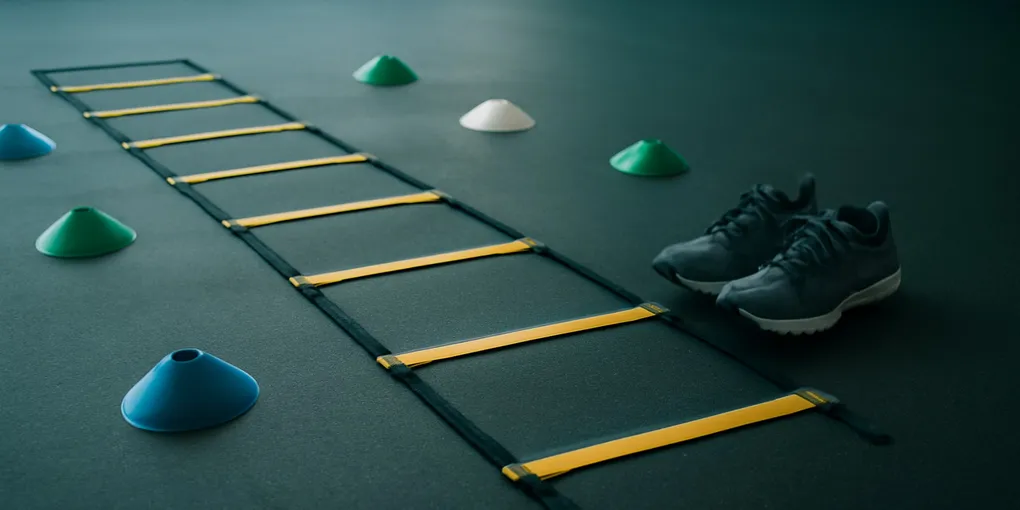
Agility Ladder Footwork Protocol: Coordination Work Without Pretending It Builds Game Speed by Itself
ProtocolQuick picks
SKLZ Quick Ladder
★ Top pick Best common starter ladder- Best Use: Indoor or outdoor footwork drills
- Caveat: Rungs can shift if feet clip them
Yes4All agility ladder and cones set
Best budget kit- Best Use: Home warm-ups and basic change-of-direction patterns
- Caveat: Check rung spacing and storage bag quality
Bottom line
An agility ladder is a coordination and warm-up tool, not a magic speed program. It can help you practice quick foot contacts, rhythm changes, and low-level direction patterns before court, field, or conditioning work. It will not replace sprinting, strength training, deceleration practice, or sport-specific decision making.
If you want a simple setup, compare a Search Amazon for SKLZ Quick Ladder with a Search Amazon for Yes4All ladder and cone kits. Buy the kit only if you will use the cones to mark starts, stops, and cuts.
Quick comparison
- SKLZ Quick Ladder: choose this when you want a common starter ladder with adjustable spacing and a simple storage bag. Search Amazon for SKLZ Quick Ladder.
- Yes4All ladder and cones kit: choose this when you want cones for starts, stops, and direction changes without buying pieces separately. Search Amazon for Yes4All agility ladder cone kits.
- Flat training cones: add these if your ladder already works but you need safer low-profile markers. Search Amazon for SKLZ flat training cones.
Quick start protocol
- Frequency: two or three sessions per week.
- Duration: 8 to 12 minutes after a general warm-up.
- Intensity: crisp and relaxed, not breathless.
- Progression: add speed only after steps stay quiet, balanced, and accurate.
- Stop point: end a drill when feet get sloppy, knees cave inward, or you start clipping rungs.
Practical score
| Factor | Weight | Score | Rationale |
|---|---|---|---|
| Research | 30% | 6.5/10 | Agility and neuromuscular training are useful, but ladder drills alone are a small piece of speed development. |
| Evidence Quality | 25% | 6.0/10 | Most strong training evidence supports broader programs that include strength, plyometrics, sprinting, and change-of-direction work. |
| Value | 20% | 8.5/10 | Ladders and cones are inexpensive and easy to use when the goal is warm-up quality. |
| User Signals | 15% | 8.0/10 | Coaches and home users like the clear visual feedback: miss the square and you know instantly. |
| Transparency | 10% | 9.0/10 | The tool should be sold as coordination practice, not as a stand-alone speed guarantee. |
| Composite | 100% | 7.1/10 | Useful low-cost coordination work when expectations stay realistic. |
Setup
Place the ladder on a flat surface with enough room to slow down after the final rung. Secure loose ends if the ladder slides. Keep pets, children, water bottles, and plates away from the lane.
Warm up first with three to five minutes of easy movement: marching, light jogging, ankle circles, bodyweight squats, or easy step-ups. Cold, frantic ladder work is where toe clips and awkward stumbles happen.
Use shoes with predictable traction. Barefoot ladder work can be fine for very slow coordination drills indoors, but it is a poor choice for fast lateral work unless the surface and your feet tolerate it well.
Drill block 1: accuracy before speed
Start with one foot in each square. Walk through the ladder, then jog through it. Keep contacts quiet and hips level. Do four passes.
Next, use two feet in each square. Step right-left into the first square, right-left into the second, and continue. Do four passes, then repeat leading with the left foot. The goal is equal rhythm, not speed.
Finally, use in-in-out-out. Step both feet into a square, then both feet outside, then advance. Keep knees tracking over toes. If your feet tangle, slow down until the pattern is clean.
Drill block 2: lateral control
Stand sideways to the ladder. Use two feet in each square while moving laterally. Do two passes each direction. Keep the chest mostly forward and avoid crossing feet unless the drill specifically calls for it. On a standard 15-foot ladder, most beginners should need about six to ten controlled contacts per pass rather than sprinting through every rung.
Add a lateral shuffle through every other square. This gives the hips more time to stay square and helps beginners avoid frantic tiny steps. If you want more challenge, place a flat cone five yards away, shuffle to it after the final rung, plant softly, and walk back. If the ladder slides on turf or tile, reduce speed or switch surfaces before adding more lateral work.
Drill block 3: integrate starts and stops
A ladder becomes more useful when it connects to acceleration and braking. Place one cone five to ten yards beyond the ladder. After a clean ladder pass, accelerate to the cone, decelerate under control, and walk back.
Do four to six total reps. Rest long enough that each rep looks coordinated. Conditioning fatigue is not the point. If you want conditioning, use a separate interval session rather than turning footwork into sloppy survival.
Four-week progression
Week one is pattern learning. Use slow passes and stop before fatigue. Week two adds moderate speed to the same patterns. Week three adds cones for controlled starts and stops. Week four adds a reaction cue, such as a partner pointing left or right after the final rung.
Do not add every progression at once. A faster pattern, longer drill, more direction change, and less rest all raise difficulty. Pick one.
What the ladder does not train
It does not teach you to read an opponent. It does not build maximal sprint mechanics. It does not strengthen tendons by itself. It does not guarantee safer cutting. Those qualities need broader training with strength, landing mechanics, acceleration, deceleration, and sport practice.
For lower-body strength and control work, pair ladder warm-ups with exercises like our lateral step-down protocol or balance pad ankle stability protocol. The ladder is the nervous-system primer, not the whole plan.
Gear notes
A basic ladder is enough. Search for a Search Amazon for SKLZ Quick Ladder, Search Amazon for Yes4All agility ladder cone sets, or Search Amazon for SKLZ flat training cones. Check rung spacing, storage, and whether the rungs lie flat.
Avoid weighted ladder drills, slippery surfaces, and complex social-media patterns before you can control simple steps. Better footwork is usually quieter, cleaner, and less dramatic than the clips make it look.
Agility ladder FAQ
Should ladder drills be done before or after lifting?
Use them before lower-body training or sport practice as a short coordination warm-up. Avoid long ladder blocks after heavy leg work when foot accuracy is poor.
How long should each drill last?
Most passes take only a few seconds. Use sets of two to four clean passes rather than timed one-minute grinds.
Are agility ladders good for kids?
They can be useful for playful coordination if supervision, space, and surface are safe. Keep drills simple and avoid turning them into punishment conditioning.
What is the biggest mistake?
Moving faster than you can control. Clipping rungs every pass means the drill is too hard or too rushed.
Sources and further reading
- CDC adult physical activity guidance: https://www.cdc.gov/physical-activity-basics/guidelines/adults.html
- ACSM physical activity guidance overview: https://www.acsm.org/education-resources/trending-topics-resources/physical-activity-guidelines
- Neuromuscular training and injury-prevention context, PubMed: https://pubmed.ncbi.nlm.nih.gov/28192770/
Frequently Asked Questions
- It can improve rhythm, coordination, and warm-up quality, but sprint speed and sport agility also require strength, acceleration, deceleration, and decision-making practice.
- Two or three short sessions per week is enough for coordination work. Keep the drills crisp rather than turning them into long conditioning sets.
- A flat non-slip surface is best. Avoid wet grass, loose gravel, crowded rooms, or any floor where a sliding rung could trip you.
- Cones are useful for adding start, stop, and direction-change points. Shoes with predictable traction matter more than fancy ladder features.