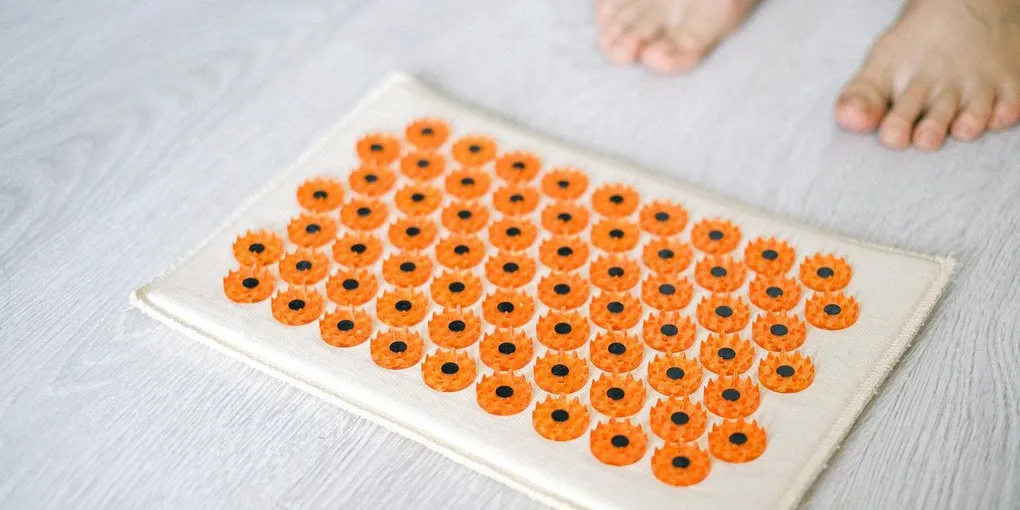
Shakti Acupressure Mat
Best OverallSpike Points: 6,210 points
$79
Quick Comparison
| Product | Key Specs | Price Range | Buy |
|---|---|---|---|
| Shakti Acupressure Mat Best Overall |
| $79 | Check Price |
| Nayoya Acupressure Mat and Pillow Set Best Value Set |
| $39 | Check Price |
| ProsourceFit Acupressure Mat Best Budget |
| $22 | Check Price |
| Bed of Nails Elite Acupressure Mat |
| $149 | Check Price |
Contains affiliate links — we may earn a small commission at no extra cost to you.
Best Acupressure Mat and Pillow 2026: Shakti vs Nayoya vs Bed of Nails Compared
Acupressure mats — spiked foam mats inspired by ancient Indian “bed of nails” practices — have become one of the most popular budget recovery tools. They promise pain relief, stress reduction, and improved sleep for $20–$150 and require nothing but lying down.
The premise is simpler than it sounds. A good acupressure mat works through well-understood neurophysiology, not mysticism. But quality varies enormously at this price point, and the wrong mat is either too painful to use consistently or too soft to do anything. This guide identifies which mats are worth using and how to use them for maximum benefit.
How Acupressure Mats Work: The Science
Acupressure mats are covered in thousands of small plastic spikes (typically 4–7 mm long). When you lie on the mat, these spikes apply distributed point pressure to the skin and superficial tissue.
The axon reflex: The primary mechanism is the axon reflex — a neural response to cutaneous (skin) stimulation. Point pressure activates sensory nerve fibers (particularly C-fibers and Aδ-fibers), which trigger local vasodilation via release of neuropeptides including substance P and CGRP. This produces the characteristic warmth that users feel after 5–10 minutes on the mat.
Neurochemical effects: Sustained pressure stimulation triggers release of endorphins and oxytocin — the body’s natural pain-modulating and stress-reducing neurochemicals. This explains the relaxation and analgesic effects reported by consistent users. For those seeking pharmaceutical-grade pain management support, our best supplements for joint health guide covers evidence-based anti-inflammatory options that pair well with physical recovery tools.
Evidence summary:
- Significant reductions in perceived pain and muscle tension (consistent across multiple small trials)
- Improved self-reported sleep quality with evening use
- Reduced cortisol levels in studies measuring stress response
- Localized vasodilation confirmed via thermographic imaging
- Mechanisms are neurophysiological, not related to traditional meridian theory
What acupressure mats do NOT do:
- Cure injury or structural pathology
- Replace physical therapy or medical treatment
- Provide the deep tissue stimulus of a professional massage
Key Buying Criteria
Spike Count and Density
The number of spike points determines pressure distribution:
- Under 5,000 points: Each spike bears more pressure — intense, can be too painful for beginners
- 5,000–7,000 points: The therapeutic sweet spot — effective stimulus, tolerable for most adults within 1–2 sessions
- 7,000–9,000 points: More distributed pressure — easier to tolerate, good for sensitive users or neck/face application
- Over 9,000 points: Gentle — appropriate for children or extremely sensitive areas
Spike Sharpness
Sharper spikes = faster onset of warmth and effects, but harder to get used to initially. Look for precision-molded ABS plastic spikes. Avoid soft rubber spikes — they don’t produce sufficient pressure for meaningful effect.
Backing Material
Firm foam backing delivers more consistent spike pressure than soft, compressible foam. Natural materials (coconut fiber, natural rubber) tend to hold their shape longer than cheap synthetic foam.
Mat Material (Skin Contact)
Linen and organic cotton are the most comfortable against bare skin and best for heat dissipation. Synthetic fabrics trap heat and feel less pleasant during extended sessions. For best results, use on bare skin — clothing reduces effectiveness by distributing pressure before skin contact.
Pillow Inclusion
An acupressure pillow targets the neck and cervical spine — one of the most tension-holding areas. Sets that include both mat and pillow are substantially better value. Look for pillow dimensions that support the natural curve of the neck (typically 8–10 inches in diameter).
Best Acupressure Mats Reviewed
Shakti Acupressure Mat — Best Overall
Shakti is the brand that popularized modern acupressure mats globally. Their mats are made in India from natural linen and coconut fiber filling — materials that hold their shape over years of use and feel significantly better against bare skin than synthetic alternatives.
The spike density (6,210 points) is in the optimal therapeutic range — intense enough to produce the axon reflex quickly but not so concentrated that first-time use is unbearable. The spikes are sharp and well-molded — no blunted or misaligned tips that reduce effectiveness.
Specs:
- Spike points: 6,210
- Mat material: Natural linen
- Fill: Coconut fiber
- Spike material: ABS plastic
- Dimensions: 26 x 16 inches
- Pillow: Sold separately or as a set
Pros:
- Natural linen and coconut fiber — best materials in this category
- Sharp, consistent spike molding
- Durable — holds its shape over long-term use
- Reputable brand with long history in this space
- Excellent for bare skin use
Cons:
- Premium price vs. competitors
- Pillow not always included (check set vs. individual product)
- Initial session intensity may deter first-timers
Price: ~$79 (mat) / ~$99 (mat + pillow set)
G6 Composite Score: 8.5/10
| Criterion | Weight | Score | Weighted |
|---|---|---|---|
| Build Quality & Durability | 30% | 8.5 | 2.55 |
| Functionality & Design | 25% | 9.0 | 2.25 |
| Value | 20% | 7.5 | 1.50 |
| Real-World Performance | 15% | 8.5 | 1.28 |
| Safety & Warranty | 10% | 8.5 | 0.85 |
| Composite | 8.5/10 |
Natural linen and coconut fiber construction and precise spike molding earn the top marks for build and functionality; the premium price relative to competitors is the primary reason value doesn’t match.
Nayoya Acupressure Mat and Pillow Set — Best Value Complete Set
The Nayoya set is the best value complete mat-and-pillow package. At under $40, it includes both components in a carry bag, making it an excellent first acupressure mat without significant financial commitment.
The cotton fabric and foam fill are not as premium as Shakti’s natural materials, but the spike quality is good — properly molded, consistent density, and produces the expected therapeutic response. This is the mat we recommend for people who are new to acupressure and want to test it before investing more.
Specs:
- Spike points: 6,210
- Mat material: Cotton
- Fill: Foam
- Dimensions: 26 x 16 inches
- Pillow: Included
- Carry bag: Included
Pros:
- Best price-to-value ratio — complete set under $40
- Includes pillow and carry bag
- Good spike quality for the price
- Easy first entry into acupressure therapy
Cons:
- Cotton + foam less durable than Shakti’s natural materials
- Foam backing will compress over time (replace ~18 months of daily use)
- Not as comfortable as natural linen on bare skin
Price: ~$39 (mat + pillow set)
G6 Composite Score: 8.3/10
| Criterion | Weight | Score | Weighted |
|---|---|---|---|
| Build Quality & Durability | 30% | 7.5 | 2.25 |
| Functionality & Design | 25% | 8.5 | 2.13 |
| Value | 20% | 9.0 | 1.80 |
| Real-World Performance | 15% | 8.0 | 1.20 |
| Safety & Warranty | 10% | 8.0 | 0.80 |
| Composite | 8.3/10 |
Outstanding value as a complete mat-and-pillow set under $40; cotton and foam construction is functional but will compress faster than natural-material alternatives, limiting the durability score.
ProsourceFit Acupressure Mat — Best Budget (Mat Only)
ProsourceFit is the most affordable quality option for users who only need a mat (no pillow). At $22, it delivers 8,820 spike points — more than most competitors, which means a gentler, more distributed pressure. This makes it a good choice for sensitive users or those who found other mats too intense.
The tradeoff: the higher spike count means slightly slower onset of the warming response compared to lower-density mats. For back pain relief and general relaxation, it’s more than adequate.
Specs:
- Spike points: 8,820
- Material: Cotton + foam
- Dimensions: 26 x 16 inches
- Pillow: Not included
Pros:
- Lowest price for a quality mat
- High spike count — gentler, more accessible for beginners
- Good for users who found sharper mats too intense
Cons:
- No pillow included — extra purchase required for neck treatment
- Synthetic materials — not as comfortable or durable as Shakti
- Gentler stimulus may require longer sessions
Price: ~$22
G6 Composite Score: 8.0/10
| Criterion | Weight | Score | Weighted |
|---|---|---|---|
| Build Quality & Durability | 30% | 7.0 | 2.10 |
| Functionality & Design | 25% | 8.0 | 2.00 |
| Value | 20% | 9.5 | 1.90 |
| Real-World Performance | 15% | 7.5 | 1.13 |
| Safety & Warranty | 10% | 8.0 | 0.80 |
| Composite | 8.0/10 |
The highest spike count (8,820) and lowest price of any mat on this list make it the best entry point for budget-conscious or sensitive users; the absence of a pillow and synthetic materials cap the build and performance scores.
Bed of Nails Elite — Best Premium Option
Bed of Nails is the premium tier of acupressure mats. The Elite model uses organic cotton, natural rubber backing, and precision-molded spikes that maintain sharpness over years of use. At $149, it’s the most expensive option on this list — but also the most durable and comfortable.
The natural rubber backing provides a firm, consistent base that doesn’t compress over time. For users who commit to daily acupressure as a long-term practice, the Elite pays for itself in longevity over cheaper alternatives.
Pros:
- Organic cotton + natural rubber — premium, long-lasting materials
- Precision spike molding — consistent pressure delivery
- Pillow and carry bag included
- Best long-term durability of any mat on this list
Cons:
- $149 is hard to justify for a first-time buyer
- Benefits over Shakti are incremental, not transformative
Price: ~$149
G6 Composite Score: 8.8/10
| Criterion | Weight | Score | Weighted |
|---|---|---|---|
| Build Quality & Durability | 30% | 9.5 | 2.85 |
| Functionality & Design | 25% | 9.0 | 2.25 |
| Value | 20% | 7.0 | 1.40 |
| Real-World Performance | 15% | 8.5 | 1.28 |
| Safety & Warranty | 10% | 9.0 | 0.90 |
| Composite | 8.8/10 |
Organic cotton, natural rubber backing, and precision-molded spikes that retain sharpness over years of daily use earn the highest build score on this list; the $149 price point is a hard sell for first-time buyers, pulling the value score down.
Comparison Table: Best Acupressure Mats 2026
| Mat | Spike Points | Material | Pillow | Price | Best For |
|---|---|---|---|---|---|
| Shakti | 6,210 | Natural linen | Sold separately | ~$79–99 | Best overall quality |
| Nayoya Set | 6,210 | Cotton | Included | ~$39 | Best value complete set |
| ProsourceFit | 8,820 | Cotton | No | ~$22 | Best budget (mat only) |
| Bed of Nails Elite | 8,008 | Organic cotton | Included | ~$149 | Best premium / longevity |
How to Use an Acupressure Mat
Setup:
- Place the mat on a firm surface (floor or firm mattress)
- Lie directly on bare skin for maximum effect — thin clothing is acceptable but reduces intensity
- Have a towel handy if initial intensity is too high (place between skin and mat, remove as you acclimate)
Session protocol:
- Week 1: 10–15 minutes per session, use daily or every other day
- Week 2+: Extend to 20–30 minutes as tolerance builds
- Common positions:
- Back pain: Lie on your back, mat under spine from shoulders to lower back
- Neck tension: Use pillow under neck, mat under upper back
- Feet: Stand on mat for 5–10 minutes (highly effective, intense)
- Abdomen: Lie face down, mat against abdomen (for digestive relaxation)
Timing:
- Morning (10–15 min): Circulation stimulation, energy
- Evening (20–30 min): Stress relief, sleep preparation — consider combining with a glycine or magnesium supplement for enhanced sleep onset
- Post-workout: Immediate muscle tension relief — works well alongside a foam roller for myofascial release across larger muscle groups
What to expect:
- Minutes 1–5: Sharp sensation, possible urge to get up (normal)
- Minutes 5–10: Warmth begins to spread — stay on the mat
- Minutes 10–20: Deep relaxation and heat throughout contact area
- After: Relaxed, slightly euphoric, reduced tension in treated areas
Related Articles
- Best Massage Gun for Muscle Recovery — percussion therapy complements acupressure for comprehensive myofascial work
- Best Magnesium Supplement for Sleep — pair evening acupressure with magnesium glycinate for deeper sleep
- Best PEMF Mat for Home Recovery — upgrade to electromagnetic recovery if you want deeper tissue effects
Frequently Asked Questions
Does an acupressure mat actually work?
Yes, within defined parameters. Acupressure mats reliably produce localized vasodilation via the axon reflex — a well-documented physiological response to point pressure on the skin. Studies show significant reductions in self-reported pain and muscle tension. The primary mechanism is neurochemical (endorphin and oxytocin release) rather than traditional acupuncture point theory.
How long should I lie on an acupressure mat?
Start with 10–15 minutes. Many users extend to 20–30 minutes as tolerance builds over 1–2 weeks. The initial sharp discomfort typically transitions to warmth and relaxation within 5–10 minutes.
Can I use an acupressure mat every day?
Yes. Daily use is appropriate. Morning use supports energy and circulation; evening use supports relaxation and sleep quality.
Is an acupressure mat safe during pregnancy?
Avoid acupressure mat use during pregnancy. Certain pressure points are associated with uterine stimulation. Pregnant women should avoid this modality until after delivery and consult their OB/GYN.
How many spike points should an acupressure mat have?
Most therapeutic mats have 5,000–9,000 points. The 6,000–8,000 range balances effectiveness and tolerability well. Fewer points = more intense per spike. More points = gentler, more accessible for sensitive users.
Frequently Asked Questions
- Yes, within defined parameters. Acupressure mats reliably produce localized vasodilation (blood vessel dilation) via the axon reflex — a well-documented physiological response to point pressure on the skin. This produces warmth, reduced muscle tension, and relaxation. Studies show significant reductions in self-reported pain and muscle tension. The primary mechanism is not traditional acupuncture point stimulation but rather diffuse pressure-induced neurochemical effects (endorphin and oxytocin release).
- Start with 10–15 minutes. Many users extend to 20–30 minutes as tolerance builds over 1–2 weeks. The initial sharp discomfort typically transitions to warmth and relaxation within 5–10 minutes. Stop immediately if pain is sharp and persistent rather than transitioning to warmth.
- Yes. Daily use is appropriate and is how most users get consistent benefit. Morning use (10–15 min) supports energy and circulation. Evening use (20 min) supports relaxation and sleep quality. Many users report improved sleep within 1–2 weeks of evening use.
- Avoid acupressure mat use during pregnancy. Certain pressure points are believed to stimulate uterine contractions — while the risk from mat use is not well-characterized, pregnant women should avoid this modality until after delivery. Consult your OB/GYN.
- Most therapeutic mats have 5,000–9,000 points. More points means more distributed pressure per point — less intense per spike, easier to tolerate but still effective. Fewer points means more pressure per spike — more intense, faster effects, but harder to tolerate initially. The 6,000–8,000 range balances effectiveness and tolerability well.