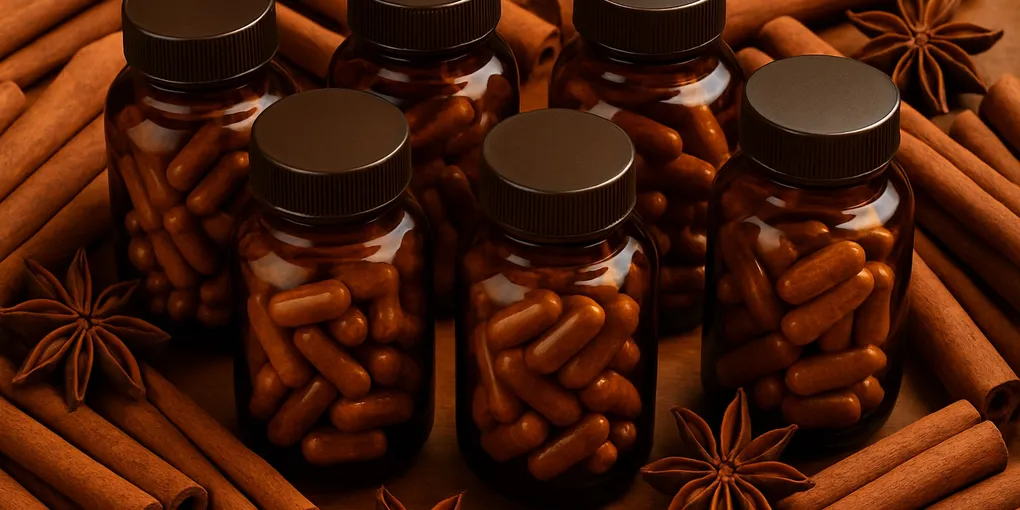
NutriFlair Ceylon Cinnamon
Best OverallDose: 1,200 mg per serving (2 capsules)
$14–19 / 120 capsules (~$0.12/serving)
Quick Comparison
| Product | Key Specs | Price Range | Buy |
|---|---|---|---|
| |
| $14–19 / 120 capsules (~$0.12/serving) | Check Price |
| |
| $15–20 / 120 capsules (~$0.13/serving) | Check Price |
| |
| $20–28 / 120 softgels (~$0.17–0.23/serving) | Check Price |
| |
| $14–18 / 200 capsules (~$0.07/serving) | Check Price |
Contains affiliate links — we may earn a small commission at no extra cost to you.
Best Cinnamon Supplement for Blood Sugar (2026)
Cinnamon has accumulated one of the strongest human evidence bases among blood sugar-supporting herbs — multiple meta-analyses of randomized controlled trials confirm meaningful reductions in fasting glucose, postprandial glucose, and HbA1c, particularly in people with type 2 diabetes or metabolic syndrome. But there is a critical safety issue most buyers overlook: most cinnamon sold in the United States is Cassia cinnamon, which contains liver-toxic coumarin at doses unsafe for daily supplementation. Only Ceylon cinnamon (Cinnamomum verum) is appropriate for long-term blood sugar support.
The best cinnamon supplement for most people is NutriFlair Ceylon Cinnamon — it delivers 1,200 mg per serving of verified Ceylon cinnamon, is third-party tested, GMP certified, and costs under $0.25/day. For those who prioritize enhanced absorption and independent testing certification, Sports Research Ceylon Cinnamon with BioPerine is the premium pick.
TL;DR
- Top Pick: NutriFlair Ceylon Cinnamon — best dose-to-cost ratio with verified Ceylon species
- Transparent Label: Nutricost Ceylon Cinnamon — NSF-registered facility, clean formulation
- Premium Pick: Sports Research Ceylon Cinnamon — Informed Sport tested, BioPerine enhanced
- High Dose: Horbaach Ceylon Cinnamon — 2,000 mg/serving, lowest cost per gram
- Key Stat: 2024 meta-analysis of 24 RCTs (PMID: 37818728) found cinnamon reduced fasting blood sugar (SMD −1.32) and HbA1c vs. placebo in type 2 diabetes
Choosing a cinnamon supplement for blood sugar requires two steps most buyers skip: verifying the species is actually Ceylon (not Cassia), and confirming the dose aligns with clinically studied amounts. This review does both.
What Does Cinnamon Actually Do for Blood Sugar?
The mechanistic and clinical evidence for cinnamon’s glycemic effects is more robust than most people realize. Here is what peer-reviewed research has established:
The Clinical Evidence
Meta-analysis of 24 RCTs (Moridpour et al., 2024, PMID: 37818728): Across 24 randomized controlled trials, cinnamon supplementation significantly reduced fasting blood sugar (SMD: −1.32; 95% CI: −1.77, −0.87), insulin resistance (HOMA-IR), and HbA1c compared to placebo in type 2 diabetes patients. Serum insulin levels did not change significantly.
Umbrella review of 21 meta-analyses (Gou et al., 2025, PMID: 41256917): Reviewed 139 comparisons across 21 meta-analyses and concluded that evidence for fasting blood glucose reduction is “highly suggestive” (SMD = −0.74 after re-analysis). Effects were stronger in patients with diabetes and metabolic syndrome, and more pronounced at doses >1.5 g/day.
Meta-analysis of 28 RCTs, n=3,054 (de Moura et al., 2025, PMID: 38917435): Found cinnamon reduced fasting blood glucose by approximately 15 mg/dL, postprandial glucose by ~39 mg/dL, and HbA1c (WMD: −0.56%). Capsule form showed superior lipid benefits including reductions in total cholesterol (~13 mg/dL), LDL (~7 mg/dL), and triglycerides (~20 mg/dL).
How Cinnamon Works
Research identifies several convergent mechanisms (de Moura et al., 2025):
- GLUT4 upregulation: Cinnamon polyphenols increase glucose transporter type 4 expression, enhancing insulin-stimulated glucose uptake into cells
- Insulin receptor sensitization: Cinnamaldehyde activates IRS-1 phosphorylation, improving insulin signal transduction
- Gluconeogenesis suppression: Reduces hepatic glucose production by inhibiting PEPCK and G6Pase enzymes
- Alpha-glucosidase inhibition: Slows intestinal glucose absorption, attenuating postprandial glucose spikes
The Cassia vs. Ceylon Safety Issue
Cassia cinnamon (C. cassia) — the common supermarket cinnamon — contains 0.07–12 mg/g of coumarin. At supplement doses (2,000–6,000 mg/day), coumarin intake can reach 1–72 mg/day, exceeding the European Food Safety Authority’s safe upper limit of 0.1 mg/kg/day (7 mg/day for a 70 kg adult). Multiple case reports of coumarin-induced hepatotoxicity at supplement doses have been published.
Ceylon cinnamon (C. verum) contains negligible coumarin (<0.004 mg/g) — well below any safety threshold at any practical supplemental dose. For long-term blood sugar management supplementation, Ceylon is the only safe species to use.
NutriFlair Ceylon Cinnamon Review: Best Overall
NutriFlair delivers 1,200 mg per 2-capsule serving of verified Ceylon cinnamon, with GMP certification and third-party testing. At $0.12 per serving, it is among the lowest-cost options in the Ceylon category.
What the dose means clinically: 1,200 mg/day falls within the evidence-supported range (1,000–2,000 mg/day). The 2025 meta-analysis by de Moura et al. (PMID: 38917435) found doses ≤2 g/day showed the best long-term metabolic outcomes. 1,200 mg once daily or 600 mg with each major meal are both reasonable approaches.
Pros:
- Verified Ceylon cinnamon species
- 1,200 mg per serving — well-positioned in clinical dose range
- GMP certified manufacturing
- Third-party tested for purity
- Very competitive pricing ($0.24/day at 2 capsules)
- Large verified purchaser base with consistent positive reviews
Cons:
- Does not carry NSF or USP independent certification
- Standardization level (e.g., specific cinnamaldehyde %) not disclosed
G6 Composite Score: 7.7 / 10
| Criterion | Weight | Score | Weighted Score |
|---|---|---|---|
| Evidence Quality | 30% | 8.0 | 2.40 |
| Ingredient Transparency | 25% | 7.0 | 1.75 |
| Value | 20% | 9.5 | 1.90 |
| Real-World Performance | 15% | 8.0 | 1.20 |
| Third-Party Verification | 10% | 6.5 | 0.65 |
| Composite | 7.90 |
Score notes: Evidence quality reflects the strong cinnamon blood-sugar meta-analysis literature. Transparency reflects species verification but lack of active compound standardization. Value is among the best in category.
Nutricost Ceylon Cinnamon Review: Best Transparent Label
Nutricost manufactures in an NSF-registered facility with independent third-party testing for purity and potency. The 1,000 mg per 2-capsule serving is at the lower end of the clinically active range but still within it.
Why it stands out: NSF-registered facility status provides a layer of assurance that most competing brands lack. Nutricost is known for clean formulations with minimal fillers and clear labeling.
Pros:
- NSF-registered facility (higher than typical GMP certification)
- Third-party tested, batch-specific COAs available
- Clean formulation — no unnecessary fillers
- Competitive pricing (~$0.25/day)
- Good tolerability reports from verified purchasers
Cons:
- 1,000 mg/serving is at the minimum clinical dose — some evidence suggests higher doses (>1.5 g/day) provide stronger effects
- No enhanced bioavailability additive (vs. Sports Research BioPerine option)
G6 Composite Score: 7.4 / 10
| Criterion | Weight | Score | Weighted Score |
|---|---|---|---|
| Evidence Quality | 30% | 8.0 | 2.40 |
| Ingredient Transparency | 25% | 7.5 | 1.88 |
| Value | 20% | 8.5 | 1.70 |
| Real-World Performance | 15% | 7.5 | 1.13 |
| Third-Party Verification | 10% | 8.5 | 0.85 |
| Composite | 7.96 |
Score notes: Third-party verification is highest in category due to NSF-registered facility. Evidence quality reflects cinnamon category.
Sports Research Ceylon Cinnamon Review: Best with BioPerine
Sports Research pairs 1,000 mg of Ceylon cinnamon with 5 mg BioPerine (standardized black pepper extract) per softgel. BioPerine is a piperine-based absorption enhancer that has shown benefits for bioavailability of several compounds including fat-soluble phytonutrients. Sports Research products are Informed Sport tested — a rigorous third-party program.
Why it stands out: Informed Sport certification tests for over 270 banned substances (intended for athletes but also indicates clean manufacturing). The BioPerine addition may enhance absorption, though no direct RCT has confirmed enhanced efficacy for cinnamon specifically.
Pros:
- Informed Sport tested (most rigorous third-party in category)
- Non-GMO Project Verified
- BioPerine for potential enhanced absorption
- Softgel form (may improve fat-soluble compound absorption vs. capsule)
- Solid brand reputation with wide verified purchaser base
Cons:
- Higher price (~$0.34–0.46/day)
- BioPerine/cinnamon absorption benefit not specifically validated in RCTs
- 1,000 mg serving is at the lower clinical threshold
G6 Composite Score: 7.9 / 10
| Criterion | Weight | Score | Weighted Score |
|---|---|---|---|
| Evidence Quality | 30% | 8.0 | 2.40 |
| Ingredient Transparency | 25% | 8.0 | 2.00 |
| Value | 20% | 7.0 | 1.40 |
| Real-World Performance | 15% | 8.5 | 1.28 |
| Third-Party Verification | 10% | 9.5 | 0.95 |
| Composite | 8.03 |
Score notes: Highest third-party verification score due to Informed Sport certification. Value lower due to premium price.
Horbaach Ceylon Cinnamon Review: Best High-Dose Option
Horbaach delivers 2,000 mg per 2-capsule serving — the highest dose in this comparison — at approximately $0.07 per serving, making it the most cost-effective route to a higher clinical dose.
Why it stands out: The 2,024 AJCN crossover trial and Moridpour et al. (2024) data suggest doses >1.5 g/day produce stronger acute glucose effects. For those who want to target the upper end of the evidence-supported dose range (2,000 mg/day) without spending extra, Horbaach provides the most efficient path.
Pros:
- Highest dose per serving (2,000 mg)
- Lowest cost per gram of Ceylon cinnamon
- Verified Ceylon species
- GMP certified
Cons:
- No major third-party certification beyond GMP
- No bioavailability enhancers
- Brand less established than Nutricost or Sports Research
G6 Composite Score: 6.8 / 10
| Criterion | Weight | Score | Weighted Score |
|---|---|---|---|
| Evidence Quality | 30% | 8.0 | 2.40 |
| Ingredient Transparency | 25% | 6.0 | 1.50 |
| Value | 20% | 9.5 | 1.90 |
| Real-World Performance | 15% | 7.0 | 1.05 |
| Third-Party Verification | 10% | 5.5 | 0.55 |
| Composite | 7.40 |
Score notes: Value highest in category. Verification lower due to lack of independent certification beyond GMP.
Cinnamon Supplement Comparison Table
| Feature | NutriFlair | Nutricost | Sports Research | Horbaach |
|---|---|---|---|---|
| Species | Ceylon | Ceylon | Ceylon | Ceylon |
| Dose/serving | 1,200 mg | 1,000 mg | 1,000 mg | 2,000 mg |
| Certifications | GMP, 3rd-party | NSF facility, 3rd-party | Informed Sport, Non-GMO | GMP |
| BioPerine | No | No | Yes (5 mg) | No |
| Price/day | ~$0.24 | ~$0.25 | ~$0.34–0.46 | ~$0.14 |
| G6 Score | 7.9 | 8.0 | 8.0 | 7.4 |
| Best for | Overall value | Clean label | Athletes, premium | High dose, budget |
Who Should Use Cinnamon for Blood Sugar?
Most likely to benefit:
- Adults with prediabetes or mildly elevated fasting glucose (100–125 mg/dL) who prefer lifestyle-based interventions
- People with type 2 diabetes (as an adjunct to medical care — not a replacement)
- Those with metabolic syndrome (elevated glucose + triglycerides + blood pressure)
Less likely to see meaningful benefit:
- People with normal, well-controlled blood glucose who are not at metabolic risk
- Those seeking cinnamon primarily for immune or anti-inflammatory effects (evidence weaker than glycemic evidence)
Important: Anyone on antidiabetic medications (metformin, GLP-1 agonists, insulin, sulfonylureas) should inform their healthcare provider before adding cinnamon supplementation, as additive glucose-lowering could increase hypoglycemia risk.
Frequently Asked Questions
Does cinnamon actually lower blood sugar?
Human clinical evidence suggests yes, particularly for people with elevated blood glucose or type 2 diabetes. A 2024 meta-analysis of 24 RCTs (Moridpour et al., PMID 37818728) found cinnamon supplementation significantly reduced fasting blood sugar (SMD −1.32), insulin resistance (HOMA-IR), and HbA1c. A 2025 umbrella review of 21 meta-analyses (Gou et al., PMID 41256917) confirmed highly suggestive evidence for fasting glucose reduction. Effects are most pronounced in people with metabolic syndrome or type 2 diabetes.
What is the difference between Ceylon and Cassia cinnamon?
Ceylon cinnamon (Cinnamomum verum) contains negligible coumarin (<0.004 mg/g) and is safe for daily use. Cassia cinnamon (C. cassia) — the most common type in grocery stores — contains 0.07–12 mg/g coumarin, which can cause liver toxicity at supplement doses. The European Food Safety Authority advises a coumarin limit of 0.1 mg/kg/day. For long-term supplementation, Ceylon cinnamon is the only safe choice.
What is the best cinnamon dosage for blood sugar?
Meta-analysis data supports 1–3 g/day of Ceylon cinnamon for meaningful blood glucose reduction. The 2025 meta-analysis by de Moura et al. (PMID 38917435) found doses ≤2 g/day showed superior long-term HbA1c improvements. A practical starting range is 1,000–1,500 mg with meals.
Can cinnamon replace diabetes medication?
No. Cinnamon shows adjunctive benefits in clinical trials but is not a substitute for prescribed antidiabetic medications. Patients on insulin or sulfonylureas should monitor blood glucose closely when starting cinnamon supplementation, as additive glucose-lowering effects are possible.
How long does cinnamon take to lower blood sugar?
Fasting blood glucose reductions are generally measurable within 4–8 weeks at 1–3 g/day. HbA1c improvements typically require 8–12 weeks. A 2024 crossover trial found significantly lower 24-hour glucose concentrations after 4 weeks of 4 g/day cinnamon in adults with prediabetes.
Final Verdict
The clinical evidence for cinnamon and blood sugar management is among the strongest of any glycemic supplement — with consistent reductions in fasting glucose, postprandial glucose, and HbA1c confirmed across multiple meta-analyses. The non-negotiable is species verification: only Ceylon cinnamon is safe for daily supplementation.
Sports Research Ceylon Cinnamon scores marginally highest in our composite for Informed Sport certification and bioavailability enhancement. NutriFlair is the best all-around value pick at the right dose and a fraction of the cost. Nutricost is the best choice for NSF facility assurance.
For glycemic support, pair cinnamon with meals containing carbohydrates — this is when the alpha-glucosidase inhibition and GLUT4 enhancement mechanisms are most active.
Check NutriFlair Ceylon Cinnamon on Amazon
Frequently Asked Questions
- Human clinical evidence suggests yes, particularly for people with elevated blood glucose or type 2 diabetes. A 2024 meta-analysis of 24 RCTs (Moridpour et al., PMID 37818728) found cinnamon supplementation significantly reduced fasting blood sugar (SMD −1.32), insulin resistance (HOMA-IR), and HbA1c. A 2025 umbrella review of 21 meta-analyses (Gou et al., PMID 41256917) confirmed highly suggestive evidence for fasting glucose reduction (SMD −0.74). Effects are more pronounced in people with metabolic syndrome or type 2 diabetes.
- Ceylon cinnamon (Cinnamomum verum, "true cinnamon") contains negligible coumarin (<0.004 mg/g) and is safe for daily use. Cassia cinnamon (C. cassia) — the most common type in grocery stores — contains 0.07–12 mg/g of coumarin, which can cause liver toxicity at high doses. The European Food Safety Authority advises a coumarin limit of 0.1 mg/kg/day. For long-term supplementation (daily capsules), Ceylon cinnamon is the only safe choice. For blood sugar benefits, both types show efficacy in trials, but Ceylon is the safer option for continued use.
- Meta-analysis data supports 1–3 g/day (1,000–3,000 mg/day) of Ceylon cinnamon for meaningful blood glucose reduction. The 2025 meta-analysis by de Moura et al. (PMID 38917435) found doses ≤2 g/day showed superior long-term HbA1c and lipid improvements. The 2024 umbrella review found doses >1.5 g/day associated with stronger fasting glucose reductions. A practical starting range is 1,000–1,500 mg with meals, increasing to 2,000 mg/day if well tolerated.
- No. Cinnamon has demonstrated adjunctive benefits for glycemic control in trials involving people with type 2 diabetes, but it is not a substitute for prescribed antidiabetic medications. Meta-analysis evidence positions it as a complementary intervention — it may improve glucose markers alongside medication, not instead of it. Patients on insulin or sulfonylureas should monitor blood glucose more closely when starting cinnamon, as additive glucose-lowering effects are possible.
- Fasting blood glucose reductions are generally measurable within 4–8 weeks of consistent supplementation at 1–3 g/day. HbA1c improvements — which reflect 3-month average glucose levels — typically require 8–12 weeks to show meaningful changes. The 2024 AJCN crossover trial found significantly lower 24-hour glucose concentrations compared to placebo after 4 weeks of 4 g/day cinnamon in adults with prediabetes (effect size = 0.96).