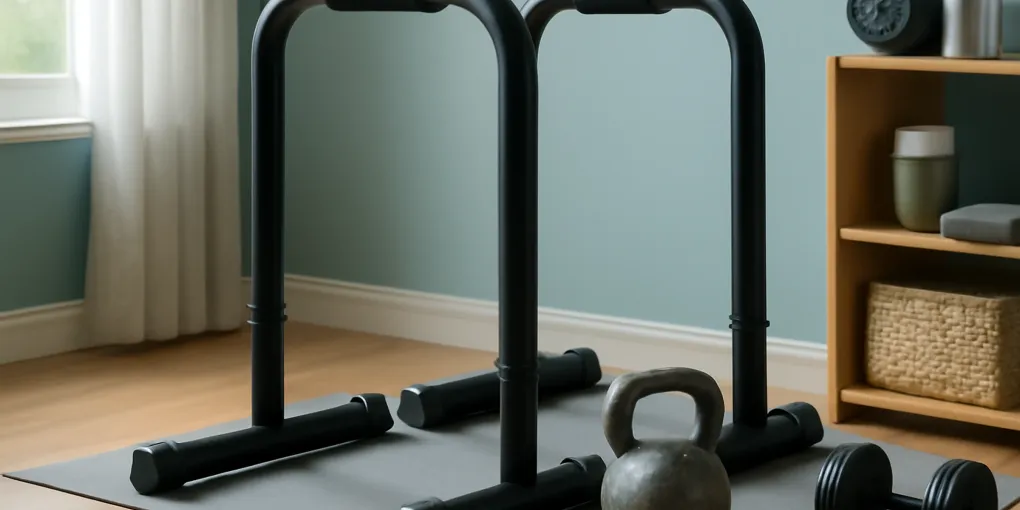
Best Dip Bars for Small Home Gyms: Stable Handles Without a Wobbly Footprint
Buyer's GuideSportsroyals Power Tower Dip Station
Best tall station searchBest Use: Users who want dips plus knee raises or pull-up-bar style stations in one corner
Quick picks
Sportsroyals Power Tower Dip Station
★ Top pick Best tall station search- Best Use: Users who want dips plus knee raises or pull-up-bar style stations in one corner
- Caveat: Taller footprint; measure ceiling clearance and base width before buying
RELIFE REBUILD YOUR LIFE Dip Station
Best compact parallel-bar search- Best Use: Small rooms where separate parallel bars can tuck beside a rack or wall
- Caveat: Check height, crossbar placement, and whether the feet rock on your floor
Lebert Fitness Equalizer Bars
Best portable bodyweight bars search- Best Use: Rows, support holds, step-through drills, and assisted dip progressions
- Caveat: Not the same as a heavy fixed dip station for deep weighted dips
Bottom line
The best dip bars for a small home gym are boring in the right ways: wide enough not to tip, tall enough for your shoulder range, and easy to store without turning the room into an obstacle course. If you want one station for dips and hanging knee raises, search Amazon for Sportsroyals Power Tower Dip Station. If floor space is tight, compare RELIFE parallel dip station options. If you mostly want rows, support holds, and portable bodyweight training, search Amazon for Lebert Fitness Equalizer Bars.
Do not buy by weight rating alone. A dip station can advertise a huge capacity and still feel sketchy if the base is narrow, the handles flare too wide for your shoulders, or the feet slide on laminate flooring. Your first test should be a controlled support hold, not a max-depth dip. For rented rooms and shared apartments, also think about noise: metal feet scraping during setup can be the difference between gear you use and gear you leave folded behind a door.
Quick picks
- One-corner bodyweight station: choose a tall power tower only if ceiling height, base width, and pull-up clearance fit your room.
- Small-room dip focus: choose parallel dip bars with rubberized feet, a crossbar that does not block your knees, and a height that lets you start from the floor safely.
- Portable training and rows: choose equalizer-style bars when inverted rows, incline push-ups, and beginner support holds matter more than heavy weighted dips.
- Skip for now: avoid dip bars if shoulder extension causes pain, if you cannot control the bottom range, or if the station rocks during a simple support hold.
What stability really means
Stability is not just the listed capacity. Look for the distance between the feet, whether the bars connect with crossmembers, and how much the handles flex when you shift side to side. A small apartment user often does better with a slightly wider base than with the narrowest foldable option.
Floor contact matters too. Rubber feet help on tile and wood, but they are not magic. If the bars move when you step into a support hold, add a dense mat or choose a station with a broader base. Do not use a sliding station for ring-style swinging, kipping, or fast circuit transitions.
Handle width and shoulder comfort
Dip bars should let your elbows track without forcing your shoulders into an awkward flare. Very wide handles can make smaller users feel jammed at the bottom. Narrow handles can crowd the torso and turn every rep into a balance drill. Adjustable-width bars are useful when more than one person will train on the station.
Depth is personal. Some lifters can dip below parallel comfortably; others should stop earlier. A good station lets you own the range you actually use. If the bars are so tall that you have to jump into position, place a stable step nearby or choose a lower option.
Power tower, parallel bars, or parallettes?
A power tower is best when one corner can handle a tall frame and you want knee raises, vertical support work, and sometimes pull-up variations. It is the least discreet option and the hardest to move for cleaning.
Separate parallel dip bars are better when storage matters. Many can slide beside a rack or under a shelf, and they let you set a shoulder-friendly width. The tradeoff is that lighter bars can shift if the feet are narrow or the crossbar is minimal.
Parallettes are the smallest choice, but they are not true dip bars for most adults. They are excellent for push-up handles, L-sits, planche progressions, and wrist-friendly floor work. They usually do not provide enough height for full dips unless you are doing bent-knee progressions or deficit push-up variations.
How the named options differ
The Sportsroyals-style power tower is the most useful search path when you want one tall frame to cover dips, vertical knee raises, and some pull-up-bar work. Measure the full height against your ceiling, not just your own standing height. You also need enough rear and side clearance to step into the station without bumping a wall, bench, or storage rack. The upside is that a connected tower usually feels more predictable for beginners than two separate lightweight bars. The downside is that it becomes furniture; if the room also holds a desk, bike trainer, or folding treadmill, the tower may dominate the corner.
The RELIFE-style parallel dip station is the better small-room starting point when dips are the main exercise and you want to choose your own bar width. Look closely at the crossbar and foot shape. A crossbar near the floor can make the setup more stable, but it can also get in the way when you step in, do knee-supported progressions, or store the bars beside a wall. If the listing shows adjustable height, confirm whether the lock points are tight and whether the tallest setting still feels rigid. Tall, narrow, lightweight bars are the combination most likely to wobble.
The Lebert Equalizer-style bar is not a heavy dip station replacement, but it earns a place in cramped rooms because it supports rows, incline push-ups, step-through mobility drills, and assisted support holds. Buy it when your training week needs repeatable bodyweight volume more than maximum dip depth. If you already know weighted dips are the goal, skip the portable compromise and look for a rack-mounted dip attachment that matches your rack or a commercial-grade stand with a wider footprint.
Practical score
| Factor | What earns a high score |
|---|---|
| Stability | Broad feet, low wobble, grippy floor contact, and no visible handle flex |
| Fit | Handle width and height match your shoulders, torso, and entry path |
| Storage | Bars move or tuck away without becoming a daily tripping hazard |
| Exercise range | Supports dips, rows, push-ups, or knee raises that you will actually repeat |
| Value | Strong enough for bodyweight progress without buying a larger station than your room can handle |
Return-window tests
On day one, place the bars where you will actually train. Perform a 10-second top support hold, five slow scapular depressions, and three partial dips. The station should not scrape, tip, or shift. If it does, stop and change the floor setup before doing deeper reps.
Next, test entry and exit. Can you step in without kicking a crossbar? Can you bail to the floor without catching your foot? Can you store the bars without blocking a doorway? Small-home-gym gear fails when the daily friction is high, even if the exercise itself feels good.
Shoulder and progression cautions
Dips load the front of the shoulder in extension, so a small home station should let you set the handles close enough that the upper arms do not drift far behind the torso. Start with a 10-second top support, then shallow 3-second eccentrics, then band- or foot-assisted reps before chasing depth. If the Sportsroyals-style tower or RELIFE-style parallel bars put your shoulders into a pinched bottom position, limit range or choose push-up handles instead. If you have shoulder pain, instability, numbness, or a history of dislocation, get individualized guidance rather than treating deeper dips as mandatory.
For strength progress, add control before load. Tempo reps, pauses, and range consistency are more useful than clipping on weight while the station wobbles. If weighted dips are the main goal, a fixed rack-mounted dip attachment or commercial-grade stand may be safer than a light portable station.
What to avoid
Avoid listings that hide dimensions or show only cropped photos. You need handle height, distance between bars, base width, and folded or stored dimensions. A station that fits a product photo may not fit the corner beside your bench.
Avoid ultra-light bars with slick plastic feet if you train on hard floors. Also be cautious with tall towers that list many exercise options but use thin tubing and a narrow rear base. Multi-use is helpful only when the frame stays still during the exercise you bought it for.
Finally, do not buy dip bars just because they seem like a small version of gym equipment. If you mainly need chest pressing, push-up handles or adjustable dumbbells may be used more often. If your goal is pulling volume, a doorway bar, cable attachment, or suspension trainer may solve the real gap better. For another compact strength option, see our push-up board guide.
Dip bar FAQ
Are dip bars safe in an apartment?
They can be, if the base is stable on your floor and you train controlled reps. Test for sliding and rocking before full-depth dips.
Are parallettes enough for dips?
Usually not for full adult dips. They are better for push-ups, L-sits, and floor skills unless you are doing a limited-range progression.
What handle width should I choose?
Choose a width that lets your elbows track comfortably without a forced flare. Adjustable-width bars are useful for shared home gyms.
Should beginners buy a power tower?
Only if the frame fits the room and you will use the extra stations. For dips alone, compact parallel bars may be easier to keep and use.
Sources
- American Council on Exercise. Dip exercise library entry and form considerations. https://www.acefitness.org/resources/everyone/exercise-library/38/dips/
- U.S. Department of Health and Human Services. Physical Activity Guidelines for Americans, 2nd edition. https://health.gov/sites/default/files/2019-09/Physical_Activity_Guidelines_2nd_edition.pdf
- American Academy of Orthopaedic Surgeons. Shoulder conditioning program. https://orthoinfo.aaos.org/en/recovery/rotator-cuff-and-shoulder-conditioning-program/