Best Plyo Boxes for Small Home Gyms: Stable Jump and Step-Up Picks
Buyer's GuideREP Fitness 3-in-1 Wood Plyo Box
$70-120
Quick picks
| Product | Key Specs |
|---|---|
| See price on Amazon | — |
| See price on Amazon | — |
| See price on Amazon | — |
| See price on Amazon | — |
Product availability, certifications, and retailer details can change; check the current Amazon page before buying.
A plyo box earns space in a small home gym only if it is stable, correctly sized, and useful beyond highlight-reel jumps. Compare height range first, then material, footprint, floor grip, edge forgiveness, weight rating, assembly quality, and whether you will mostly do step-ups or real jumps. For most readers, the better first use is controlled step-ups, low hops, elevated push-ups, and landing practice. A box that is too tall turns every rep into a shin-risk test.
If you want one practical starting point, search Amazon for the REP Fitness 3-in-1 Wood Plyo Box. If missed jumps are likely or you train when tired, search Amazon for a Rogue Foam Games Box or another dense soft box with a clearly listed footprint and weight.
Quick picks
- Best value: REP Fitness 3-in-1 Wood Plyo Box, because the three-height layout covers step-ups and jumps without buying three boxes.
- Best shin-friendly premium pick: Rogue Foam Games Box, for athletes who want forgiveness more than compact storage.
- Best budget option: Yes4All 3-in-1 Wooden Plyo Box, if you assemble it tightly and check for wobble.
- Best soft beginner box: BalanceFrom 3-in-1 Soft Plyo Box, especially for low jumps and cautious step work.
What matters before the brand
The first buying decision is height. A 20-inch box is already enough for many adults when the goal is a quiet landing with knees tracking over the feet. A 24- or 30-inch target makes sense only after you can land softly, step down under control, and stop when fatigue changes mechanics.
The second decision is surface. Wood boxes feel crisp and stable for step-ups, but the edge is unforgiving. Foam boxes are kinder when you miss, but cheap soft boxes can feel mushy or shift on smooth floors. A box used on rubber flooring is safer than one sliding on polished concrete.
The National Strength and Conditioning Association describes plyometric training around rapid stretch-shortening movements, sound landing mechanics, and planned progression rather than random jumping volume (https://www.nsca.com/education/articles/kinetic-select/plyometric-training/). That is the lens for buying: choose a box that keeps progression boring.
Practical score
| Factor | Weight | Score | Rationale |
|---|---|---|---|
| Research | 30% | 6.5 | Plyometric principles are well established, but home-box product claims are mostly specification based. |
| Evidence Quality | 25% | 6.0 | Technique and progression matter more than the brand name. |
| Value | 20% | 7.5 | A single three-height box can cover many lower-body and upper-body variations. |
| User Signals | 15% | 7.0 | Stability, assembly quality, and surface grip drive real satisfaction. |
| Transparency | 10% | 7.0 | Good listings show dimensions, material, weight rating, and assembly details. |
| Composite | 100% | 6.7 | Worth buying if you pick a conservative height and use it for more than max jumps. |
Wood, foam, or soft shell?
Wood is the best value when you are doing step-ups, seated box squats, incline push-ups, and controlled jumps. It gives a clear landing surface and does not compress much. The downside is obvious: a missed jump can scrape your shin, and a loose assembly can turn a stable-looking box into a hazard.
Foam is better when misses are likely. That includes beginner jump practice, high-rep conditioning circuits, and shared family gyms where people may overestimate their height. Foam does not make poor programming safe, but it reduces the penalty for a near miss.
Soft-shell boxes sit between those categories. They are often cheaper than premium foam and friendlier than bare plywood. Check whether the listing gives a real weight rating and whether reviewers mention sliding, seam wear, or leaning under step-ups.
Size guide for small rooms
Buy the lowest height that still supports your training. For step-ups, the working height should let the front knee and hip move without you pushing hard off the trailing leg. If you need a launch from the floor to stand up, the box is too high for strength work.
For jumps, start lower than your ego wants. A good rep is quiet, balanced, and repeatable. If you land in a deep squat with a loud thump, the box is too high or the set is too long. Use our jump rope interval protocol when you need conditioning without repeated high landings.
Small spaces also need clearance. Leave room to step down, not just jump up. A box wedged beside dumbbells, a wall mirror, or a treadmill invites awkward exits. If your room is tight, a 3-in-1 box that can also serve as a bench substitute may justify the footprint.
Product notes
The REP Fitness 3-in-1 Wood Plyo Box is the practical default. It is not the softest or fanciest pick, but the three heights make it useful for a home gym that needs one durable block. Buy it if you value stable step-ups and can respect the hard edges.
The Rogue Foam Games Box is for people who know they will jump, miss, or train in group-style circuits. The price and size are real drawbacks. It makes less sense if your main goal is slow unilateral strength work.
The Yes4All wooden box is a budget path to the same basic format. Inspect the panels, tighten the screws evenly, and test it with step-ups before jumping. If it rocks, stop and fix the assembly.
The BalanceFrom soft box is a better fit for cautious beginners than for power athletes. It gives you a softer target for low jumps, but you should still choose a height that lets you land quietly.
Step-ups, jumps, and accessory uses
For step-ups, choose a height that lets the working leg do the work. Your front foot should stay flat, your torso should not fold forward dramatically, and the trailing foot should not launch you upward. If you feel the back leg doing most of the work, lower the height. A 12- to 16-inch setup can be more useful than a 24-inch setup for controlled strength work.
For jumps, the box is a landing target, not a measure of your worth. Start with low, quiet reps and step down between jumps. The safest home-gym progression is usually low box jumps, then slightly sharper takeoffs, then a small height increase only if the landing still looks the same. If you are programming jumps for conditioning, keep the box low enough that fatigue does not change foot placement.
For accessories, a plyo box can replace several small pieces of equipment. Use it for rear-foot-elevated split squats, incline push-ups, elevated mountain climbers, box squats, seated band rows, and supported single-leg Romanian deadlifts. Those uses justify the footprint even if you only jump once or twice per week.
Buying checklist for small apartments
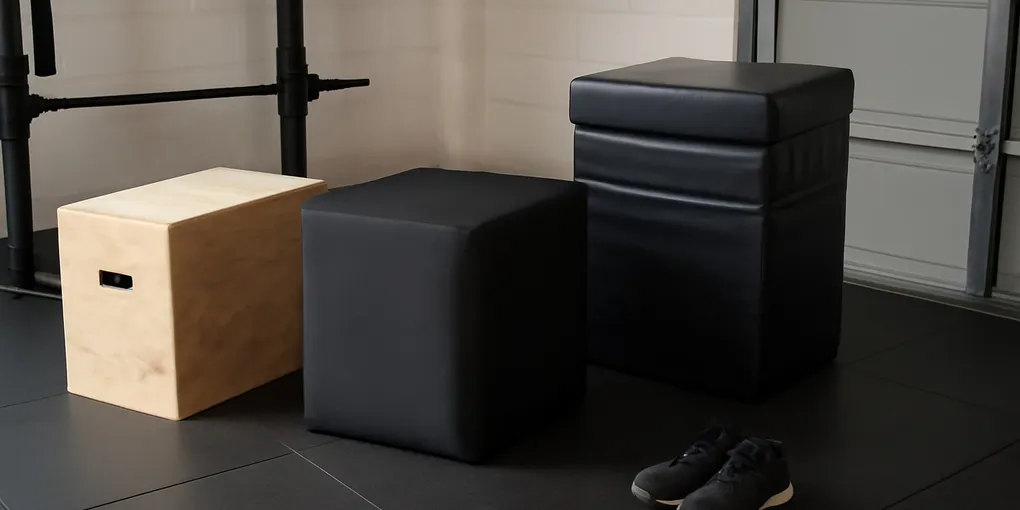
Measure the storage footprint before you buy. A 20-by-24-by-30-inch wooden box can dominate a small room if it has no place to live between workouts. If it must sit in a living area, a clean wooden box may be easier to tolerate visually than a large black foam block.
Check the edge design. Rounded or sanded wooden edges are less hostile than sharp plywood corners, but they are still hard. Foam edges are friendlier, yet the box needs enough density that it does not collapse under a step-up. Read reviews for wobble, seam splitting, vinyl tearing, and slick bottoms.
Look for a clearly stated weight rating and assembly method. For wood boxes, internal bracing, flush screws, and aligned panels matter. For soft boxes, the shell should not twist when you press a knee into the corner. If the listing hides dimensions, uses only lifestyle photos, or makes vague claims about professional use without specs, choose a more transparent option.
How to test the box on arrival
Before jumping, place the box on the surface where you will train and press each corner with your foot. It should not rock. Step up slowly for five reps per side. Then perform three low hops to the floor beside the box. If the floor feels slick, fix the surface before using the box.
For wooden boxes, recheck screws after the first session and again after a week. For foam boxes, inspect seams and corners. Store any box away from heaters, water, and sharp equipment. A plyo box is simple, but it still fails when neglected.
One more practical test: film one set from the front and side. If the box height forces a toe-only landing, a deep collapse, or a side step after every rep, lower the target. Useful plyometric work should look repeatable before it looks impressive. That visual check is more valuable than any listing claim about elite training.
Plyo Box FAQ
Should I buy a 20, 24, or 30 inch plyo box?
Most home users should buy a three-in-one box that includes a 20-inch side, then treat 24 and 30 inches as later options. Step-ups and landing drills do not require a huge box.
Are box jumps bad for knees?
Box jumps are not automatically bad, but tired landings, high targets, and poor step-downs can irritate knees or ankles. Start low, keep volume small, and stop when landings get loud.
What should I avoid in a cheap plyo box?
Avoid hidden dimensions, vague weight ratings, slick bottoms, and reviews that mention wobble or splitting. For wood boxes, assembly quality is part of the product.
Frequently Asked Questions
- Most home users should start with a 12, 16, or 20 inch surface, not a 30 inch ego jump.
- Foam is more forgiving on a missed shin, but stability, floor grip, fatigue, and landing control still matter.
- Yes. Step-ups, split squats, incline push-ups, and controlled landing drills may be more useful than max-height jumps.