Best Instant-Read Thermometers for Protein Meal Prep: Food Safety Without Dry Chicken
Buyer's GuideThermoWorks Thermapen ONE
Best premium speedBest Use: Frequent cooking and fast temperature checks
$80-110
Quick picks
| Product | Key Specs |
|---|---|
| See price on Amazon |
|
| See price on Amazon |
|
| See price on Amazon |
|
Product availability, certifications, and retailer details can change; check the current Amazon page before buying.
Bottom line
An instant-read thermometer is one of the cheapest health tools in a meal-prep kitchen. It helps you cook chicken, turkey, fish, eggs, and leftovers to safe temperatures without using color, texture, or wishful thinking as a safety test. It also prevents the opposite problem: cooking every lean protein until it is dry because you are afraid of undercooking. Source: CDC food-safety prevention guidance.
For most readers, the best buy is a folding probe thermometer that reads quickly, has an easy-to-read display, and can be cleaned without drama. Premium models feel faster and more durable, but even a budget thermometer is a major upgrade over cutting into chicken and guessing.
Quick picks for protein meal prep
- See current Thermapen ONE options — best for frequent cooks who value near-instant readings and build quality.
- Search Amazon for Lavatools Javelin PRO Duo — best middle ground for speed, display, and price.
- Search ThermoPro digital instant-read thermometers — best budget route if you are starting from no thermometer.
Practical score
| Factor | Weight | Score | Rationale |
|---|---|---|---|
| Research | 30% | 7.0 | Food-safety temperature guidance is strong, even though thermometer brand trials are not the point. |
| Evidence Quality | 25% | 6.8 | The safety case is clear; product choice depends on speed, accuracy, durability, and usability. |
| Value | 20% | 8.0 | A thermometer can prevent wasted protein, overcooking, and risky guessing at a low cost. |
| User Signals | 15% | 7.2 | Speed, display angle, and cleaning determine whether it gets used every cook. |
| Transparency | 10% | 6.5 | Better listings state response time, accuracy range, waterproofing, and battery type. |
| Composite | 100% | 7.1 | A high-value kitchen tool for anyone batch-cooking protein. |
| Source: CDC food-safety prevention guidance. |
Why temperature beats color
Chicken and turkey can look done before the center reaches a safe temperature, and some safely cooked meat can still show pinkness depending on pH, cooking method, and bone proximity. Fish, reheated leftovers, and egg dishes have their own failure modes. A thermometer turns meal prep from a visual guess into a repeatable check.
For body-composition readers, this matters because lean protein is easy to ruin. Dry chicken breast and chalky turkey meatballs make high-protein eating harder than it needs to be. A thermometer helps you stop cooking when the food is safe and still edible. Source: CDC food-safety prevention guidance.
Options worth comparing
ThermoWorks Thermapen ONE
The Thermapen ONE is the premium choice if you cook often and hate waiting for numbers to settle. Fast readings matter when checking several chicken breasts, pork chops, or fish fillets before they overcook.
- Best fit: frequent meal preppers, grill users, and anyone who cooks multiple proteins per week.
- Watch out for: price; the benefit is speed and feel, not a magical safety category.
- Check current Thermapen ONE listings.
Lavatools Javelin PRO Duo
The Javelin PRO Duo is the sensible middle option for many home cooks. It typically costs less than premium thermometers while still offering a folding probe, readable display, and fast enough response for weeknight cooking.
- Best fit: readers who meal prep regularly but do not need the most expensive tool.
- Watch out for: marketplace seller, warranty terms, and whether the display orientation suits your hand.
- Compare Javelin PRO Duo options.
ThermoPro budget digital thermometer
A ThermoPro-style budget thermometer is good enough if it gets you to check temperatures consistently. It may read slower and feel less durable, but it is far better than having no probe at all.
- Best fit: beginners, dorm kitchens, occasional grilling, and low-budget meal prep.
- Watch out for: slow readings; leave the probe in place long enough for the center temperature to stabilize.
- Search ThermoPro instant-read thermometers.
Features that matter more than gadgets
Response time is the first feature. If a thermometer takes too long, users pull it out early or stop using it. Accuracy is second, especially around common food-safety thresholds. A readable display is third; if you have to twist your wrist over a hot pan to read the number, the tool is less useful.
Water resistance helps because raw poultry and fish require serious cleaning habits. A magnet, backlight, or rotating display can be nice, but none matters if the probe is slow, fragile, inaccurate, or hard to clean after handling raw meat.
How to use it without contaminating the kitchen
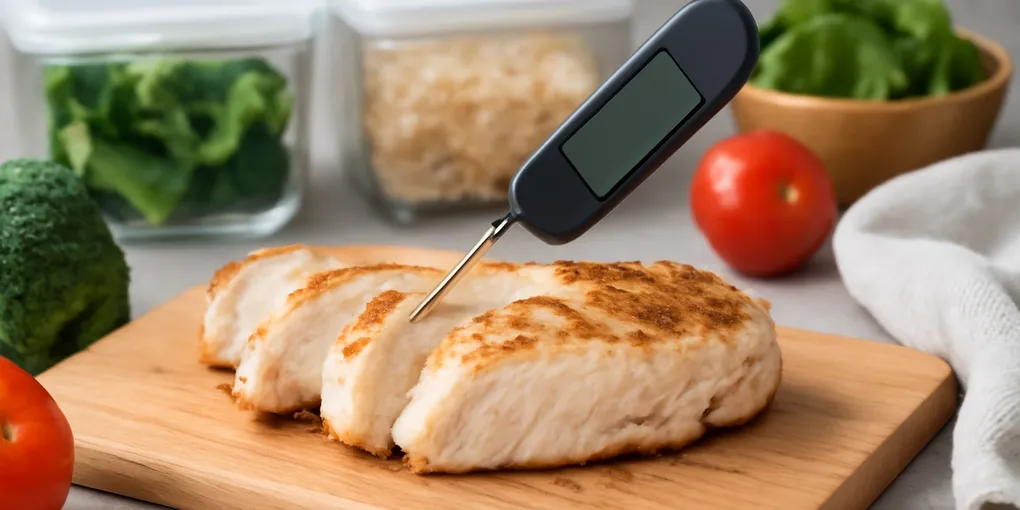
Insert the probe into the thickest part of the food, avoiding bone, pan, and obvious fat pockets. For thin items, insert from the side so more of the probe tip sits in the center. Clean the probe after raw contact and again before checking a different ready-to-eat item.
For batch cooking, check several pieces, not only the smallest one. Chicken breasts, meatballs, salmon fillets, and turkey burgers vary in thickness. Pulling the whole tray based on the thinnest piece is how the thickest piece stays risky.
Accuracy checks and calibration habits
You do not need to obsessively calibrate a home thermometer before every chicken breast, but you should know whether it is wildly wrong. An ice-water check is a simple sanity test: fill a glass with crushed ice and a little water, stir, let it settle, then place the probe tip in the slush without touching the glass. It should read close to 32°F. Boiling-water checks are also possible, but altitude changes the boiling point, so they are easier to misread.
If the thermometer is off by several degrees and cannot be adjusted, replace it or mentally account for the offset only if you are confident. For food safety, a cheap questionable thermometer is not much better than guessing. Also replace probes that have cracked housings, unstable readings, corrosion in the battery compartment, or hinges that no longer hold position.
Meal-prep mistakes a thermometer prevents
The most common protein-prep mistake is cooking by time alone. A tray of chicken breasts may include pieces with different thicknesses, different starting temperatures, and different positions in the oven. The edge pieces can be done while the thick center piece is still below target. A thermometer lets you remove done pieces and give thicker pieces a few more minutes. Source: CDC food-safety prevention guidance.
The second mistake is checking only after the food has rested too long. Carryover heat can raise temperature after removal, but the amount depends on size and cooking method. For small chicken strips or fish fillets, there may be little carryover. For a roast or thick turkey loaf, carryover can matter. Learn the pattern for the foods you actually cook instead of applying one rule to every protein. Source: CDC food-safety prevention guidance.
The third mistake is forgetting leftovers. Meal prep is not only about first-cook safety. Reheated leftovers should be heated thoroughly, and a probe is useful when microwaves create hot edges and cool centers. Stir, rest, and check the middle of dense foods instead of assuming steam means every bite is hot. Source: CDC food-safety prevention guidance.
Which thermometer format should you skip?
Skip decorative novelty thermometers, slow dial-style probes for fast meal prep, and leave-in oven probes if your main need is checking many individual pieces. Leave-in probes are useful for roasts and smoker sessions, but they are not as convenient for checking six chicken breasts, turkey burgers, salmon portions, or reheated containers.
Also decide whether you need a long probe, a very thin probe tip, or a compact folding body. Thin tips leave smaller holes in fish and burgers and can read centers more easily. Long probes keep hands farther from grill heat but may feel clumsy in shallow pans. For apartment meal prep, a compact folding unit is usually easier to store than a bulky barbecue-focused model.
If you cook for kids, pregnancy, older adults, or anyone immunocompromised, the upgrade from guessing to measuring is especially worthwhile. Keep one clean plate for cooked food, one utensil for raw handling, and the thermometer within reach before the pan is hot. Good workflow prevents the tool from becoming an afterthought. Source: CDC food-safety prevention guidance.
For high-protein dieting, the hidden value is consistency. Once you learn that your usual chicken breast reaches target at a certain thickness and pan setting, weekly meal prep becomes easier to repeat. The thermometer teaches the pattern; it does not have to make cooking complicated.
FAQ
What temperature should chicken reach for meal prep?
USDA guidance uses 165°F for poultry. Some cooks use time-and-temperature pasteurization methods, but the simple home rule is to verify the thickest part with a clean thermometer.
Is an expensive thermometer more accurate?
Not automatically. Premium thermometers usually buy faster response, better construction, easier reading, and better water resistance. Accuracy still depends on the model, calibration behavior, and using the probe correctly.
Can one thermometer handle meat, leftovers, and baking?
Yes, an instant-read thermometer can check cooked meat, reheated leftovers, water temperature, and some baking tasks. Do not leave a standard instant-read probe in the oven unless the product is specifically designed for leave-in use.
Sources
- CDC. Four steps to food safety: clean, separate, cook, and chill. CDC.
- Health Canada. Safe internal cooking temperatures. Health Canada.
- Related reading: Best kitchen scales for protein and creatine accuracy and Protein timing after evening workouts.