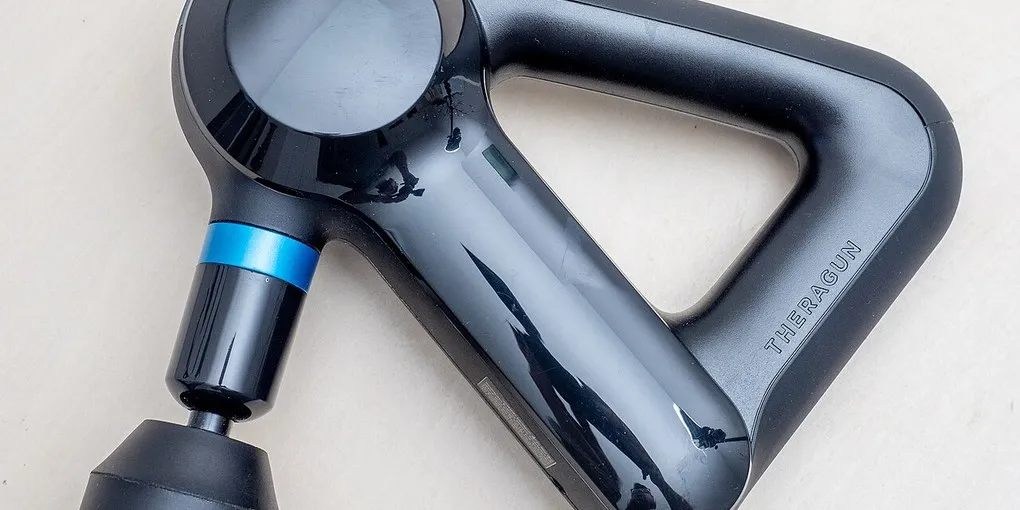
Theragun Pro Plus
Best OverallStall Force: 60 lbs
$499–599
Quick Comparison
| Product | Key Specs | Price Range | Buy |
|---|---|---|---|
| Theragun Pro Plus Best Overall |
| $499–599 | Check Price |
| Hyperice Hypervolt 2 Pro Best Quiet Option |
| $299–349 | Check Price |
| Bob and Brad Q2 Mini Best Budget |
| $60–80 | Check Price |
Contains affiliate links — we may earn a small commission at no extra cost to you.
Best Massage Gun for Muscle Recovery 2026: Theragun vs Hypervolt
Percussive therapy has been part of elite sports medicine for decades. Massage guns brought what was once a physical therapist-administered treatment into home gyms and gym bags — and the technology has matured significantly since the first consumer devices appeared around 2016.
The challenge in 2026 is choosing between a market saturated with products ranging from $40 Amazon knockoffs to $600 professional devices. The price range is extreme; the performance range is nearly as large. Understanding what specifications actually matter — stall force, stroke length, amplitude, noise level — separates a tool that genuinely accelerates recovery from a vibrating toy.
This guide covers the essential specs, the top devices at each tier, and how to integrate percussive therapy into your recovery protocol.
How We Score
We evaluate each product using a 5-factor composite scoring system:
| Factor | Weight | What We Measure |
|---|---|---|
| Research Quality | 30% | Clinical evidence, study count, peer review status |
| Evidence Quality | 25% | Dosage accuracy, bioavailability, form effectiveness |
| Value | 20% | Cost per serving, price-to-quality ratio |
| User Signals | 15% | Real-world reviews, verified purchase data |
| Transparency | 10% | Label clarity, third-party testing, company credibility |
How Massage Guns Work (And What the Research Says)
Percussive therapy delivers rapid, short-amplitude pulses of pressure into muscle tissue — typically 1,200–3,200 percussions per minute (PPM). The mechanisms overlap with traditional massage therapy but are distinct in delivery speed and penetration.
Neurological desensitization: The rapid stimulation of mechanoreceptors (Ruffini endings, Meissner’s corpuscles, Golgi tendon organs) temporarily reduces pain signaling via the gate-control theory of pain. This is why a massage gun feels so effective for acute muscle soreness — it is partially desensitizing the pain pathway, not just mechanically loosening tissue.
Increased local circulation: Percussive pressure promotes local blood flow and lymphatic drainage, supporting nutrient delivery and metabolic waste removal from fatigued muscle tissue.
Fascial release and mobility: Repeated percussion at the muscle-fascia interface can improve tissue extensibility and range of motion. Multiple studies show acute improvements in flexibility following percussive therapy, comparable to static stretching.
DOMS reduction: The most practically relevant benefit — several controlled trials show percussive therapy before and after exercise reduces DOMS severity and accelerates return to performance. A 2021 systematic review found consistent evidence for reduced muscle soreness and improved recovery across multiple study designs.
Muscle activation: Pre-activity use at higher frequencies can increase muscle activation — some athletes use massage guns as part of warm-up routines to wake up specific muscle groups.
The Specs That Actually Matter
Stall Force: The amount of pressure required to stop the device’s motor. Measured in pounds. Low stall force (15–25 lbs) means the gun stops easily when you press into muscle — providing insufficient deep tissue penetration. Effective devices: 40+ lbs; professional devices: 60+ lbs. This is the most important spec for deep tissue recovery.
Stroke Length (Amplitude): How far the attachment head travels with each percussion, measured in mm. Longer amplitude (16mm+) penetrates deeper into muscle tissue. Shorter amplitude (6–10mm) is more superficial — better for surface activation, worse for deep tissue work. Budget devices typically max out at 8–12mm.
Percussions Per Minute (PPM): Speed setting range. Most users find 1,750–2,400 PPM optimal for recovery; higher speeds (2,400–3,200 PPM) are used for warm-up activation. Variable speed control is important.
Noise Level: Professional settings and sleep environments demand quiet devices. The loudest massage guns run at 70–80 dB — comparable to a vacuum cleaner. Premium devices operate at 45–60 dB. If using in a hotel room or late at night, noise matters significantly.
Battery Life: Most sessions last 5–15 minutes. 120+ minutes of battery covers weeks of casual use between charges. 180+ minutes of battery is relevant for traveling athletes.
Attachments: The provided attachment heads determine versatility — ball (general use), flat (large muscle groups), bullet (trigger points), fork (spine/Achilles), dampener (bony areas). Quality of attachments matters for durability and hygiene.
Top Massage Gun Picks
1. Theragun Pro Plus — Best Overall
Theragun is the device that created the consumer percussive therapy market, and the Pro Plus remains the benchmark for professional-grade home devices. The Pro Plus adds biometric guidance (built-in EMG sensors measure muscle tension in real time) and extends Theragun’s already-superior 16mm amplitude and 60-lb stall force.
The 16mm stroke length is the key differentiator. Competing devices at this price range top out at 12–14mm — Theragun’s extra amplitude reaches deeper muscle belly, making it genuinely more effective for large, dense muscle groups (glutes, quads, back).
Features:
- 60 lbs stall force — won’t stall under full pressure
- 16mm amplitude — deepest penetration of any mainstream device
- 5 built-in speeds (1,750–2,400 PPM) + customizable via app
- Rotating arm with 4 positions for ergonomic reach to hard-to-reach areas
- Built-in EMG sensors (Pro Plus exclusive) guide optimal treatment pressure
- OLED screen, Bluetooth app integration with guided routines
- Comes with 6 attachment heads including premium proprietary materials
What we like:
- The rotating arm design solves back and shoulder reach — genuinely useful, not a gimmick
- EMG feedback helps users who overtreate or undertreat pressure
- Industry-best amplitude for deep tissue work
- Well-established brand with strong warranty and customer support
- Widely used by professional sports teams and physical therapists
What to know:
- Premium price ($500+) is a serious commitment
- Heavier than competitors at 2.4 lbs — noticeable for extended sessions
- App experience is robust but requires setup time
Best for: Serious athletes, physical therapy patients, anyone who wants the best-performing device for deep tissue recovery.
Check current price on Amazon →
2. Hyperice Hypervolt 2 Pro — Best Quiet Performance
Hyperice has positioned itself as Theragun’s primary competitor and has captured significant market share among athletes who prioritize quiet operation. The Hypervolt 2 Pro matches the Theragun Pro on stall force (60 lbs) and is meaningfully quieter — a real advantage for office use, hotel rooms, or late-night recovery sessions.
The 14mm amplitude slightly underperforms the Theragun’s 16mm for deep tissue penetration, but for most users — particularly those treating upper body muscle groups, calves, and lateral structures — 14mm is more than sufficient.
Features:
- 60 lbs stall force — matches Theragun Pro
- 14mm amplitude — slightly less than Theragun, still excellent
- 3 speed settings + pressure indicator
- Pressure sensor provides real-time force feedback
- Whisper Quiet technology — among the quietest high-performance devices
- 180-minute battery — best battery life in the high-performance tier
- 5 attachment heads included
- TSA-compliant battery (removable)
What we like:
- Quietest high-stall-force device available — 55dB at max speed
- 180-minute battery significantly outperforms competitors
- TSA-compliant removable battery for frequent travelers
- More compact and lighter than Theragun Pro Plus (1.8 lbs)
- Official device of the NBA and US Ski Team
What to know:
- 14mm amplitude vs Theragun’s 16mm — marginally less deep tissue penetration
- Fewer speed options (3 vs 5) limits fine-tuning
- No rotating arm — rear muscles harder to reach without assistance
Best for: Travelers, office athletes, anyone for whom noise level is a priority; equal to Theragun for most recovery applications.
Check current price on Amazon →
3. Bob and Brad Q2 Mini — Best Budget Option
Physical therapists Bob Schrupp and Brad Heineck built a YouTube following of millions by giving straightforward, no-BS advice. Their branded massage gun line follows the same philosophy: honest specs, no inflated claims, competitive pricing.
The Q2 Mini is a compact device with 35 lbs stall force and 10mm amplitude — below the professional tier, but substantially above the cheap Amazon knockoffs that claim “60 lbs stall force” and deliver nothing close to it. For users treating upper body muscles, calves, and forearms, the Q2 Mini is effective.
Features:
- 35 lbs stall force — adequate for light-to-moderate pressure needs
- 10mm amplitude — effective for superficial to mid-depth muscle work
- 5 speed settings (1,200–3,200 PPM) — good range
- Compact, lightweight (1.3 lbs) — easy to travel with
- 120-minute battery
- 6 attachments included
What we like:
- Honest specifications from a trusted physical therapy source
- Compact and light — ideal for travel or gym bag
- Effective for arms, calves, neck, and upper back
- Price-to-performance ratio is the best in the budget tier
- Backed by PT professionals who test and endorse their products honestly
What to know:
- 35 lbs stall force will stall under heavy pressure on large muscle groups (quads, glutes)
- 10mm amplitude is insufficient for deep glute/back work
- Not for serious athletes with high-volume training loads
Best for: Casual fitness users, office workers with neck and upper back tension, travelers who need a compact device.
Check current price on Amazon →
Massage Gun Comparison
| Feature | Theragun Pro Plus | Hypervolt 2 Pro | Bob & Brad Q2 Mini |
|---|---|---|---|
| Stall Force | 60 lbs | 60 lbs | 35 lbs |
| Amplitude | 16mm | 14mm | 10mm |
| Speeds | 5 | 3 | 5 |
| Noise | ~65 dB | ~55 dB | ~60 dB |
| Battery | 150 min | 180 min | 120 min |
| Weight | 2.4 lbs | 1.8 lbs | 1.3 lbs |
| Price | $499–599 | $299–349 | $60–80 |
| Best for | Deep tissue, max perf | Quiet, travel | Budget, casual |
How to Use a Massage Gun Effectively
Pre-workout (activation): Use at higher speed settings (2,000–3,200 PPM) for 30–60 seconds per muscle group. Focus on the muscles you are about to train. This primes the neuromuscular system without inducing the relaxation response that can reduce power output.
Post-workout (recovery): Use at lower to medium speed settings (1,750–2,400 PPM) for 2–3 minutes per muscle group. Slow, deliberate movement across the muscle belly. Pause on trigger points for 10–15 seconds.
DOMS management (24–72 hours post-training): Use at low-medium speeds on sore areas. The neurological desensitization effect provides immediate relief. Combine with light movement for best outcomes.
Fascia and range of motion: Pre-stretching percussion for 60–90 seconds on tight muscles increases tissue extensibility and improves subsequent stretch quality. Useful before yoga, mobility work, or physical therapy exercises.
Areas to avoid:
- Direct bony prominences (kneecap, collarbone, ankle bones)
- Open skin, bruises, or recent injuries
- Directly over the spine (use the fork attachment around the spine, not on it)
- Veins, arteries, or lymph nodes in the neck and groin
- Do not use on anyone with blood clotting disorders without physician clearance
Session length: 2–3 minutes per muscle group is sufficient for most applications. More is not necessarily better — extended sessions beyond 5 minutes per area can cause bruising in sensitive tissue.
Pairing Percussive Therapy with Other Recovery Tools
Massage guns work best as part of a comprehensive recovery stack:
- Cold exposure: Post-exercise cold plunge or cold shower + percussive therapy in the recovery window is an increasingly popular combination. See our cold plunge vs ice bath guide.
- Red light therapy: PBM pre- or post-workout combined with percussive therapy addresses both the cellular (mitochondrial) and mechanical components of recovery. See our red light therapy benefits article.
- Sauna: Contrast therapy (heat + cold) is well-evidenced. Adding percussive therapy post-sauna (when tissue is warm and pliable) can enhance soft tissue release.
- Sleep: Recovery is ultimately a function of sleep quality. The best massage gun in the world does not compensate for consistently poor sleep. See our best sleep tracker article.
Frequently Asked Questions
Is Theragun or Hypervolt better?
For deep tissue work and maximum amplitude: Theragun Pro Plus. For quiet operation, lighter weight, and battery life: Hypervolt 2 Pro. Both match on stall force (60 lbs) — the primary performance metric for serious use. Choose based on your secondary priorities.
How deep does a massage gun actually penetrate?
It depends on amplitude and tissue composition. High-amplitude devices (16mm) can penetrate 4–6cm into soft tissue — reaching deep muscle belly on the quads and glutes. Lower-amplitude devices (10mm) penetrate 1–3cm — effective for superficial muscle groups and fascial layers. No massage gun reaches deeper than 6–8cm regardless of specification.
Can a massage gun break up scar tissue?
Massage guns can improve tissue extensibility and reduce adhesion in superficial scar tissue over time, but they cannot break up internal scar tissue or fibrosis. For significant post-surgical scar tissue, work with a physical therapist who uses deeper manual techniques or instrument-assisted soft tissue mobilization (IASTM).
How often should I use a massage gun?
Daily use is fine for most people at moderate intensity. Pre- and post-workout use is the most evidence-supported application. Avoid using on the same area more than 2–3 times per day — overuse can cause tissue irritation and bruising.
Are cheap massage guns worth it?
Only if the specifications are accurate. The main problem with cheap devices is not the price — it is that specifications are frequently fabricated. A $40 device claiming “60 lbs stall force” typically delivers 15–20 lbs. If you find a budget device with honest specifications (Bob and Brad, for example), it can provide real value for light to moderate use.
The Bottom Line
For serious athletes and heavy training loads: Theragun Pro Plus is the best device for deep tissue recovery. The 16mm amplitude, rotating arm design, and 60 lbs stall force make it the performance leader. If budget allows, it is worth the premium.
For most users who want quality without Theragun prices: Hypervolt 2 Pro matches Theragun on the metrics that matter most (stall force, overall performance) while being quieter, lighter, and better for travelers. The $300 price point is the sweet spot in this category.
For casual users and those on a budget: Bob and Brad Q2 Mini provides real percussive therapy capability at an honest price. Know its limitations (35 lbs stall force, 10mm amplitude) and choose it for appropriate applications.
The worst decision is buying an unbranded Amazon device with fabricated specifications because the specs look impressive on paper. A massage gun that stalls at 15 lbs is providing surface vibration, not percussive therapy.
Related reading: Cold Plunge vs Ice Bath, Red Light Therapy Benefits, and Best Foam Roller for Muscle Recovery — percussion therapy and foam rolling are highly complementary.
Related Articles
- Best Recovery Tools for Athletes
- Best Foam Roller for Muscle Recovery
- Best Compression Recovery Boots
- Best Recovery Tools for Athletes
- Best Tart Cherry Supplement for Recovery
Frequently Asked Questions
- For deep tissue work and maximum amplitude: Theragun Pro Plus. For quiet operation, lighter weight, and battery life: Hypervolt 2 Pro. Both match on stall force (60 lbs) — the primary performance metric for serious use. Choose based on your secondary priorities.
- It depends on amplitude and tissue composition. High-amplitude devices (16mm) can penetrate 4–6cm into soft tissue — reaching deep muscle belly on the quads and glutes. Lower-amplitude devices (10mm) penetrate 1–3cm — effective for superficial muscle groups and fascial layers. No massage gun reaches deeper than 6–8cm regardless of specification.
- Massage guns can improve tissue extensibility and reduce adhesion in superficial scar tissue over time, but they cannot break up internal scar tissue or fibrosis. For significant post-surgical scar tissue, work with a physical therapist who uses deeper manual techniques or instrument-assisted soft tissue mobilization (IASTM).
- Daily use is fine for most people at moderate intensity. Pre- and post-workout use is the most evidence-supported application. Avoid using on the same area more than 2–3 times per day — overuse can cause tissue irritation and bruising.
- Only if the specifications are accurate. The main problem with cheap devices is not the price — it is that specifications are frequently fabricated. A $40 device claiming "60 lbs stall force" typically delivers 15–20 lbs. If you find a budget device with honest specifications (Bob and Brad, for example), it can provide real value for light to moderate use.