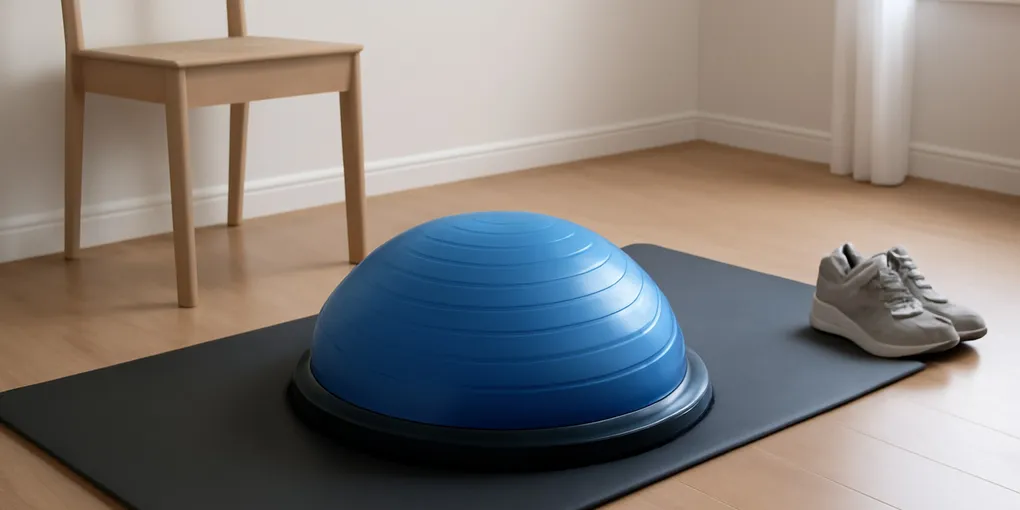
BOSU Balance Trainer Review: Useful Stability Tool or Bulky Home-Gym Distraction?
ReviewBOSU-style half-dome balance trainer
Best for controlled balance drillsBest Use: Low-height balance drills, supported split squats, and core variations
$70-140
Quick picks
BOSU-style half-dome balance trainer
★ Top pick Best for controlled balance drills- Best Use: Low-height balance drills, supported split squats, and core variations
- Caveat: Not necessary for most strength lifts
Dense foam balance pad
Simpler alternative- Best Use: Ankle-control practice with less height and less storage bulk
- Caveat: Less versatile for dome-side exercises
Bottom line
The BOSU Balance Trainer is a useful tool if you treat it as a balance and coordination surface, not as a magic way to make every exercise more athletic. It can help with supported single-leg work, low-load core drills, and ankle-control practice. It is a poor default for heavy squats, loaded overhead work, or anyone who just needs a simple strength program.
Quick picks for balance tools
- BOSU Balance Trainer: buy this if you want a durable dome for controlled ankle drills, split-stance work, planks, and low-load balance practice. Compare diameter, weight rating, pump, and storage size before paying for the larger tool. Search Amazon for BOSU balance trainers.
- Dense foam balance pad: choose this cheaper, flatter option for ankle-control work, rehab-style drills, or people who do not need a bulky half-dome. A pad is less dramatic, but it solves many of the same home-training problems with less storage friction. Search Amazon for dense foam balance pads.
If ankle control is the main reason you are shopping, our balance pad ankle stability protocol is the simpler starting point.
Quick verdict
- Buy it if: you will use supported balance drills, low-load split-squat variations, dead bugs, planks, and controlled ankle work.
- Skip it if: you mostly want to build strength, have very limited floor space, or are tempted to turn heavy lifts into circus tricks.
- Safer starter move: use the dome side up, keep a chair or rack nearby, and start with two-foot stance or supported single-leg taps.
Practical score
| Factor | Weight | Score | Rationale |
|---|---|---|---|
| Research | 30% | 6.2 | Balance training has useful evidence, but not every unstable-surface exercise transfers to better performance. |
| Evidence Quality | 25% | 5.8 | The product is a surface choice; outcomes depend on exercise selection, supervision, and progression. |
| Value | 20% | 5.9 | More expensive and bulkier than a foam pad, but more versatile if used weekly. |
| User Signals | 15% | 7.2 | Owners like variety; complaints usually involve storage, wobble, and underuse. |
| Transparency | 10% | 6.5 | Good listings show diameter, included pump, surface texture, and weight rating. |
| Composite | 100% | 6.2 | Useful for a narrow job, weak as a general home-gym priority. |
What the BOSU does well
The half-dome shape gives you a raised, compliant surface. Dome-side-up work challenges ankle, knee, hip, and trunk control without requiring the aggressive tilt of a wobble board. That makes it useful for supported single-leg stance, gentle lateral weight shifts, and low-load split squat regressions.
It also creates comfortable positions for core drills. Forearms on the dome can make a plank more wrist-friendly. Hands on the dome during a dead bug variation can give you tactile feedback. Sitting on the dome for pelvic tilts can help some users feel trunk position better than lying flat.
Those are modest wins, but they are real wins. The mistake is assuming instability automatically improves strength. Heavy strength work usually benefits from a stable surface because you can produce force, repeat technique, and progress load. The CDC strength guideline is about challenging major muscle groups, not making every set wobbly.
Where it gets misused
The common misuse is loading exercises that already require precision. Heavy goblet squats, overhead presses, and fast plyometrics on a dome add fall risk and reduce load without a clear payoff for most home users. If the unstable surface forces you to cut the load so much that the target muscle is no longer challenged, the exercise changed into balance practice. That is fine if balance practice was the goal. It is not fine if the plan was leg strength.
Another misuse is using the flat platform side up without understanding the risk. That position can tip abruptly. It may belong in supervised training for some athletes, but it is not a casual living-room move.
BOSU vs foam balance pad
A foam balance pad is flatter, cheaper, and easier to store. It is often the better first buy for ankle-control drills because it creates mild instability without adding much height. The BOSU adds more variety: dome planks, supported split squats, kneeling balance, and gentle step-over drills.
Choose the BOSU if you want one larger tool for varied balance and core sessions. Choose the pad if your goal is quiet ankle work, especially if you already have a small space or other home-gym clutter.
Setup and safety checklist
- Put the dome on a dry, flat floor with clear space around it.
- Keep a wall, rack, counter, or chair within fingertip reach for first sessions.
- Start dome side up. Save platform-side work for coached settings.
- Use slow reps, short holds, and low loads.
- Stop if the foot cramps, knee caves sharply inward, or you need a full grab to stay upright.
The CDC falls-prevention guidance is written for older adults, but the principle applies broadly: reduce avoidable trip and slip hazards before adding balance challenges.
Best exercises to start with
Supported two-foot stance
Use the dome side up on a dry floor, with a wall, rack, or heavy chair within fingertip reach. Stand with both feet near the center rings, keep knees soft, and hold 20 to 30 seconds. Step down between attempts instead of jumping off the dome. If the dome compresses so far that your ankles roll inward, reduce hold time or use a foam pad first.
Single-leg toe taps
Stand beside a chair, put one foot on the dome, and tap the free foot forward, sideways, and behind you. The stance knee should track over the middle toes, and the support hand should stay light. Start with five taps per direction rather than long reach distances. This is a better BOSU job than loaded single-leg squats because the target is ankle and hip control, not maximum leg strength.
Forearm plank on the dome
Place forearms on the dome and hold a 10- to 20-second plank. The curved surface can be friendlier than flat handles for some wrists and elbows, but it also makes shoulder shrugging easier. Stop the set when ribs flare, low back sags, or the dome starts sliding. Add time only after three clean holds.
Who should skip it
Skip the BOSU for now if you have a recent ankle sprain, unexplained dizziness, sharp joint pain, new numbness, or a fall history that has not been evaluated. Also skip it if your basic strength plan is inconsistent. A dome cannot replace progressive squats, hinges, pushes, pulls, and carries.
For many readers, the smartest sequence is boring: floor strength first, foam pad second, BOSU third if you still want the variety.
BOSU Balance Trainer FAQ
Can a BOSU improve balance?
It can help you practice balance tasks, especially when drills are controlled and progressed gradually. It does not guarantee better sport performance or safer daily movement by itself.
Is the BOSU good for core training?
Yes, for low-load core variations such as planks, dead bugs, and controlled kneeling drills. It is less useful when instability causes you to lose the position you were trying to train.
Is a BOSU better than a wobble board?
For many home users, yes. It is less abrupt than many wobble boards and easier to use with support nearby. Wobble boards are more specialized and can be too aggressive for beginners.
Sources
Frequently Asked Questions
- It is worth considering if you will use it for controlled balance, rehab-adjacent drills cleared by a clinician, and core variations. It is not essential for general strength training.
- Most home lifters should not load heavy squats on an unstable dome. Use the floor for strength and save the dome for low-load balance or coordination drills.
- A dense foam balance pad is cheaper, easier to store, and usually enough for basic ankle-control work.