Does Mouth Taping Actually Work for Sleep? What the Research Shows
Direct Answer: Mouth taping may modestly improve snoring and morning dry mouth in habitual mouth-breathers by encouraging nasal breathing, but the clinical evidence is extremely limited. Only one small pilot study has been published in a peer-reviewed journal, and no large-scale randomized controlled trials exist. Mouth taping is NOT a treatment for sleep apnea and carries real risks for anyone with nasal obstruction or respiratory conditions.
TL;DR
- Snoring: One small pilot study suggests possible reduction; evidence quality is low
- Sleep quality: No RCT data directly measuring sleep architecture or sleep efficiency
- Nasal breathing: Mechanistically sound — nasal breathing warms, humidifies, and filters air
- Sleep apnea: Not a treatment. Potentially dangerous for undiagnosed OSA
- Safety: Generally safe for healthy nasal breathers; unsafe for nasal obstruction or respiratory disease
- Evidence Verdict: Promising mechanism, viral trend, but insufficient clinical data to recommend broadly
What Is Mouth Taping?
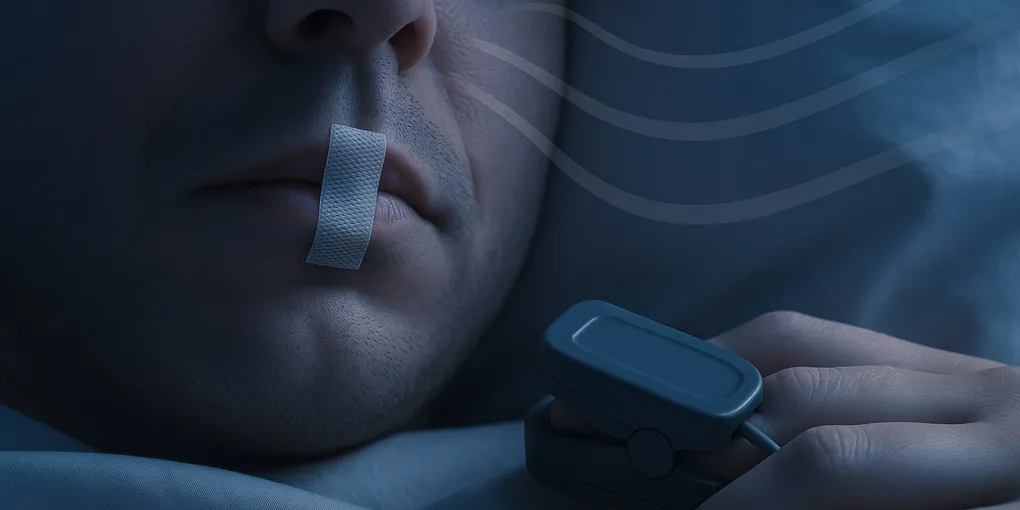
Mouth taping is exactly what it sounds like: applying a small strip of porous tape across the lips before sleep to keep the mouth closed and encourage breathing through the nose. The practice has exploded on social media platforms like TikTok and Instagram, with proponents claiming benefits ranging from reduced snoring to deeper sleep, better oral health, and even improved facial structure.
The underlying premise is anatomically sound. Humans are obligate nasal breathers during rest under normal conditions. The nose filters particulates, humidifies dry air, warms cold air, and produces nitric oxide — a vasodilator that improves oxygen exchange in the lungs. Chronic mouth breathing bypasses these benefits and is associated with dry mouth, dental caries, gum disease, and in children, facial developmental changes.
Whether adhesive tape across the lips is the right intervention to restore nasal breathing is the central question — and one with surprisingly little rigorous research behind it.
The Clinical Evidence
Lee et al., 2022 — The Only Peer-Reviewed Mouth Taping Study
The only published clinical trial specifically testing mouth taping for sleep was conducted by Lee et al. and published in Healthcare in 2022. It was a small pilot study with 30 participants who identified as mouth breathers.
Protocol: Participants wore 3M Micropore tape (1.25 cm wide) vertically across the center of their lips nightly for 4 weeks. Outcomes were measured by sleep questionnaires and overnight oximetry.
Results:
- Snoring time (measured by oxygen desaturation events) decreased significantly in the mouth-taping group vs. baseline
- Nasal breathing self-assessment scores improved
- No significant changes in oxygen saturation nadir or sleep efficiency
- No adverse events were reported
Limitations: No control group (single-arm pre-post design), small sample size, short duration, subjective primary outcomes, and no polysomnography (the gold standard for sleep measurement). This study is hypothesis-generating, not practice-guiding.
Indirect Evidence: Nasal Breathing and Sleep Quality
While direct mouth taping evidence is sparse, the broader literature on nasal breathing supports the mechanistic rationale:
- Nitric oxide (NO) production: The paranasal sinuses produce NO, which dilates pulmonary vessels and improves ventilation-perfusion matching. Nasal breathing increases NO delivery to the lungs; mouth breathing does not (Lundberg & Weitzberg, 1999).
- Chronic mouth breathing and OSA: Several observational studies associate chronic mouth breathing with increased apnea-hypopnea index (AHI), though causality is unclear. Mouth opening during sleep reduces pharyngeal airway diameter, potentially increasing collapse risk.
- Oral health: Mouth breathing dries oral mucosa, reducing saliva’s protective buffering capacity. A 2015 systematic review ( International Journal of Pediatric Dentistry ) confirmed associations between mouth breathing and increased caries, gingivitis, and malocclusion in children.
What Is Missing
No RCT has tested mouth taping against placebo tape (or no tape) with polysomnography as the primary outcome. No study has examined:
- Long-term safety (skin irritation, lip trauma, psychological discomfort)
- Efficacy in people with allergic rhinitis or deviated septum
- Impact on sleep architecture (REM vs. deep sleep percentages)
- Differential effects by age, sex, or BMI
Potential Benefits (Mechanistically Plausible, Not Proven)
Reduced Snoring in Mouth Breathers
For people who snore specifically because they sleep with an open mouth, keeping the lips closed may reduce palatal vibration. The Lee pilot study supports this hypothesis, but confirmation requires a placebo-controlled trial.
Less Morning Dry Mouth
This is the most immediately observable benefit. Mouth breathers frequently wake with dry mouth, sore throat, and bad breath. Closing the mouth eliminates evaporative water loss from the oral mucosa. This is not a sleep quality benefit per se, but a comfort benefit.
Improved Nasal Patency Over Time
Some otolaryngologists speculate that consistent nasal breathing may reduce turbinate swelling through positive pressure feedback, though this mechanism has not been clinically validated.
Risks and Contraindications
Mouth taping is not risk-free. The following groups should avoid it entirely:
- Sleep apnea: Untreated OSA can cause hundreds of breathing pauses per night. Blocking the oral airway escape route could worsen hypoxemia.
- Nasal obstruction: If you cannot comfortably breathe through your nose for 5 minutes while awake, taping your mouth shut during sleep is unsafe. Common causes include deviated septum, chronic rhinitis, nasal polyps, and acute upper respiratory infections.
- Asthma and COPD: These conditions may require mouth breathing during exacerbations.
- Epilepsy: During a nocturnal seizure, oral airway protection is critical.
- Children: Do not tape children’s mouths. Pediatric facial development, airway anatomy, and emergency airway needs differ fundamentally from adults.
Even for healthy adults: Skin irritation, anxiety, and claustrophobia are reported side effects. Start with a small vertical strip (not a full horizontal seal) and discontinue if you experience any breathing discomfort.
How to Try Mouth Taping Safely
If you are a healthy adult with no nasal obstruction and no sleep apnea risk factors, here is a conservative protocol:
- Test nasal patency: Close your mouth and breathe through your nose for 5 minutes while sitting upright. If this is uncomfortable or impossible, do not proceed.
- Choose the right tape: Use porous medical paper tape (3M Micropore) or commercially available mouth tape strips with a central vent. Avoid plastic or non-porous tapes.
- Apply vertically: Place a 1–1.5 inch strip vertically across the center of your closed lips. This allows some lateral mouth opening for emergency breathing while still encouraging lip closure.
- Do not seal the entire mouth: The goal is a gentle reminder, not an airtight lock.
- Stop if: You wake gasping, experience anxiety, notice skin irritation, or develop any breathing difficulty.
The Bottom Line
Mouth taping has a plausible mechanism (promoting nasal breathing) and one small pilot study suggesting snoring reduction. However, the evidence base is far too thin to support the sweeping claims made on social media. It is not a sleep apnea treatment, it is not safe for people with nasal obstruction, and it has never been tested in a rigorous randomized controlled trial.
If you are a healthy nasal breather who occasionally mouth-breathes during sleep, mouth taping is a low-risk experiment with potential comfort benefits. If you have any respiratory condition, sleep disorder, or nasal blockage, skip the trend and consult a physician.
Frequently Asked Questions
- For healthy adults without breathing disorders, mouth taping is generally safe when using porous tape designed for skin (surgical or hypoallergenic paper tape). It is NOT safe for people with sleep apnea, chronic nasal obstruction, asthma, COPD, or any condition that impairs nasal breathing. Always test nasal patency first — if you cannot comfortably breathe through your nose for 5 minutes while awake, do not tape your mouth.
- The limited available evidence suggests it may reduce snoring in some people by promoting nasal breathing, but the effect size is modest and data quality is low. A 2022 pilot study (Lee et al., *Healthcare*) found that mouth taping reduced snoring time and improved nasal breathing in mouth-breathing volunteers. However, no large-scale RCT has confirmed these findings in a general population.
- No. Mouth taping is not a treatment for obstructive sleep apnea (OSA). If you suspect sleep apnea — loud snoring, witnessed apneas, morning headaches, excessive daytime sleepiness — you need a clinical sleep study and physician-directed treatment (CPAP, oral appliance, or positional therapy). Taping the mouth of a person with OSA could be dangerous.
- Use porous, hypoallergenic tape specifically designed for skin. Medical paper tape (Micropore) or pre-cut mouth tape strips with a breathable vent are appropriate. Never use duct tape, packing tape, or non-porous adhesives. Apply a small strip vertically across the center of the lips — the goal is gentle reminder-to-close, not an airtight seal.
- Anecdotal reports suggest 1–3 weeks of consistent nightly use before noticing changes in morning dry mouth or snoring. However, clinical data on time-to-effect is essentially nonexistent. If you do not notice subjective improvements within 2 weeks, mouth taping is unlikely to be a high-impact intervention for you.