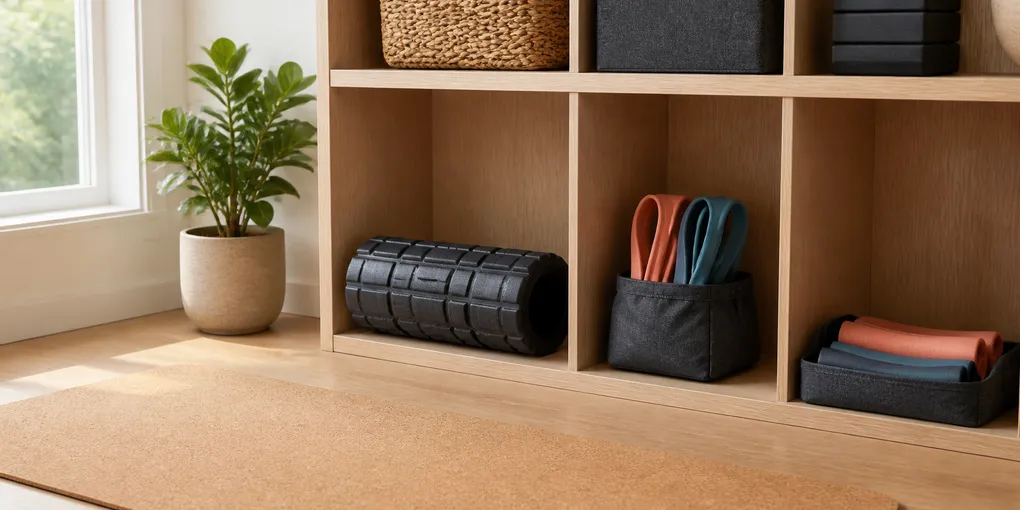
Foam-Roller and Resistance-Band Storage Compared
Evidence ExplainerQuick picks
Fat Gripz Original
★ Top pick Compact handle sleeves- Return spot: Small lidded bin or a shallow drawer
- Listing check: Confirm the pair and current package contents
Gripmaster Hand Exerciser
Small hand accessory- Return spot: Small tray, drawer, or pouch with other hand tools
- Listing check: Confirm the stated tension and configuration
Fit Simplify Resistance Loop Exercise Bands
Loop-band set with carry bag- Return spot: Its carry bag inside a visible low bin or basket
- Listing check: Confirm the bag and resistance-level set are included
Arena Strength Fabric Booty Bands
Fabric-band set with carry case- Return spot: Carry case or a shallow open bin
- Listing check: Confirm the case and three-band set are included
The annoyance is usually not that a foam roller or a few bands take much room. It is that the roller rolls into the path of the next workout while the bands settle into a loose pile that no longer looks like a set. Give the roller its own measured return spot, then keep the bands contained as one kit. Those are different storage jobs.
A round roller needs length, depth, and a stop. Loop and fabric bands need containment, visibility, and a way to keep the light, medium, and heavy pieces together. Start with the place they will land after the session, not with an organizer that looks tidy while empty.
Choose the storage format by its job
Use the equipment’s shape and the reset you want to make when comparing a cubby, bin, pouch, or hook. These are the decision criteria that prevent an organizer from becoming another piece of gym clutter:
| Decision factor | Roller | Loop or fabric bands | Skip this format when |
|---|---|---|---|
| Clear dimensions | Needs enough length and depth to rest without rolling out | Needs only enough room for the folded set or case | The container crowds the roller or buries small bands |
| Containment | A cubby edge, basket wall, or upright stop keeps it from migrating | A pouch, case, or small bin keeps every resistance level together | The storage has no boundary for loose pieces |
| Retrieval | One lift from the cubby or basket | One grab of the whole kit, not a search for one loop | You need to move unrelated gear first |
| Reset location | Near the mat but outside the walking path | Beside the roller or warm-up area | Returning it requires crossing the room or opening several containers |
Give the roller a dimension, not a vague corner
Measure the roller first, then add a little clearance at each end so it can be lifted out without scraping a shelf side. A lower cubby works when it is long enough for the roller to rest horizontally. A tall floor basket or a narrow spot beside a rack can work for an upright roller if it cannot tip into a walking route.
The return spot should answer three practical questions:
| Storage detail | What to measure or check | Why it matters |
|---|---|---|
| Length | Roller length plus finger clearance | A roller that only barely fits tends to stay on the floor |
| Depth | Roller diameter plus the cubby’s front edge | A too-shallow shelf lets it drift out |
| Route | The space between the mat and the storage spot | A clear one-step reset is easier to repeat |
Avoid using a deep miscellaneous basket as the roller’s only home. It may hold the roller, but it also turns bands, straps, and small tools into items to fish out from underneath it.
Keep loops as one visible set
Loop bands disappear because each one is thin, not because the set needs a large organizer. A zip pouch, the supplied carry bag, or a small handled bin gives the set a boundary. Put that container where you finish warm-up work or where you put the roller away; a shelf that is technically available but across the room adds another decision at the end of training.
Fit Simplify lists its five-piece resistance-loop set as 10 by 2 inches and says the set includes a carry bag. That makes the bag a reasonable starting container, but the bag itself still needs a named shelf, bin, or hook so it does not migrate into a gym bag or drawer. Fit Simplify’s resistance-band catalog is the current maker source for those included-item details.
If you use bands with different resistance levels, return all of them at once. A simple check is to leave the bag unzipped or use an open bin: if one color or loop is missing, the reset is visible before the next session.
Fabric bands need a shallow, dry home
Fabric loops are bulkier than thin latex loops, so a shallow bin or their case is easier to use than a crowded hook. Fold each band once rather than winding it tightly around other gear. Keep the container away from a damp towel pile and give the bands a chance to dry after cleaning or a sweaty session.
Arena Strength describes its fabric-band package as three bands with a carry case. That is useful for keeping the set together, not proof that the case will fit a particular shelf. Measure the case or use a small open bin that lets the folded bands sit side by side. Arena Strength’s product page is the maker source for the stated carry-case and three-band contents.
Put small hand tools in the same reset zone
Handle sleeves and finger exercisers take very little space, but they can vanish into a bench drawer alongside unrelated accessories. A small tray or lidded bin beside the band pouch gives these tools a fixed endpoint without asking them to share the roller cubby.
Fat Gripz describes its original thick-grip sleeve format as fitting around a barbell, dumbbell, or cable attachment; its product page lists a 2.25-inch outer diameter for the Pro version. Those details are a reminder to store grip accessories as compact pieces, separate from anything that needs a long cubby. Fat Gripz’s product page is the maker source for the current product description and listed diameter.
For every small accessory, use the same return sequence: release it from the bar or bench, place it in the tray, and put the tray back with the band kit. The routine matters more than whether the container has a lid.
A storage note that takes two minutes to make
Before buying another basket or rack, write down the following:
- The roller’s length and diameter.
- The inside width, height, and depth of the possible cubby or bin.
- Whether the band set has a supplied bag or case.
- The one place where small accessories will return.
- The path from the mat to all of those locations.
This separates a listed product feature from a room measurement. A carry case keeps a band set together; it does not tell you whether the shelf is wide enough. A roller can stand upright; that does not tell you whether it will block a door or bench.
Current compact accessories and band listings
The current Article evidence records these four available, direct-resolver listings. Use the listing page to confirm the package and configuration that matters to your reset plan.
Fat Gripz Original
Check the current Fat Gripz Original listing on Amazon.
Gripmaster Hand Exerciser
Check the current Gripmaster Hand Exerciser listing on Amazon.
Fit Simplify Resistance Loop Exercise Bands
Check the current Fit Simplify Resistance Loop Exercise Bands listing on Amazon.
Arena Strength Fabric Booty Bands
Check the current Arena Strength Fabric Booty Bands listing on Amazon.
Evidence boundary
Maker pages and current availability evidence can identify included bags, cases, and listed dimensions. They cannot measure your shelf, floor path, or roller. Measure the return location and recheck the current listing before buying storage or adding a new item.
Frequently asked questions
Where should a foam roller go in a small home gym?
Give it a dedicated cubby, floor basket, or wall-adjacent upright spot that is at least as long and deep as the roller. Keep the path to that spot clear so returning it takes one motion after training.
Should resistance bands be hung or stored in a bag?
A supplied bag or case keeps a set together, while a hook can make one light loop easy to grab. Choose the method that prevents bands from being mixed with chargers, straps, or loose accessories.
Can a foam roller and bands share one storage bin?
They can share a larger bin, but a roller often uses the depth and can hide small loops underneath. A divided bin, a roller cubby plus a band pouch, or two adjacent containers makes the reset easier to see.