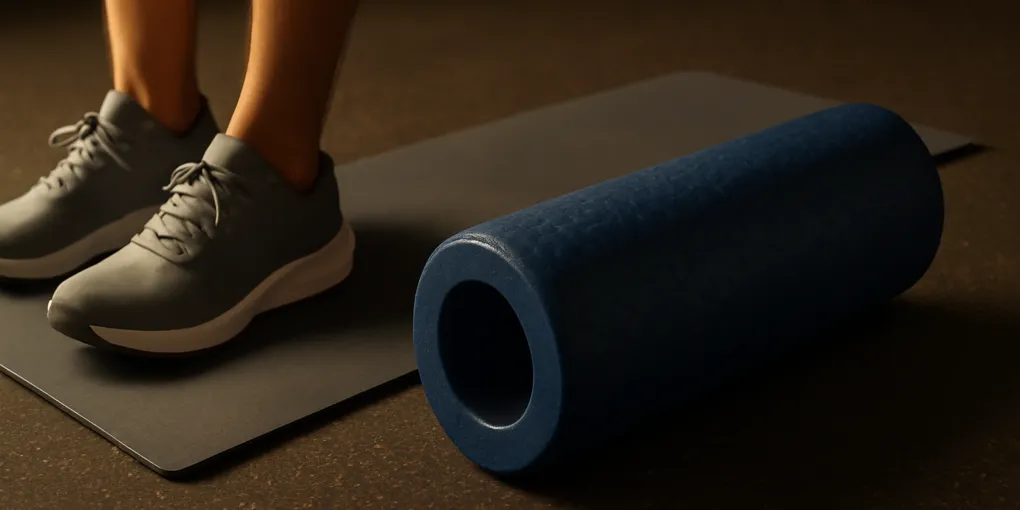
Foam rolling can help recovery mainly by reducing soreness perception and improving short-term range of motion, not by instantly repairing muscle tissue. The best use is brief, targeted rolling after training or during warm-ups when mobility feels limited. The evidence supports modest benefits, realistic expectations, and avoiding painful pressure.
What Foam Rolling Actually Does
Foam rolling is a self-myofascial pressure tool. The roller compresses soft tissue while the user controls angle, speed, and pressure. The most defensible explanation is not that the roller breaks adhesions or flushes toxins. It likely changes sensory input, tolerance to stretch, local blood flow, and how stiff a muscle feels for a short period. Wiewelhove et al., 2019 (PMID: 31024339; doi:10.3389/fphys.2019.00376) found small recovery and performance effects across studies, with practical benefits that are real but limited. Cheatham et al., 2015 (PMID: 26618062) similarly reported short-term range-of-motion improvements without clear evidence that rolling damages performance. That makes foam rolling a useful accessory, not a replacement for sleep, progressive training, protein, carbohydrate, and sane workload management.
What the Recovery Evidence Supports
The most consistent recovery signal is reduced delayed-onset soreness and improved readiness perception. Hendricks et al., 2020 (PMID: 32825976) reviewed range of motion, recovery markers, and performance outcomes and found that results depend on protocol, muscle group, and outcome measured. Objective markers of muscle repair are less impressive than subjective soreness changes. That distinction matters. A reader may feel better after rolling and still need normal recovery time before another hard session. Vibration foam rollers may add comfort or novelty, but Skinner et al., 2022 (PMID: 35244802) found that vibration evidence is not strong enough to justify dramatic claims. Buy vibration only if the price and sensation fit the use case, not because the motor promises superior recovery.
Before Training or After Training?
Before training, foam rolling works best as a short mobility primer. Roll a tight area for 30 to 60 seconds, then perform active warm-up drills and the actual movement pattern. Long, painful rolling before a session can distract from better preparation. After training, use foam rolling to reduce soreness perception, downshift, or address an area that feels stiff. Hughes and Ramer, 2019 (PMID: 31803517) noted that duration matters and that more rolling is not automatically better. A practical ceiling is about one to two minutes per muscle group. If the reader needs 30 minutes of rolling just to train normally, the larger problem may be load management, movement selection, or recovery capacity.
How to Choose a Foam Roller
Start with a medium-density smooth roller unless there is a clear reason to choose something more aggressive. Very hard, spiked rollers can feel productive because they hurt, but pain is not proof of better adaptation. Search Amazon for medium density foam roller, textured foam roller, or vibration foam roller. Screen products for length, firmness, return policy, surface texture, charging requirements if motorized, and whether the roller is large enough for the target area.
Foam Roller Scorecard
| Criterion | Weight | What earns a high score |
|---|---|---|
| Comfort control | 30% | Enough pressure to feel useful without forcing bracing or sharp pain |
| Size and shape | 25% | Long enough for back and legs, portable enough for the intended use |
| Surface design | 20% | Smooth or moderate texture before aggressive knobs |
| Evidence fit | 15% | Marketed for mobility and soreness, not detox or tissue repair miracles |
| Value | 10% | Durable foam or motor features that justify the price |
A Simple Rolling Protocol
Use a two-step rule. First, roll the target area slowly for 30 to 60 seconds while breathing normally. Second, immediately do an active drill that uses the new range of motion. For calves, that might be ankle rocks and easy hops. For quads, it might be split squats. For upper back, it might be thoracic rotations. This pairing turns a temporary sensation into a movement opportunity. Avoid rolling directly on joints, numb areas, acute injuries, varicose veins, or unexplained swelling. If rolling causes tingling, radiating pain, bruising, or worse symptoms the next day, stop and reassess.
Common Mistakes
The first mistake is chasing pain. A roller should not become a punishment tool. The second mistake is using rolling to avoid fixing training errors. If soreness is constantly severe, reduce volume, improve sleep, adjust exercise selection, or improve fueling. The third mistake is believing that expensive vibration automatically outperforms a simple roller. A motor can make the experience pleasant, but the research does not support paying premium prices for guaranteed superior recovery. The best roller is the one the reader will use briefly, consistently, and without turning recovery into another stressful workout.
How to Fit Foam Rolling Into a Week
Foam rolling works best when it has a small, boring role. Put it after hard lower-body sessions if soreness makes the next day feel stiff. Put it before lifting only when a specific movement needs a little more range, such as ankle motion before squats or upper-back extension before overhead work. Do not roll every muscle every day because a checklist says recovery must look complicated.
A practical weekly plan is two to four short exposures. For a runner, that might mean calves and quads after intervals, then glutes and upper back after a long run. For a lifter, it might mean lats before pressing and quads after high-volume leg work. The point is targeted use, not turning foam rolling into a second workout.
What Foam Rolling Cannot Fix
Foam rolling cannot fix poor programming, insufficient sleep, under-fueling, or a sudden jump in training volume. It also cannot diagnose pain. If a reader has persistent sharp pain, swelling, weakness, or symptoms that change gait, the issue deserves a training adjustment or medical evaluation rather than a harder roller.
It is also not a detox method. Sweat, lymphatic claims, and tissue-cleanse language are common in marketing, but they are not the evidence-based reason to buy a roller. The defensible reason is simpler: short-term mobility, soreness perception, and a low-cost way to pay attention to how tissue feels.
Smooth vs Textured vs Vibrating Rollers
A smooth roller is the default because it is predictable. Textured rollers can help some users target smaller areas, but they can also encourage too much pressure. Vibrating rollers may feel better for some people, but the evidence does not justify assuming they are categorically superior. If budget is tight, buy a durable smooth roller and spend the difference on shoes, protein, or coaching.
Choose length based on use. A full-length roller is easier for upper-back work and beginners. A short roller travels better and fits in small apartments. Density matters too. Softer rollers are better for sensitive users; firm rollers suit heavier users or those who already know they tolerate pressure.
Red Flags During Rolling
Stop if rolling causes numbness, tingling, burning nerve pain, unusual bruising, dizziness, or symptoms that last beyond the session. Avoid rolling directly behind the knee, over the front of the neck, across acute strains, or on areas with skin infection. People taking anticoagulants or bruising easily should be conservative.
Use a discomfort scale. A 3 to 5 out of 10 is plenty. If the face tightens, breathing stops, or the body guards against the pressure, the nervous system is probably not receiving a relaxation signal. Less pressure often works better.
How to Judge Results
Judge foam rolling by a simple before-and-after movement check. If ankle mobility, squat comfort, shoulder reach, or perceived stiffness improves for the session, the tool did its job. If nothing changes after a week of reasonable use, stop forcing it.
The best recovery tools reduce friction. A roller that sits unused in a closet is worse than a five-minute walk, a consistent bedtime, or an easier training day. Keep the tool because it makes training smoother, not because the internet made it feel mandatory.
Four-Week Implementation Plan
Week one is the baseline week. Keep the tool or protocol easy enough that it can be repeated without special motivation. Record the setup, the session length, perceived effort, and any next-day symptoms. Do not change multiple variables at once because that makes the result hard to interpret.
Week two is the consistency week. Repeat the same setup two or three times and look for a stable pattern. If the session feels smoother, keep it. If the product creates irritation, annoyance, or avoidance, downgrade the intensity or choose a simpler tool. A plan that looks optimal but never gets repeated is not actually optimal.
Week three is the small-progression week. Add one modest change: a few minutes, a slightly harder variation, or a cleaner setup. Keep everything else stable. This is where many people overreach because early success feels motivating. Resist that impulse. The goal is a durable habit that supports training and health.
Week four is the decision week. Decide whether the tool deserves a permanent place, a situational role, or retirement. Keep it if it clearly improves consistency, comfort, or decision-making. Use it situationally if it only helps during travel, soreness, or specific training blocks. Drop it if the benefit is vague.
Evidence-to-Practice Checklist
Before buying anything, define the job. The best product is different for mobility, aerobic training, step awareness, and strength training. After buying, test the product in a low-stakes session before relying on it during a hard workout, race week, or rehab block.
Use three measures: whether the setup is safe, whether the benefit is repeatable, and whether the cost is proportionate. This keeps the decision grounded. A product can be evidence-compatible and still not worth buying for a specific reader. It can also be modestly helpful without being essential.
Who Should Be More Conservative
Readers returning from injury, managing chronic pain, taking medications that affect bleeding or heart rate, or following clinician instructions should progress more slowly. Fitness products often look low-risk because they are sold over the counter, but context matters. A safe tool used aggressively can become a problem.
Conservative does not mean passive. It means starting with a version that preserves tomorrow’s ability to train, walk, work, and sleep normally. That standard is especially useful for readers who tend to turn every health experiment into a challenge.
Frequently Asked Questions
Is foam rolling better before or after a workout?
Before training, use it briefly for mobility. After training, use it for soreness perception and relaxation. Neither timing replaces a proper warm-up or recovery plan.
How long should I foam roll each muscle?
Start with 30 to 60 seconds per muscle and rarely exceed two minutes. More pressure and more time are not automatically better.
Can foam rolling remove knots?
It may change how tight a spot feels, but it probably does not mechanically break tissue knots. Treat it as sensory and mobility support.
Should foam rolling hurt?
Mild discomfort is normal. Sharp pain, numbness, tingling, bruising, or guarding means the pressure is too aggressive.
Bottom Line
Foam rolling is worth using when the goal is short-term mobility, soreness management, and a calmer transition after training. It is not a tissue-repair shortcut. Buy a simple roller first, use it briefly, pair it with active movement, and judge success by whether training feels smoother without adding more stress.
References
- Wiewelhove T et al. Frontiers in Physiology. 2019. PMID: 31024339. doi:10.3389/fphys.2019.00376.
- Hendricks S et al. Journal of Bodywork and Movement Therapies. 2020. PMID: 32825976.
- Cheatham SW et al. International Journal of Sports Physical Therapy. 2015. PMID: 26618062.
- Skinner B et al. International Journal of Sports Physical Therapy. 2022. PMID: 35244802.
- Hughes GA and Ramer LM. International Journal of Sports Physical Therapy. 2019. PMID: 31803517.
Frequently Asked Questions
- Before training, use it briefly for mobility. After training, use it for soreness perception and relaxation. Neither timing replaces a proper warm-up or recovery plan.
- Start with 30 to 60 seconds per muscle and rarely exceed two minutes. More pressure and more time are not automatically better.
- It may change how tight a spot feels, but it probably does not mechanically break tissue knots. Treat it as sensory and mobility support.
- Mild discomfort is normal. Sharp pain, numbness, tingling, bruising, or guarding means the pressure is too aggressive.