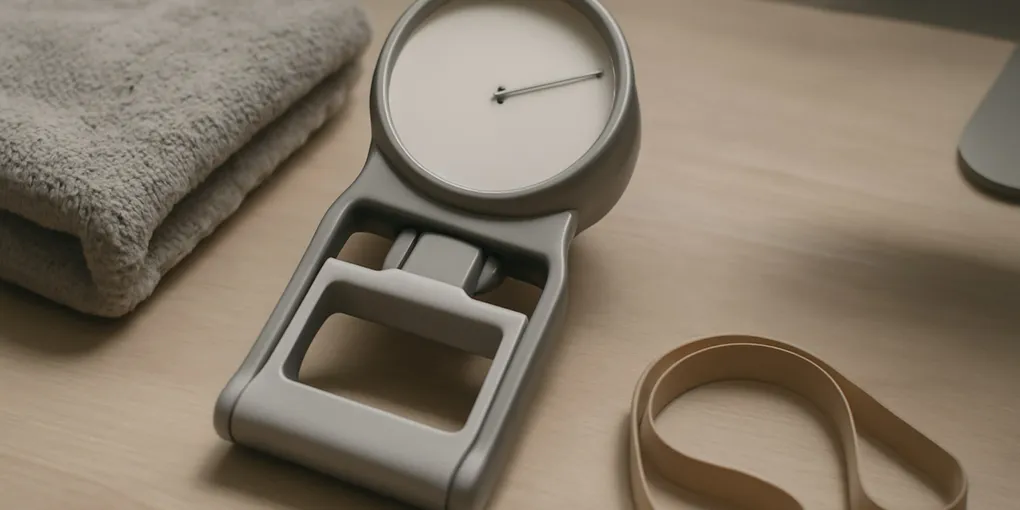
Grip Strength Dynamometer Review: A Useful Health Signal, Not a Diagnosis
ReviewDigital hand grip dynamometer
Best home trend toolBest Use: Monthly left-right grip trend checks and return-to-training notes
$25-70
Quick picks
| Product | Key Specs |
|---|---|
| See price on Amazon |
|
| See price on Amazon |
|
| See price on Amazon |
|
Product availability, certifications, and retailer details can change; check the current Amazon page before buying.
Bottom line
A hand grip dynamometer is worth buying if you want a repeatable strength trend, not if you want a home diagnosis. Grip strength is linked with aging, function, and some health outcomes in population research, but one low reading cannot tell you why the number is low. The useful home version is simple: buy a device with a handle that fits your hand, test both sides the same way, record the best of three tries, and watch the trend over months.
For most readers, a digital hand grip dynamometer search on Amazon is enough. A hydraulic hand dynamometer search on Amazon makes sense only if you want a heavier, more clinic-like tool. If the goal is training rather than testing, an adjustable hand gripper search on Amazon is a separate purchase.
Quick picks
- Best home test device: Search Amazon for digital grip dynamometers if you want a small device for monthly trend checks.
- Best clinic-style category: Search Amazon for hydraulic hand dynamometers if you care more about sturdy mechanics than pocket storage.
- Best training add-on: Search Amazon for adjustable hand grippers after you already have a baseline number.
For a nearby lower-body balance metric, compare this with our balance board guide for ankle stability. Both tools are most useful when they make training decisions more specific.
What the grip number can tell you
Grip strength is a crude but useful proxy for hand and forearm force. It also travels with broader function in older adults because frailty, illness, inactivity, pain, and low muscle mass can all show up as weaker squeezing. That is why grip strength appears in research on sarcopenia and functional status.
At home, the number is most helpful as a personal baseline. If your right hand usually peaks at 44 kg and drops to 34 kg after an elbow flare, that is actionable training information. If both hands fall over several months without a clear reason, the answer is not to squeeze harder through pain; it is to ask what changed in training, nutrition, sleep, medication, nerve symptoms, or health status.
What it cannot tell you
A dynamometer cannot diagnose arthritis, nerve compression, tendon injury, stroke risk, malnutrition, or frailty by itself. It also cannot compare you fairly with another person unless the protocol, handle spacing, posture, age, sex, hand size, and device quality are considered. A cheap device can still show your own trend, but it should not be treated as a lab instrument.
Do not use a low score to label yourself as unhealthy. Do not use a high score to ignore numbness, night pain, hand clumsiness, or sudden weakness. Those are clinical signals.
Digital versus hydraulic dynamometers
Digital home dynamometers win on convenience. They are small, easy to read, and usually store several users. The problem is variation: some handles are too narrow or too wide, some readings jump with hand position, and some devices feel flimsy at higher forces. Choose a model with adjustable handle spacing, a kilogram or pound display you can read without changing posture, and a shape that does not dig into the thumb web.
Hydraulic-style devices are closer to what many clinics use, but they cost more and take up space. The better category for a rehab office is not automatically the better category for a home drawer. If you only plan to test once per month, a decent digital unit may produce more useful data because you will actually use it.
How to test grip strength at home
Use the same setup every time, because posture can move the reading as much as actual strength changes:
- Sit upright with feet flat and keep the tested arm unsupported.
- Keep the shoulder relaxed and elbow bent about 90 degrees.
- Set the handle spacing so the middle finger joints wrap comfortably around the grip instead of pinching the fingertips.
- Hold the wrist neutral, not flexed or cocked back.
- Squeeze hard for three to five seconds without holding your breath or leaning your torso.
- Rest at least 30 to 60 seconds between attempts.
- Record three trials per hand, save the best score for each side, and note kilograms or pounds so future entries match.
Test before heavy pulling, climbing, deadlifts, or forearm work. A fatigued test is still a test, but it answers a different question. If you are tracking recovery from tennis elbow, wrist pain, or hand surgery, follow the clinician’s position and frequency instead of inventing a new protocol. Do not compare a standing, arm-straight gym reading with a seated, elbow-bent rehab reading; treat those as separate baselines.
How to read the trend
For training, compare left to right and month to month. A small day-to-day swing is normal. A larger drop that repeats across several sessions matters more, especially if it comes with pain, numbness, visible swelling, new tremor, or trouble opening jars and carrying bags.
For aging and health monitoring, the useful question is whether grip strength is stable while your normal life stays stable. If the number falls while body weight, appetite, activity, or energy also change, the dynamometer is only one clue. Bring the log to a clinician rather than trying to self-correct with grippers.
When to buy a gripper too
A gripper is for training crush strength; a dynamometer is for measuring. Buy the dynamometer first if you care about data. Add a gripper only if you can train without joint pain and you understand that gripper strength is narrow. Pull-ups, carries, rows, deadlifts, climbing, and towel holds all train grip differently.
Start light. Two or three short sessions per week is enough for most people. Stop if you get finger joint pain, thumb-base pain, numbness, or elbow symptoms that linger into the next day.
FAQ
Is a cheap grip strength dynamometer accurate enough?
It can be accurate enough for personal trend tracking if you use the same device, handle setting, posture, and warm-up each time. It is not accurate enough to make medical decisions from one number.
Should I test both hands?
Yes. Test both hands because side-to-side differences can reveal training asymmetry, hand dominance, or a problem worth investigating when the gap is new and persistent.
How often should I measure grip strength?
Monthly is enough for general tracking. Weekly testing can be useful during rehab or a grip training block, but daily squeezing usually adds noise and fatigue.
Does grip strength predict lifespan?
Research links weaker grip with higher risk in populations, but that does not make your home score a personal lifespan forecast. Use it as a strength and function signal, not a prediction.
Sources
- Bohannon RW. Grip strength: an indispensable biomarker for older adults.
- Roberts HC, Denison HJ, Martin HJ, et al. A review of the measurement of grip strength in clinical and epidemiological studies.
- Cruz-Jentoft AJ, Bahat G, Bauer J, et al. Sarcopenia: revised European consensus on definition and diagnosis.