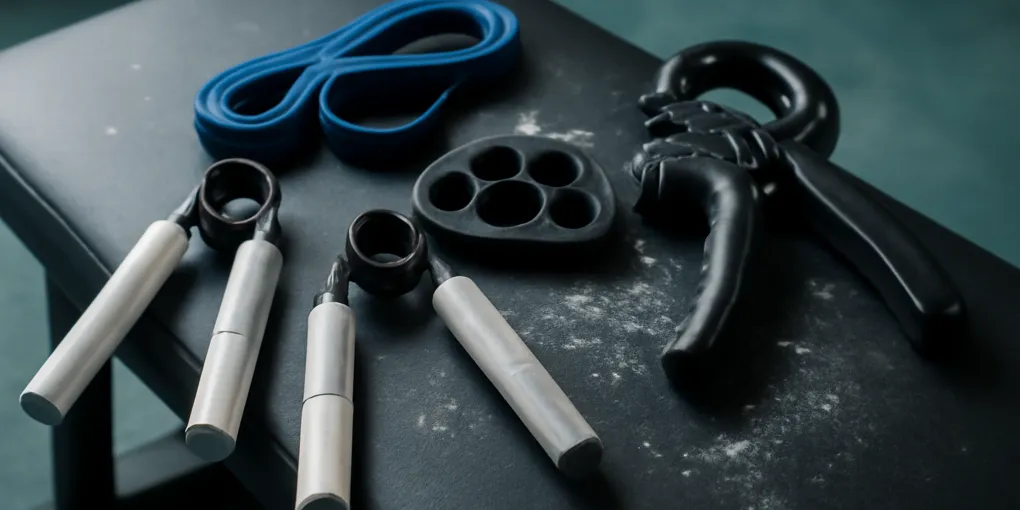
Best Grip Strength Trainers 2026: Evidence-Based Picks for Hands, Forearms, and Longevity
Buyer's GuideIronMind Captains of Crush Gripper
Best Progressive GripperResistance: Multiple fixed levels
$25–35
Quick picks
| Product | Key Specs |
|---|---|
| See price on Amazon |
|
| See price on Amazon |
|
| See price on Amazon |
|
| See price on Amazon |
|
Product availability, certifications, and retailer details can change; check the current Amazon page before buying.
Quick Take
Grip strength is not just a party trick. Handgrip strength is one of the simplest field markers of overall muscle function, and large cohort studies associate low grip strength with higher mortality risk. The practical takeaway is not that a $20 gripper is magic. It is that your hands, forearms, shoulders, and pulling strength deserve progressive training just like your squat or push-up.
This guide focuses on tools that make grip work easy to program at home: classic spring grippers, finger exercisers, thick-grip sleeves, and budget adjustable trainers. Before buying, compare current resistance ranges, handle spacing, knurling, return policy, and whether the device fits the kind of grip work you actually plan to train.
How We Evaluated
We scored grip trainers on five practical factors:
| Factor | Weight | What mattered |
|---|---|---|
| Progressive overload | 30% | Can resistance be increased predictably over months? |
| Joint friendliness | 25% | Does the tool allow controlled reps without finger or elbow irritation? |
| Training transfer | 20% | Does it help real lifting, carrying, climbing, or daily function? |
| Value | 15% | Cost, durability, and usefulness after the beginner phase |
| Simplicity | 10% | Can someone actually use it consistently? |
Why Grip Strength Matters
A 2018 systematic review and meta-analysis in Journal of the American Medical Directors Association found muscular strength, including grip strength, predicted all-cause mortality in apparently healthy adults across very large samples (PubMed: 29425700). A later dose-response meta-analysis reported thresholds where lower handgrip strength was associated with higher all-cause, cardiovascular, and cancer mortality risk (PubMed: 36332759).
That does not prove squeezing a gripper prevents disease. Grip strength is partly a marker: people with more muscle, better neuromuscular function, more physical activity, and less frailty tend to test stronger. But markers can still be useful. If your grip is weak, it is a nudge to train pulling strength, carry heavy objects safely, and build a stronger upper body.
Best Overall: IronMind Captains of Crush Gripper
Search IronMind Captains of Crush on Amazon →
Captains of Crush grippers are the standard for progressive crush-grip training. The advantage is the level system: instead of guessing with a loose adjustable spring, you can move from easier trainers to harder grippers as your strength improves.
What we like:
- Clear progression across fixed resistance levels
- Durable knurled handles
- Better long-term target than generic novelty grippers
- Useful for low-rep strength sets
What to know:
- Fixed resistance means you may eventually need multiple grippers
- Aggressive knurling can feel rough at first
- Not ideal for finger-extension balance, so add extensor work
Best for: lifters, climbers, and anyone who wants a real progression path.
Best for Finger Control: Gripmaster Hand Exerciser
Search Gripmaster hand exercisers on Amazon →
The Gripmaster style is less about crushing a maximal spring and more about individual finger control. Each finger presses against its own pad, which can help musicians, climbers, and people who want controlled hand endurance.
What we like:
- Trains finger independence better than a single-hinge gripper
- Available in multiple resistance levels
- Good for warm-ups and higher-rep practice
What to know:
- It is not the best tool for maximal grip strength
- Very high reps can still irritate tendons if you rush volume
- Choose lighter than your ego suggests
Best for: controlled finger practice, warm-ups, and accessory work.
Best Gym Add-On: Fat Gripz Original
Search Fat Gripz Original on Amazon →
Fat Gripz sleeves clip around dumbbells, barbells, and cable handles, increasing handle diameter. That forces the fingers and forearms to work harder during rows, curls, carries, and some pulling movements.
What we like:
- Turns existing gym exercises into grip training
- Useful for loaded carries and rows
- More transferable than only squeezing a spring
What to know:
- Reduces the weight you can lift, so use strategically
- Not for maximal deadlifts where grip failure could compromise training
- Best as an accessory, not a replacement for normal handles
Best for: people already lifting who want grip work without adding many extra exercises.
Best Budget Starter: Adjustable Hand Grip Trainer
Search adjustable hand grip trainers on Amazon →
Generic adjustable grippers are inexpensive and widely available. They are not as precise as a serious fixed-level gripper, but they are a reasonable way to test whether you will actually train grip consistently.
What we like:
- Cheap entry point
- Adjustable tension is beginner-friendly
- Easy to keep near a desk
What to know:
- Resistance claims are often inaccurate
- Build quality varies widely
- Progress tracking is less reliable than fixed grippers
Best for: beginners who want a low-cost habit builder before upgrading.
A Simple Grip Training Plan
Start with two sessions per week for four weeks.
- Warm up with 20 easy open-close reps per hand.
- Do 3 sets of 5–8 controlled gripper reps per hand, stopping 1–2 reps before failure.
- Add 2 sets of 20–30 second farmer carries or suitcase carries if you have dumbbells.
- Finish with 2 sets of finger-extension work using rubber bands or hand-opening drills.
Progress by adding reps first. When you can complete all sets easily with clean control, move to a harder gripper or add another carry set.
Safety Notes
Grip tendons adapt slower than enthusiasm. If you feel sharp finger pain, medial elbow irritation, or lingering soreness around the wrist, reduce intensity and volume. People with carpal tunnel syndrome, inflammatory arthritis, recent hand injury, or nerve symptoms should get clinician guidance before hard grip training.
Related reading
- For a broader home-training setup, see our best recovery tools for athletes.
Bottom Line
If you want the most serious progression path, start with an appropriately easy Captains of Crush gripper — see current price on Amazon. If you already lift, Fat Gripz — see current price on Amazon may transfer better to real training. If you just want to begin, a budget adjustable gripper is fine — consistency beats perfect equipment.
How We Score
Grip trainers were scored on adjustability, measurable resistance, hand-size fit, tendon-friendliness, durability, price, and whether the tool supports progressive training instead of random squeezing.
| Factor | Weight | How it applies to grip trainers |
|---|---|---|
| Research | 30% | Whether the product supports training qualities that matter in strength research: progressive loading, repeatable effort, and transfer to real tasks. |
| Evidence Quality | 25% | Whether claims are modest and consistent with exercise physiology rather than promising isolated hand training will transform whole-body health. |
| Value | 20% | Cost, durability, and whether the tool remains useful after the first month. |
| User Signals | 15% | Pattern of real-world adoption by lifters, climbers, musicians, or rehab-style users. |
| Transparency | 10% | Clear resistance levels, materials, sizing, and manufacturer information. |
Grip products score lower when they hide resistance details, make exaggerated medical claims, or encourage daily max-effort squeezing without recovery guidance.
What Most People Get Wrong About Grip Training
The most common mistake is treating grip as a nervous habit instead of a strength quality. Squeezing a gripper randomly during meetings can build some endurance, but it is hard to measure and easy to overuse. A better plan has sets, reps, rest, and progression.
The second mistake is training only closing strength. Crush grip matters, but real hand function also includes support grip, pinch grip, wrist position, and finger extension. If you only close the hand hard and never train opening or carrying, the elbows and forearms may complain.
The third mistake is assuming stronger hands require maximal tools. Beginners often buy a gripper too heavy to close cleanly. Partial grinding reps feel intense but rarely build skill. Start with a resistance you can close through full range for controlled sets, then progress.
Match the Tool to Your Goal
For general health and longevity, grip training should support a broader strength plan. That means two or three weekly exposures, paired with rows, loaded carries, pull-downs, or dead hangs. A gripper is useful, but it should not be your only upper-body stimulus.
For climbing, finger strength is sport-specific. A Gripmaster can help warm-ups and finger awareness, but serious climbers usually need climbing-specific programming, hangboard progression, and tendon-load management. Do not jump from desk-worker hands to aggressive hangboard protocols.
For lifting, thick-grip sleeves and carries often transfer better than only spring grippers. Rows, suitcase carries, and farmer walks train the shoulder girdle and trunk while forcing the hand to hold load under fatigue.
For musicians or keyboard-heavy workers, lighter finger exercisers may be more appropriate than maximal crush tools. The goal is control and endurance, not proving you can close a hard gripper.
Programming Details: Four-Week Starter Plan
Week 1 is practice. Use an easy gripper for 2 sessions. Do 3 sets of 6 reps per hand with slow closes and slow opens. Add two 20-second suitcase carries if you have a dumbbell.
Week 2 adds volume. Keep the same resistance and complete 4 sets of 6-8 reps. Add finger-extension work using rubber bands: 2 sets of 15-20 openings per hand.
Week 3 adds density. Keep total reps similar but shorten rest slightly. Add one carry set or one dead-hang set if your shoulders tolerate hanging.
Week 4 tests readiness. If every rep is clean and no elbow or finger irritation appears, move up one resistance step or keep the same tool and use slower eccentrics.
Avoid failure most of the time. Grip tendons often feel fine during the session and irritated later. Leave one or two clean reps in reserve.
Buying Checklist
Before you buy, answer these questions:
- Do I need a measurable progression path or just a desk-friendly habit tool?
- Will the handle texture irritate my skin?
- Can I train both hands equally?
- Does the tool fit my current strength level?
- Can I pair it with carries, rows, or band extension work?
If you are unsure, buy a beginner-friendly tool first. The best grip trainer is not the hardest one; it is the one that lets you accumulate months of pain-free practice.
References
- García-Hermoso A, et al. Muscular strength as a predictor of all-cause mortality: systematic review and meta-analysis. J Am Med Dir Assoc. 2018. PubMed: 29425700
- López-Bueno R, et al. Thresholds of handgrip strength for all-cause, cancer, and cardiovascular mortality: systematic review with dose-response meta-analysis. Ageing Research Reviews. 2022. PubMed: 36332759
- Dodds RM, et al. Grip strength across the life course: normative data from twelve British studies. PLoS One. 2014. PubMed: 25474696
Frequently Asked Questions
- They can build forearm endurance and crush-grip strength, especially when progressed over time. For visible forearm growth, combine grippers with carries, rows, dead hangs, wrist extension work, and enough total training volume.
- Two to four short sessions per week is enough for most people. Treat hard gripper attempts like strength training, and avoid daily max-effort crushing if your fingers or elbows feel irritated.
- Yes, observational research consistently finds that lower handgrip strength is associated with higher all-cause and cardiovascular mortality risk. That does not mean grippers alone extend lifespan; grip is likely a useful proxy for whole-body muscle function and activity.