Best Walking Poles for Fitness and Balance in 2026
Buyer's GuideLEKI Spin Shark SL Nordic Walking Poles
Best fitness-walking pairBest Use: Purposeful Nordic walking on pavement and paths
Check current price
Quick picks
| Product | Key Specs |
|---|---|
| See price on Amazon |
|
| See price on Amazon |
|
| See price on Amazon |
|
| See price on Amazon |
|
Product availability, certifications, and retailer details can change; check the current Amazon page before buying.
The best walking poles for fitness and balance are not generic sticks. For fitness-walking technique on pavement, compare the Search Amazon for LEKI Spin Shark SL Nordic Walking Poles. For a lightweight folding pole that also travels well, look at the Search Amazon for Black Diamond Distance Z Trekking Poles. For value-priced adjustable trekking poles, compare Search Amazon for Cascade Mountain Tech Carbon Fiber Quick Lock Poles and Search Amazon for Montem Ultra Strong Trekking Poles.
Quick picks
- Best Nordic fitness pair: Search Amazon for LEKI Spin Shark SL Nordic Walking Poles for deliberate arm drive on pavement.
- Best lightweight travel pair: Search Amazon for Black Diamond Distance Z Trekking Poles if folding length matters.
- Best value adjustable pair: Search Amazon for Cascade Mountain Tech Carbon Fiber Quick Lock Poles for pavement, gravel, and light trail use.
- Best durable adjustable pair: Search Amazon for Montem Ultra Strong Trekking Poles when sturdiness matters more than minimum weight.
Why Walking Poles Are Having a Moment
Walking is accessible, but many people want a version that feels more intentional than a casual stroll. Poles add rhythm, arm drive, and a sense of full-body involvement. They can also help some walkers feel steadier on hills, gravel, or long outings.
Nordic walking research suggests that pole walking can increase oxygen consumption and energy expenditure compared with ordinary walking at similar speeds, depending on technique and population. Reviews have also studied Nordic walking in cardiometabolic and rehabilitation contexts. That does not mean poles are required for health. It means they can be a useful progression for people who already like walking.
Nordic Poles vs Trekking Poles
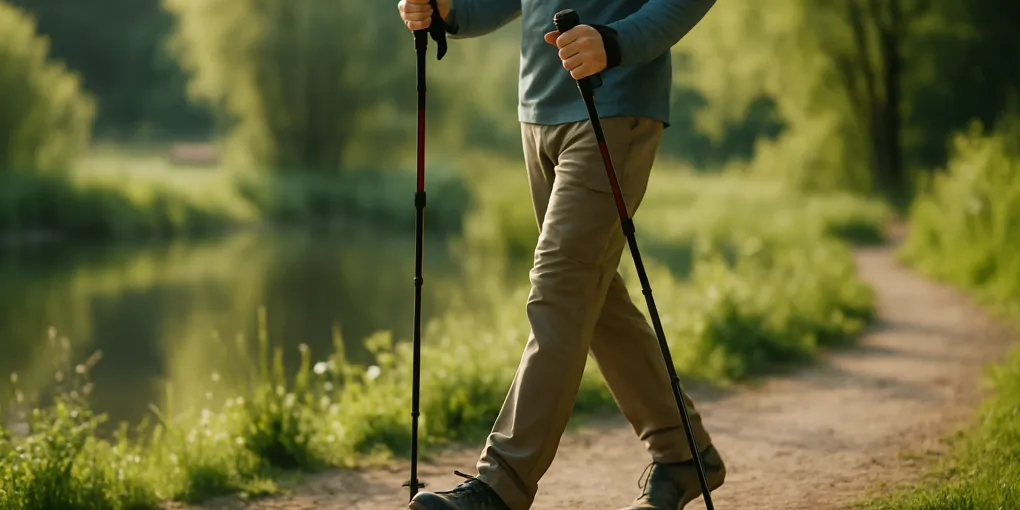
Nordic walking poles are usually designed for forward propulsion. They often have glove-style straps that let the walker push through the hand and release slightly behind the body. They are best for pavement, paths, and deliberate fitness walking.
Trekking poles are designed for terrain management. They often have adjustable sections, wrist straps, and tips or baskets for dirt, gravel, snow, or mixed surfaces. They are better for hikes and uneven ground.
Some readers need one pair for neighborhood walking. Others need trail durability. Do not buy a delicate fixed-length Nordic pole if the real use case is rocky hiking.
Product Shortlist Strategy
For product screening, start with Search Amazon for Nordic walking poles adjustable, Search Amazon for trekking poles cork grip, and Search Amazon for walking poles rubber tips pavement.
Screen for length range, locking mechanism, grip comfort, replacement tips, and whether the pole is sold as a pair. A cheap pole that collapses under load is not a bargain.
Walking Pole Scorecard
| Criterion | Weight | What earns a high score |
|---|---|---|
| Fit and adjustability | 30% | Length range fits the user and terrain without awkward posture |
| Grip and strap comfort | 25% | Cork, foam, or ergonomic grip with secure but non-irritating straps |
| Tip system | 20% | Rubber tips for pavement plus carbide or trail tips when needed |
| Locking reliability | 15% | Stable lever or twist lock that does not slip during use |
| Portability | 10% | Folds or telescopes if travel storage matters |
How to Size Poles
A simple starting point is to hold the grip with the pole tip on the ground and the elbow bent near 90 degrees. For fitness walking, small adjustments can change rhythm and shoulder comfort. For downhill terrain, poles may need to be longer; for uphill, shorter.
Do a ten-minute test before a long walk. If shoulders shrug, wrists ache, or the pole tips land noisily far in front, adjust length and technique.
Technique Basics
Walk tall, keep shoulders relaxed, and let the opposite arm and leg move together naturally. The pole should plant slightly behind or near the body for Nordic-style propulsion, not stab far ahead like a cane. Trail use is different: poles can plant ahead for stability on descents or uneven sections.
Start with short sessions. Hands, wrists, shoulders, and elbows need time to adapt to repetitive pole use. If the first outing causes upper-body soreness, reduce duration before blaming the poles.
Who Should Use Caution
People with shoulder impingement, wrist pain, balance disorders, neuropathy, or neurological conditions should be careful. Poles can help some people feel steadier, but they can also create trip hazards if technique is poor. A clinician or physical therapist can help if the goal is fall-risk management rather than fitness variety.
Poles are not a substitute for medical mobility aids. If a cane, walker, or prescribed assistive device is needed, follow clinical guidance.
How to Judge Walking Poles
Judge poles by the job they must do. A Nordic fitness pair should have pavement tips, glove-style straps, and a length that supports arm drive without shrugging the shoulders. A trekking pair should have reliable locks, carbide or trail tips, and enough adjustability for climbs, descents, and shared household use. A travel pair should pack small without feeling flimsy at the joints.
Do not overrate a pole just because it is carbon or expensive. A fixed-length Nordic pole can be excellent for an experienced pavement walker and wrong for a beginner who needs adjustability. A rugged trekking pole can be excellent on gravel and annoying for quiet neighborhood loops.
Best Pole Type by Reader Goal
For fitness walking on pavement, prioritize Nordic-style poles with rubber tips, comfortable straps, and a length that supports a relaxed arm swing. For hills and trails, prioritize trekking poles with reliable locks and tips that grip dirt or gravel. For travel, folding poles can be useful, but check lock strength and packed length.
For balance confidence, the decision is more personal. Some people feel steadier with poles because they add contact points and rhythm. Others trip over the poles or overthink every step. Start in a safe, flat environment before taking poles to crowded sidewalks or uneven trails.
Fixed vs Adjustable Length
Fixed-length poles are lighter and simpler. They make sense when one person uses them for the same style of walking. The downside is obvious: if the length is wrong, there is no easy fix.
Adjustable poles are more versatile. They work for different users, hills, travel, and changing footwear. They also introduce a failure point. A poor lock can slip under load, which is dangerous on descents. If buying adjustable poles, lock reliability matters more than saving a few ounces.
Grip Materials
Cork grips can feel good in warm weather and may manage sweat well. Foam is light and soft, but quality varies. Rubber can be durable and grippy, though some users dislike it for long warm walks. The best grip is the one that does not create hot spots after 30 to 60 minutes.
Straps matter too. A strap that supports Nordic technique should not cut into the hand. A trekking-pole strap should be easy to adjust and release. If the reader has wrist pain or hand numbness, strap pressure and grip diameter deserve extra attention.
A Beginner Progression
Start with a 10-minute flat walk. Keep the poles quiet and relaxed. If they slap loudly or land far ahead of the body, slow down and shorten the stride. Add five minutes per outing until a normal walk feels natural.
After two or three easy sessions, try a mild hill or longer route. Do not combine new poles with maximal pace, new shoes, and technical terrain. Like any training variable, pole use has a learning curve.
Maintenance and Replacement Tips
Rubber tips wear down, especially on pavement. Check them regularly and replace before metal pokes through. Trail tips can dull or bend. Locks should be cleaned if grit makes adjustment difficult.
A pole that collapses once should be taken seriously. Inspect the lock, tighten according to manufacturer instructions, and test at home before using it on a descent. If it keeps slipping, replace it.
When Poles Are Not the Right Tool
Walking poles are not medical fall-prevention devices by default. If a reader needs a cane, walker, brace, or clinician-prescribed support, fitness poles should not replace it. Poles also may not suit crowded urban environments where tips catch on cracks, stairs, or other pedestrians.
Shoulder or wrist symptoms are another reason to modify. Shorter sessions, softer grip, different strap setup, or ordinary walking may be better. The goal is more sustainable movement, not forcing a gadget into every walk.
How To Compare Value
Do not compare only sticker price. Include replacement tips, lock quality, warranty, and whether the pole fits multiple surfaces. A $25 pair that slips or burns through tips may cost more frustration than a $60 pair with stable locks and accessible spare parts.
For most readers, the best value is a midrange adjustable pair from a brand with clear specs and replacement parts. Ultra-cheap poles are tempting, but the failure point is exactly where safety matters.
Fit with other walking gear
Poles change hand, shoulder, and route demands, while shoes change foot comfort and belt or pavement contact. If your main problem is indoor desk walking rather than outdoor rhythm or hills, start with our treadmill desk walking shoes guide instead. If the route is outside and uneven, pole lock reliability and tip choice matter more than shoe aesthetics.
Surface-Specific Setup
For pavement, rubber tips reduce noise and improve grip. They also protect carbide tips from wearing down too quickly. For dirt or gravel, rubber tips may slip, so exposed carbide or trail tips can work better. Snow and mud may require baskets, though many neighborhood walkers never need them.
Readers should match tips to the route they actually use each week. A pole that is perfect for mountain trails may be annoying on concrete. A quiet pavement setup may be slippery on wet leaves or loose gravel. Replacement tips are inexpensive, so factor them into the purchase rather than treating them as optional extras.
Fitness Programming With Poles
Start by replacing one ordinary walk per week with a pole walk. Keep pace conversational and focus on rhythm. After two weeks, add a second pole walk or add short brisk intervals, such as six rounds of one minute faster and two minutes easy. The poles should help posture and cadence, not turn every walk into a maximal workout.
For people returning to exercise, poles can be paired with step goals, heart-rate zones, or time-on-feet targets. The simplest metric is consistency: more comfortable walking minutes each week without joint flare-ups or hand irritation.
Bottom Line
Walking poles can make walking more engaging, rhythmic, and confidence-building. Choose Nordic poles for fitness technique and trekking poles for uneven terrain. Prioritize fit, grip comfort, tips, and reliable locks. Then start with short walks until technique feels natural.
Walking poles FAQ
Are walking poles good exercise?
They can make walking more rhythmic and add upper-body involvement, especially with Nordic-style technique. They are still a walking accessory, not a replacement for progressive strength or aerobic training.
Are Nordic poles the same as trekking poles?
No. Nordic poles are usually better for fitness walking on pavement and paths. Trekking poles are usually better for hills, gravel, travel, and mixed terrain.
What height should walking poles be?
Start near a 90-degree elbow angle with the tip on the ground, then adjust for terrain and comfort. Folding fixed-length poles require more careful sizing before purchase.
References
- Tschentscher M et al. American Journal of Preventive Medicine. 2013. Health benefits of Nordic walking: a systematic review.
- Pellegrini B et al. PLoS One. 2015. Exploring muscle activation during Nordic walking.
- Church TS et al. Research Quarterly for Exercise and Sport. 2002. Field testing of physiological responses associated with Nordic walking.
Frequently Asked Questions
- They can increase upper-body involvement and perceived stability, especially when used with a purposeful arm swing.
- Not exactly. Nordic poles are designed for fitness walking technique, while trekking poles are often built for trail stability and adjustable terrain.
- A common starting point is elbow angle near 90 degrees when the pole tip is on the ground, then adjust for comfort and terrain.
- People with shoulder, wrist, balance, or neurological concerns should start slowly and consider clinician guidance.