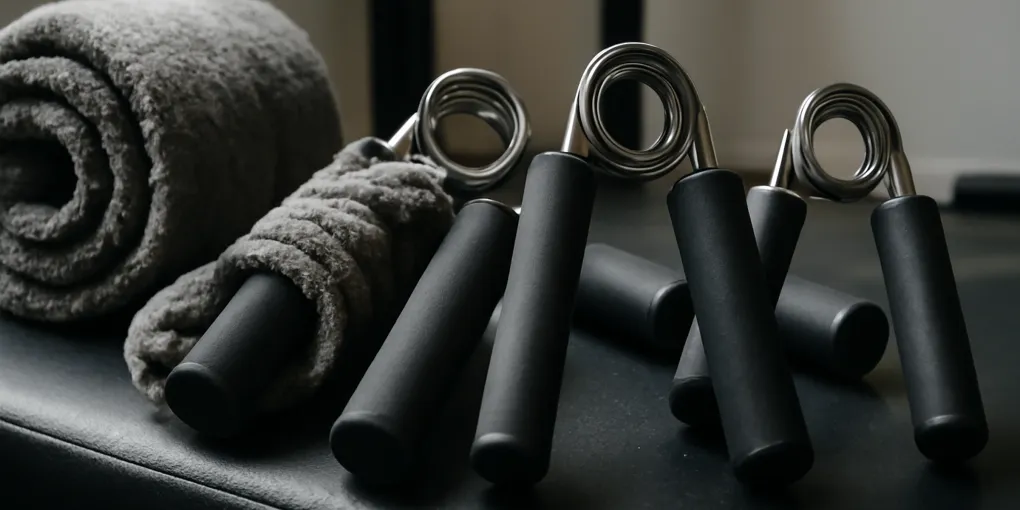
Best Hand Grip Trainers for Forearm Strength: Springs, Adjustability, and When to Use a Towel Instead
Buyer's GuideIronMind Captains of Crush Gripper
Best fixed-strength searchBest Use: Progressive crush-grip training when you want known challenge levels
Quick picks
IronMind Captains of Crush Gripper
★ Top pick Best fixed-strength search- Best Use: Progressive crush-grip training when you want known challenge levels
- Caveat: Fixed resistance means you may need more than one level
GD Iron Grip EXT 90 Adjustable Gripper
Best adjustable metal search- Best Use: Users who want a broad resistance range in one tool
- Caveat: Bulkier than a simple spring gripper and not as pocketable
Gripmaster Hand Exerciser
Best finger-control search- Best Use: Finger-specific light work for musicians, climbers, or rehab-adjacent drills with professional guidance
- Caveat: Not a heavy crush-strength tool
Fat Gripz Original
Best lifting carryover search- Best Use: Turning rows, curls, and carries into thicker-handle grip work
- Caveat: Can reduce load sharply and should be added gradually
Bottom line
A good grip trainer gives you a clear resistance target without chewing up your palms or tricking you into doing hundreds of useless squeezes. For classic crush strength, search Amazon for IronMind Captains of Crush Gripper levels. If you want one tool with adjustable tension, search Amazon for GD Iron Grip EXT 90 adjustable grippers. Finger-control users can search Amazon for Gripmaster Hand Exerciser models, while lifters who want gym carryover should search Amazon for Fat Gripz Original thick handles for rows and carries instead of only squeezing on the couch.
Grip training is specific. A spring gripper trains crush grip, not automatically better deadlifts, climbing endurance, or elbow comfort. Compare resistance range, handle spacing, texture, progression steps, and whether the tool matches crush, support, pinch, or finger-control work before buying. Match the tool to the task: grippers for closing strength, thick handles for support grip, towels for holds, and lighter finger tools only when the goal is control rather than maximum squeeze.
Quick picks
- Classic crush strength: Search Amazon for IronMind Captains of Crush Gripper when fixed levels and repeatable progression matter.
- One adjustable tool: Search Amazon for GD Iron Grip EXT 90 Adjustable Gripper if several users or phases need different resistance.
- Finger-control work: Search Amazon for Gripmaster Hand Exerciser for lighter independent-finger drills.
- Barbell carryover: Search Amazon for Fat Gripz Original when rows, curls, and carries are already in your plan.
Pick the grip job first
Crush grip is the ability to close the hand forcefully. That is what spring grippers train. Support grip is the ability to hold something heavy while the fingers resist opening. Farmer’s carries, dead hangs, and thick-handle rows target that better. Pinch grip uses the thumb against the fingers and needs plates, blocks, or pinch tools.
Most people buying a first gripper actually want forearms that help with lifting, chores, or sports. In that case, a gripper can be useful, but it should not replace loaded carries. Our farmer’s carry grip conditioning protocol is the better starting point if your hands fail during carries or deadlifts.
Resistance range and progression
Buy a resistance you can close cleanly for several controlled reps, not the hardest gripper you can barely move. Partial reps with a too-heavy gripper often train ego more than forearms. A fixed gripper system is best when you know your current level and want a simple ladder. An adjustable gripper is better when multiple people will use it or you want lighter warmups and heavier work in one unit.
Progress by quality first. A useful set looks like slow closes, a short hold, and full hand opening between reps. If your wrist bends, your shoulder hikes up, or your palm skin becomes the limiting factor, the resistance is too high or the volume is too much.
Handle comfort and skin
Knurled metal handles feel secure but can be harsh at high volume. Smooth plastic can be more comfortable but may slip when hands sweat. If you already lift with barbells, a moderately aggressive handle is fine. If you type all day, play an instrument, or have sensitive skin, choose comfort and lower volume over maximal bite.
Do not ignore callus pain. Torn skin stops grip training faster than weak forearms. Keep sets modest, stop before hot spots become blisters, and avoid stacking heavy grippers after high-volume pulling days.
Programming that does not annoy elbows
Two or three short grip sessions per week is enough for most recreational lifters. Put gripper work after lifting, not before deadlifts or pull-ups. Start with two to four sets of five to eight controlled closes per hand, or short timed holds with a submaximal gripper.
If the inside or outside of your elbow starts aching, reduce volume and remove thick-handle work for a week. Forearm tendons often complain about sudden jumps in squeezing volume. Pain that changes daily tasks or persists should be assessed by a clinician, not trained through.
When a towel or carry is better
A towel dead hang, suitcase carry, or farmer’s carry trains the hand while the shoulder, trunk, and posture also have to work. That is closer to many real-world grip demands. A gripper is more convenient and measurable, but convenience can become mindless repetition.
Use a gripper when you need a small, trackable accessory. Use carries when your goal is whole-body support grip. Use finger tools when a coach, therapist, or sport requirement calls for lighter finger control.
Practical score
| Factor | What earns a high score |
|---|---|
| Resistance match | Challenging but closeable with clean wrist position |
| Progression | Clear levels or adjustment range instead of mystery tension |
| Handle comfort | Secure without tearing skin during modest volume |
| Carryover | Matches crush, support, pinch, or finger-control goal |
| Recovery cost | Does not compromise lifting, typing, or elbow comfort |
Buyer fit scenarios
Barbell lifter: start with support-grip work before chasing the hardest spring. Thick-handle rows, suitcase carries, and dead hangs usually transfer better to pulling sessions than a gripper used randomly at night. Add a medium gripper only after you know your elbows tolerate the extra squeezing volume.
Desk worker who wants stronger hands: pick a comfortable adjustable gripper or light finger tool and keep the dose small. The goal is blood flow, control, and gradual strength, not palm pain before a day of typing. Avoid max-effort closes when your wrists or elbows already feel irritated.
Climber or racquet-sport athlete: crush grip is only one piece. Finger position, endurance, shoulder strength, and sport technique matter. Use grippers as a small accessory, not as a replacement for sport-specific practice or a coach-directed plan.
Older adult or rehab-adjacent user: choose light resistance and get guidance if hand pain, arthritis symptoms, numbness, or recent injury is part of the picture. A product marketed as therapeutic is not automatically appropriate for every hand.
How to test a gripper after delivery
Warm up with easy open-close reps before judging resistance. A useful gripper closes with the wrist neutral and the knuckles stacked, not with the shoulder shrugged and the wrist bent. Try both hands. If the weaker hand cannot move the trainer through a controlled range, choose a lighter setting or a different model.
Inspect handle spacing too. Very wide handles can make the first part of the close awkward for smaller hands. Very narrow handles may feel easy at the start and harsh at the finish. If skin pain appears before forearm fatigue, the handle texture or resistance is a poor match.
Red flags in product listings
Skip listings that advertise a huge resistance number without explaining how it was measured. Gripper ratings are not always comparable across brands, and the number on the page may not match how the tool feels in the hand. Look for clear resistance options, handle dimensions, return terms, and user photos that show the actual spring or adjustment mechanism.
Avoid bundles that include many unrelated gadgets if the main gripper looks flimsy. Finger stretchers, counting dials, and forearm rollers can be useful in narrow cases, but they do not rescue a poor spring gripper. For crush strength, the hinge, spring, and handle alignment matter more than accessory count.
Also watch for handles that are too slick or too aggressively textured for your use. A lifter doing three hard sets may tolerate sharper metal. A musician or desk worker using light daily drills may need smoother handles and lower resistance so training does not interfere with work.
Weekly example plan
Monday after lifting: three sets of five controlled closes per hand with a medium gripper, stopping two reps before form breaks. Wednesday: two farmer carry trips or two dead hangs, using the farmer’s carry grip conditioning protocol if you need a full plan. Friday: two lighter gripper sets plus wrist and finger opening work.
Keep notes on resistance, reps, and elbow response. If support-grip lifts improve but gripper numbers stall, that may still be a win. If the gripper improves while pulling sessions feel worse, reduce accessory volume. Grip work should support the main training week. It should not make warmup sets feel slippery, make typing uncomfortable, or turn every pulling day into a forearm recovery problem.
Hand grip trainer FAQ
Do hand grippers build forearms?
They can build crush-grip strength and some forearm muscle, but carryover depends on the task. Use carries and hangs too if you want stronger support grip.
Should I use grippers every day?
Most people should not start daily. Grip tissues get irritated by sudden high volume. Begin with two or three short sessions per week.
Are adjustable grippers better than fixed grippers?
Adjustable grippers are more flexible. Fixed grippers are simpler and easier to compare across sessions. The better choice depends on whether you value one-tool convenience or precise levels.
Can grip trainers help wrist pain?
They are not a generic wrist-pain fix. Light hand work may be part of a rehab plan, but pain, numbness, or weakness deserves professional guidance.
Sources
- American Society for Surgery of the Hand. Hand and wrist exercise cautions. https://www.assh.org/handcare/condition/hand-therapy-exercises
- Bohannon RW. Grip strength: an indispensable biomarker for older adults. https://pubmed.ncbi.nlm.nih.gov/30683660/
- Hand-focused strength and proprioceptive training for healthy adults: systematic review and meta-analysis. https://pubmed.ncbi.nlm.nih.gov/38887689/