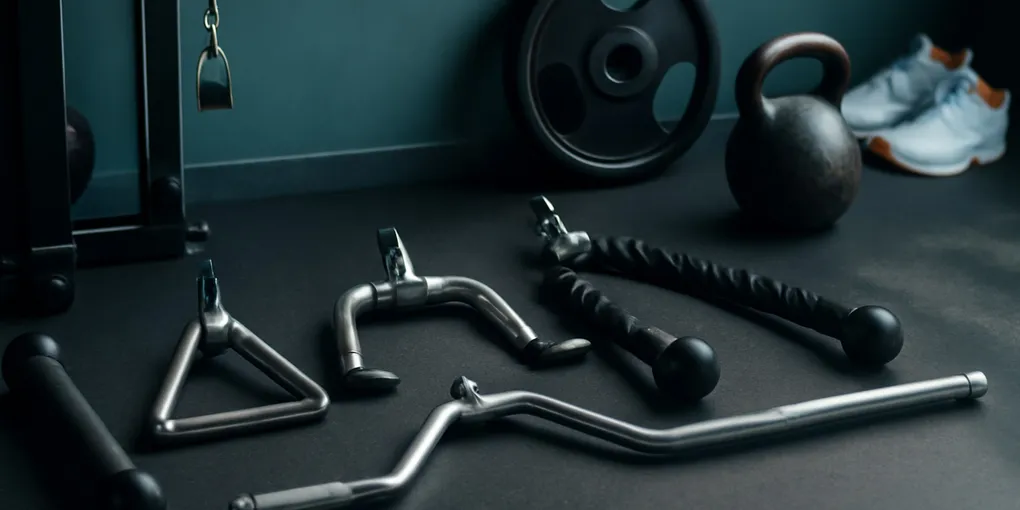
Best Cable Attachments for Home Gyms: Handles, Ropes, Bars, and Ankle Straps That Earn Their Hook Space
Buyer's GuideCAP Barbell Deluxe Triceps Rope
Best first rope attachmentBest Use: Pressdowns, face pulls, cable crunches
Quick picks
| Product | Key Specs |
|---|---|
| See price on Amazon |
|
| See price on Amazon |
|
| See price on Amazon |
|
| See price on Amazon |
|
Product availability, certifications, and retailer details can change; check the current Amazon page before buying.
Bottom line
The best cable attachments for a home gym are the ones that solve repeatable exercises without eating storage space. Most people should buy a rope, independent handles, and one bar before chasing specialty grips. Add ankle straps if your pulley height and training plan actually support lower-body cable work.
A practical starter cart is a search Amazon for the CAP Barbell Deluxe Triceps Rope, search Amazon for a Yes4All rotating straight bar, and search Amazon for DMoose padded ankle straps only if you will use them weekly.
Quick picks
- First buy for most lifters: a durable rope attachment for pressdowns, face pulls, and cable crunches.
- Best wrist-friendly option: independent D-handles that let each hand rotate naturally.
- Best lower-body add-on: padded ankle straps when your pulley can be set low enough.
- Best heavy-row upgrade: reinforced strap handles or a neutral-grip row handle with a comfortable grip diameter.
Practical score
| Factor | Weight | Score | Rationale |
|---|---|---|---|
| Research | 30% | 7.0/10 | Resistance-training benefits are well supported, but attachment-specific evidence is mostly biomechanics and practical fit. |
| Evidence Quality | 25% | 6.5/10 | The useful claims are about grip angle, range of motion, and setup friction rather than clinical outcomes. |
| Value | 20% | 8.5/10 | A small set of attachments can unlock many exercises on an existing pulley. |
| User Signals | 15% | 8.0/10 | Rope, handles, bars, and ankle straps have clear use cases and easy buyer feedback to inspect. |
| Transparency | 10% | 8.5/10 | The weak points are visible: stitching, welds, D-rings, grip texture, and rotation. |
| Composite | 100% | 7.5/10 | High-value accessories when bought for specific exercises, not as a bundle of unused metal. |
How to choose without buying a junk drawer
Start with exercises, not attachment count. If your program includes triceps pressdowns, face pulls, kneeling crunches, rows, and curls, a rope plus handles plus a bar covers most needs. If your program includes cable kickbacks, standing hip abduction, or hamstring curls, add ankle straps. If it does not, skip them until the need is real.
Check the carabiner path before purchase. Some compact home pulleys use small carabiners that do not rotate cleanly through thick attachment eyes. A stiff connection can twist the cable, shorten range of motion, or make light accessories feel awkward.
Grip diameter matters. Very thin metal bars can irritate hands under load, while oversized rubber grips can be hard for smaller hands. For heavy rows, a handle that feels secure matters more than a dramatic product photo.
Rope attachment: best first purchase
A rope is useful because the hands can separate and rotate. That makes it good for pressdowns, face pulls, rope hammer curls, and cable crunches. The key details are rope thickness, end stops, and center connector quality.
Search for a Search Amazon for CAP Barbell Deluxe Triceps Rope if you want a basic proven pattern. Avoid ropes with slick ends, weak stitching, or vague load language. For face pulls, keep loads modest enough that the movement finishes with shoulder external rotation rather than a whole-body lean.
Independent handles: best for natural wrist paths
D-handles are boring in the best way. They let each hand find its own path for rows, flyes, pulldowns, and single-arm work. That is valuable if straight bars make wrists or elbows complain.
Look for smooth handle rotation, a non-slip grip, and enough handle length for your hand size. A pair of search Amazon for Yes4All cable handles is usually a better early purchase than a specialty multi-grip bar because it works for bilateral and unilateral exercises.
Straight bar or EZ bar: best for fixed-angle work
A rotating straight bar is useful for pressdowns and curls when you want both hands locked at the same distance. Rotation matters because the cable should not fight the wrist through the rep.
If straight bars bother your wrists, search for an Search Amazon for Yes4All EZ curl cable attachment. The angled grip can feel better for curls and some pressdowns. Do not assume an angled bar is automatically safer; comfort and load control decide.
Ankle straps: only if your pulley supports them
Padded ankle straps can make cable kickbacks, hip abduction, adduction, and standing hamstring curls easier to set up. They are not magic glute builders. The pulley needs to be low enough, the strap needs to sit securely, and the load needs to stay controlled.
Search Amazon for Search Amazon for DMoose cable ankle straps or similar padded D-ring straps. Avoid narrow straps that dig into the ankle or twist under load. If setup takes longer than the exercise, use bands or a different movement.
Safety checklist before loading
Inspect stitching, welds, D-rings, carabiners, and grip slippage before the first heavy set. The safe load is only as strong as the weakest component in the chain. Keep faces and joints out of the line of pull when testing a new attachment.
Match the attachment to the movement. Heavy low rows may need stronger handles than light pressdowns. Face pulls need a rope and controlled load. Ankle work needs padding and a stable stance. If an attachment changes your body position more than the target muscle, choose a simpler tool.
Starter bundle by training style
For a strength-focused garage gym, choose one rope, one pair of independent handles, and one rowing handle or straight bar. That covers pressdowns, cable curls, rows, pulldowns, cable crunches, and face pulls without creating a pile of nearly identical grips. If you already follow a pull-day setup like our lifting straps for deadlifts and pull days guide, independent handles are the cable equivalent of choosing wrist comfort before load bragging.
For a mobility and accessory setup, prioritize lighter attachments that make positioning easier: handles for single-arm rows, a rope for face pulls, and ankle straps for hip work. Keep loads moderate and make the target joint path clean. A heavy attachment does not make a small stabilizer exercise better.
For a compact apartment pulley, skip long lat bars until you know you have enough clearance. A long bar can hit walls, racks, or door frames before the exercise reaches full range. Short handles and a rope are easier to store and less likely to punish a small room.
For shared household use, buy attachments with simple grip surfaces and easy adjustment rather than aggressive knurling. A handle that works for one person with large hands may be annoying for another person with smaller hands. If multiple users train, neutral handles and a rope are the safest first bets.
What to avoid
Avoid giant bundles where half the pieces duplicate the same movement. A V-bar, straight bar, EZ bar, rope, dual rope, rotating handles, triangle row, and ankle straps may look like a deal, but cheap bundles often hide weak carabiners, rough welds, slick grips, or attachments nobody uses.
Avoid vague load claims. A listing should make clear what the attachment is built to handle, and you should still stay below the weakest link in the pulley, cable, carabiner, and anchor. This matters even more on DIY wall pulleys where the anchor may be the true limit.
Avoid attachments that solve a problem you do not have. A specialty triceps bar is not useful if you already press down comfortably with a rope. A long lat bar is not useful if your ceiling and pulley height force partial reps. Ankle straps are not useful if you never train lower-body cable accessories.
Final buying order
Buy in this order if you are starting from zero: rope, independent handles, rotating bar, ankle straps, then specialty row or pulldown handles. That order matches how often most home lifters can use each piece across push, pull, core, and lower-body accessory sessions.
Before checking out, confirm three details: the connector fits your carabiner, the grip will not become slick with sweat, and the attachment does not shorten the exercise so much that the weight stack or plate-loaded trolley bottoms out. Those three checks prevent most cable-accessory regret.
If two products look similar, choose the one with clearer photos of the connector, stitching, welds, and grip texture. A slightly plainer attachment with visible construction details is a better bet than a glossy bundle that hides the contact points.
Home-gym cable attachment FAQ
Do I need a lat pulldown bar?
Only if vertical pulling is a major part of your setup. Many compact home gyms can start with handles and a rope before buying a long pulldown bar.
Is a rope better than a V-bar for triceps?
A rope allows more hand separation, while a V-bar feels more fixed and stable. Pick based on elbow comfort and control.
Can I use cable attachments with resistance bands?
Sometimes, but band tension and connector style differ from cable pulleys. Make sure the attachment cannot slip, whip back, or overload a weak band anchor.
How should I store cable attachments?
Use a wall hook, pegboard, or small bin near the pulley. If attachments live across the room, you will stop using half of them.
Sources and further reading
- CDC adult physical activity guidance: https://www.cdc.gov/physical-activity-basics/guidelines/adults.html
- ACSM physical activity guidance overview: https://www.acsm.org/education-resources/trending-topics-resources/physical-activity-guidelines
- Resistance training and health review, PubMed: https://pubmed.ncbi.nlm.nih.gov/23302793/
Frequently Asked Questions
- Start with a rope, a pair of independent handles, and either a straight bar or EZ-style bar depending on wrist comfort. Add ankle straps only if lower-body cable work is part of your plan.
- Most use carabiners, but fit still depends on carabiner opening, attachment eye size, cable height, and whether the attachment rotates freely under load.
- Cheap attachments can be fine for light accessory work, but inspect welds, stitching, D-rings, and grip slippage. Do not exceed the weakest rated component.
- A rope is the usual first pick because it lets the hands separate and rotate near the face. Keep the load controlled and avoid turning the movement into a lower-back lean.