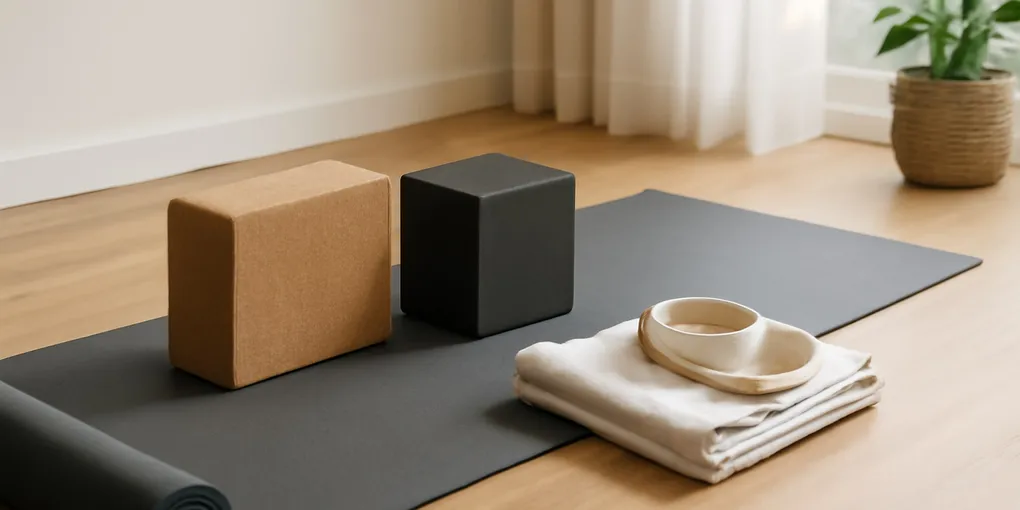
Best Yoga Blocks for Mobility Work: Cork, Foam, and Stable Support for Home Stretching
Buyer's GuideManduka Cork Yoga Block
Best stable cork blockBest Use: Supported hip hinges, hamstring work, standing poses, and heavier hands
$18-30 each
Quick picks
| Product | Key Specs |
|---|---|
| See price on Amazon |
|
| See price on Amazon |
|
| See price on Amazon |
|
| See price on Amazon |
|
Product availability, certifications, and retailer details can change; check the current Amazon page before buying.
A yoga block is not only for yoga class. It is a simple height adjuster for mobility work: bringing the floor closer during hamstring hinges, giving the hand a stable landing in lunges, supporting a chest opener, or making a stretch less aggressive. The right block lets you hold a cleaner position. The wrong block crushes, slides, or feels too unstable to trust.
If you want firm support, search Amazon for Manduka Cork Yoga Block. If you want an inexpensive pair for light stretching, search Amazon for Gaiam Essentials Yoga Block. If ankle mobility is your main problem, pair blocks with our mini band shoulder warm-up protocol only when upper-body prep also needs support; do not turn every stretch into a prop collection.
Quick picks
- Best firm block: Manduka Cork Yoga Block for stable hand pressure and supported hinges.
- Best budget pair: Gaiam Essentials Yoga Block if you want two soft blocks for the price of one premium cork block.
- Best premium cork alternative: Hugger Mugger Cork Yoga Block for firm edges and a grippy natural feel.
- Best larger foam set: Trideer Yoga Block 2 Pack if you want two-block setups for home stretching.
Practical score
| Factor | Weight | Score | Rationale |
|---|---|---|---|
| Research | 30% | 5.5 | Yoga and stretching research supports mobility, balance, and comfort in broad terms, but blocks themselves are a support tool, not an active treatment. |
| Evidence Quality | 25% | 5.0 | The choice is mainly mechanical: height, firmness, grip, and user tolerance. |
| Value | 20% | 8.5 | A pair of blocks costs little and can replace awkward stacked books or unsafe furniture. |
| User Signals | 15% | 8.0 | Stability, edge comfort, odor, and denting drive satisfaction. |
| Transparency | 10% | 8.0 | Dimensions and material are usually visible in listings. |
| Composite | 100% | 6.6 | A cheap, useful support tool when you buy for firmness and height instead of color. |
How to choose cork vs foam
Choose cork if you press into the block with meaningful force. Cork feels more stable for standing hip hinges, half-kneeling positions, supported triangle variations, and strength-adjacent mobility where the block becomes a mini platform. It also resists denting better than soft foam. The downside is weight and edge feel. If you kneel next to it, drop it, or use it under the spine, cork can feel unforgiving.
Choose foam if comfort matters more than load. Foam is better for restorative positions, gentle chest support, beginner stretching, and people who want a lighter block. The tradeoff is wobble. Cheap foam can compress under a hand, and that compression changes the joint angle while you are trying to relax.
The National Center for Complementary and Integrative Health notes that yoga is generally safe for healthy people when practiced appropriately, but injuries can happen, especially when people force positions or have medical conditions (https://www.nccih.nih.gov/health/yoga-what-you-need-to-know). A block should reduce strain, not help you push deeper than your tissue tolerates.
Product-by-product notes
Manduka Cork is the easiest firm-block recommendation. It is dense, stable, and simple. Use it for hamstring hinges where fingertips do not reach the floor, supported runners-lunge positions, or hand support during balance work. Buy one if you only need a reach aid. Buy two if both hands need equal height.
Gaiam Essentials is the budget foam pick because the common two-pack setup gives you symmetrical support. It is good for couch-stretch assistance, supported bridge setup, seated forward folds, and upper-back positioning where cork would feel too hard. If the block visibly caves under your hand, move to cork.
Hugger Mugger Cork is a premium cork alternative for people who care about firm edges and natural grip. It is not required for casual stretching, but it is a solid buy if you already know you prefer cork.
Trideer foam sets are useful when you want a pair and a slightly larger landing zone. Check dimensions before buying because third-party listings can vary. Larger blocks can feel safer under bigger hands, but they also take more storage space.
What to avoid
Avoid mystery blocks with no dimensions. The common size is about 9 by 6 by 4 inches. Smaller blocks can be fine for travel but less useful as stable support. Avoid slick blocks if you use them on hardwood or a thin mat. A sliding block is worse than no block because it can surprise the wrist, shoulder, or hip.
Avoid using a block as a medical fix for pain. If a position causes sharp pain, numbness, tingling, or joint catching, reduce range or stop. Harvard Health notes that stretching should be comfortable rather than painful and that warming up first can make stretching safer (https://www.health.harvard.edu/staying-healthy/the-importance-of-stretching). The block helps set range; it does not overrule symptoms.
Best setups for home mobility
For hamstrings, place a block under each hand and hinge from the hips with a soft knee bend. The blocks let you keep the spine calmer instead of reaching for the floor.
For hip flexors, put a foam block under the hand on the front-leg side during a half-kneeling lunge. That support helps you keep the pelvis steady instead of dumping weight into the low back.
For chest opening, place a foam block at a low or medium height under the upper back, not the neck. Start with short holds. If the block feels too sharp or your arm symptoms change, stop.
How many blocks to buy
Buy one block if your main use is a single-hand reach aid. That covers supported hamstring hinges, one-sided lunges, and occasional balance support. Buy two blocks if you do floor mobility more than once per week. Two blocks let both hands land at the same height, support both knees or forearms in restorative positions, and make chest-opening setups more predictable.
A pair also helps if two people in the house train together. Foam pairs are cheap enough that sharing one block is rarely worth the hassle. For cork, buying one premium block first is reasonable if you are testing firmness. Add the second only if you actually use it.
Fit by use case
For runners, cork blocks make sense for half-kneeling hip flexor work and supported hamstring hinges because they do not collapse when your hands press down. For desk workers, foam blocks are more comfortable under the upper back during short chest-opening holds. For lifters, cork gives better feedback during adductor rock-backs, squat-pry positions, and supported single-leg hinge practice.
For older adults or anyone with balance concerns, stability beats softness. A block that wobbles can make a stretch feel less safe. Use the lowest height that gives control, place the broad face on the floor when possible, and keep another support nearby if balance is uncertain.
Care and storage
Cork blocks can shed lightly and may darken with sweat or hand oils. Wipe them with a damp cloth and let them dry fully before storing. Foam blocks can absorb odor faster, especially if they live in a hot car or gym bag. Avoid soaking either material unless the manufacturer specifically says it is safe.
Store blocks where you will use them. If they disappear into a closet, you will go back to reaching for the floor or stacking unstable books. A pair beside the mat is boring but effective. For small apartments, stack the blocks on the short edge next to the mat or store them in an open bin with bands. The point is quick access, because mobility tools that need setup tend to lose to the couch.
Price and return-policy notes
The cheapest foam blocks are usually fine for occasional stretching, but very soft foam can dent after repeated hand pressure. If the block is only for restorative floor work, that may not matter. If the block will support standing balance, lunges, or loaded hinges, denting and edge collapse matter more than saving a few dollars.
Cork blocks usually cost more per block, so return policy matters. Texture, edge radius, and weight feel different across brands. If you have wrist sensitivity, order from a retailer that makes returns simple, and test the block on the three positions you actually plan to use: one standing support, one kneeling support, and one floor support.
Do not pay extra for a bundle that includes straps, wheels, or towels unless you already need those items. A clean two-block setup is enough for most mobility sessions. The extra accessories often sit unused while the blocks do the real work.
Yoga block FAQ
Are yoga blocks worth buying for non-yoga mobility?
Yes, if they help you hold cleaner positions. They are especially useful when the floor is too low, your balance is shaky, or a stretch becomes aggressive without support.
Should beginners buy cork blocks?
Beginners can buy cork if they want stability. Foam is softer and cheaper, but cork may feel safer under the hands for standing positions.
Can I use books instead?
Books work in a pinch, but they slide, vary in height, and can collapse unevenly. A block is safer and more predictable for repeated mobility work.
Frequently Asked Questions
- Cork is better when you need firm support under the hand. Foam is better for soft, restorative, or beginner positions.
- Buy two if you do symmetrical positions, supported lunges, or chest-opening setups. One is enough for simple reach support.
- The common 9 by 6 by 4 inch size works for most adults. Larger hands or balance-focused use may favor a firmer cork block.