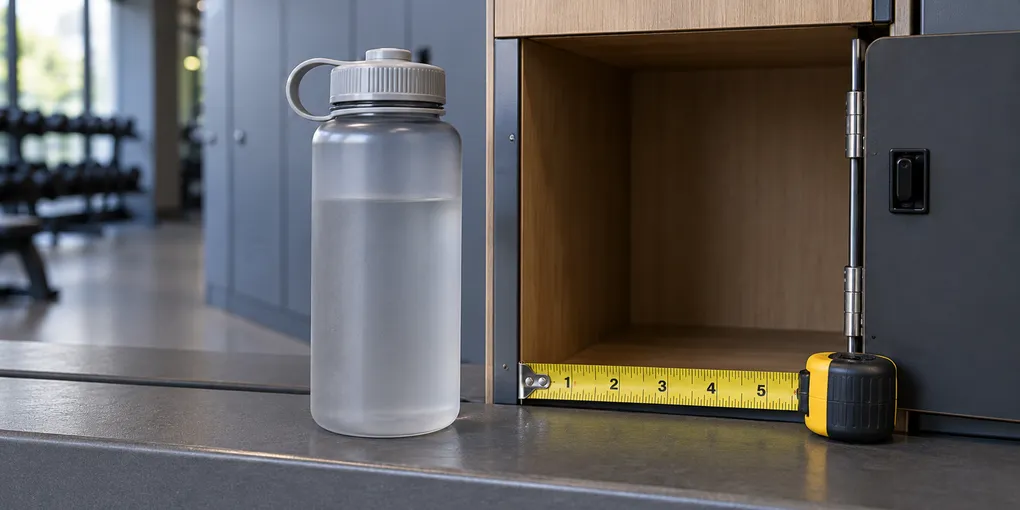
Measure a 32-Ounce Water Bottle Before Using a Locker Cubby
Evidence ExplainerA 32-ounce bottle can look as though it belongs in a gym locker, then catch on the cubby’s front lip or keep the door from closing. Measure the cubby’s clear width and height first, then compare them with the bottle’s widest body and full height. Nalgene lists one 32-ounce Wide Mouth bottle at 3.5 inches in diameter and 8.25 inches high, so a cubby needs more than a broad-looking opening to work well.
The useful measurement is the smallest space the bottle must pass through, not the room you can see behind it. A quick check before you head to the locker room can keep the bottle from becoming the thing you have to carry separately.
Measure the cubby’s opening before its interior
Open the locker door fully and measure straight across the narrowest part of the opening. Check for a rolled metal edge, latch hardware, a shelf support, or a door that intrudes into the space. Those details can make the usable width smaller than the shelf inside.
Write down the clear width rather than estimating from the locker door. For the Nalgene example, the 3.5-inch body diameter is the number that has to clear the opening. Its listed 2.5-inch cap diameter does not help if the bottle body is wider.
If the cubby has a raised lip, measure above it as well as at the shelf surface. A bottle may slide through high in the opening but snag when you try to set it down. That is a sign to use a different spot, not to force the bottle past the edge.
Check height and the space above the cap
Measure from the shelf to the lowest fixed part above it: the cubby ceiling, an upper shelf, a hook, or a locker-door brace. Then compare that number with the bottle’s complete height, including the cap and any loop that stays upright.
The Nalgene listing gives its 32-ounce Wide Mouth bottle a height of 8.25 inches. A cubby that measures exactly 8.25 inches tall leaves no working room to lower the bottle in or take it out. Leave a little clearance so you can grip the cap without scraping the locker surface.
Height also matters when the bottle will stand close to a locker door. A bottle that fits beneath a shelf may still project far enough forward to meet the door or its latch when you close it.
Measure depth as a separate decision
Width and height get the bottle through the front. Depth tells you whether it can live there. Run the tape from the inside back wall to the front edge, then account for any door panel, hook, or stored item that occupies that space when the locker closes.
For an upright bottle, the depth does not need to equal the full 8.25-inch height. It does need to contain the 3.5-inch body without leaving the bottle so far forward that the door presses on it. A shallow cubby can be workable for a bottle on its side only if the opening, door, and shelf lip still leave enough room to place and retrieve it.
Use the bottle you actually carry for a dry fit. Empty it, place it in the cubby, close the door gently, and reopen it. Do not hold the door shut against resistance; that can hide a poor fit and put pressure on the cap or locker hardware.
Account for the parts that change the fit
The printed bottle dimensions are a starting point, not a complete packing measurement. Add any removable part that remains on the bottle when you use the locker:
| Part to check | What to measure | Why it can change the cubby fit |
|---|---|---|
| Silicone boot | Outside diameter at the base | It can make the bottle wider than the bare body |
| Carrying loop | Height or width when it stands up | It may meet the cubby ceiling or door |
| Protective sleeve | Widest covered point | Fabric and padding add bulk |
| Cap or straw | Full height when closed | A tall cap can use the clearance above the body |
Check the cubby again if you change to a different lid or add a boot. Even bottles with the same 32-ounce capacity can have different proportions, so capacity alone is not a locker-fit measurement.
Make the locker decision in two minutes
Use this short sequence while the locker is empty:
- Record the cubby’s narrowest clear width, clear height, and usable depth.
- Record the bottle’s widest point and its full height with the usual cap and accessories.
- Test the empty bottle in the cubby and close the door without pushing against it.
- Choose another location if the bottle rubs, prevents the door from closing, or sits where it can fall when the door opens.
This keeps the decision grounded in the space you actually have. A bottle that has a little room around it is easier to retrieve, less likely to scrape the locker, and less likely to be in the way when you return after a workout.
Evidence boundary
The published measurements here apply to the cited Nalgene bottle model. Other 32-ounce bottles, lids, boots, and locker designs can need different clearances, so measure the specific bottle and cubby before relying on the fit.
Frequently asked questions
What locker measurement matters first for a water bottle?
Measure the clear width at the cubby’s narrowest point first. A bottle cannot use the interior space if it cannot pass the opening or a lip at the front.
Do I need to measure cubby depth?
Yes. Depth tells you whether the bottle can sit fully inside without holding the door open or protruding into the aisle.
Is a 32-ounce bottle always the same size?
No. Capacity does not set the outside dimensions. Compare the exact bottle, lid, boot, and carrying loop you plan to use.